
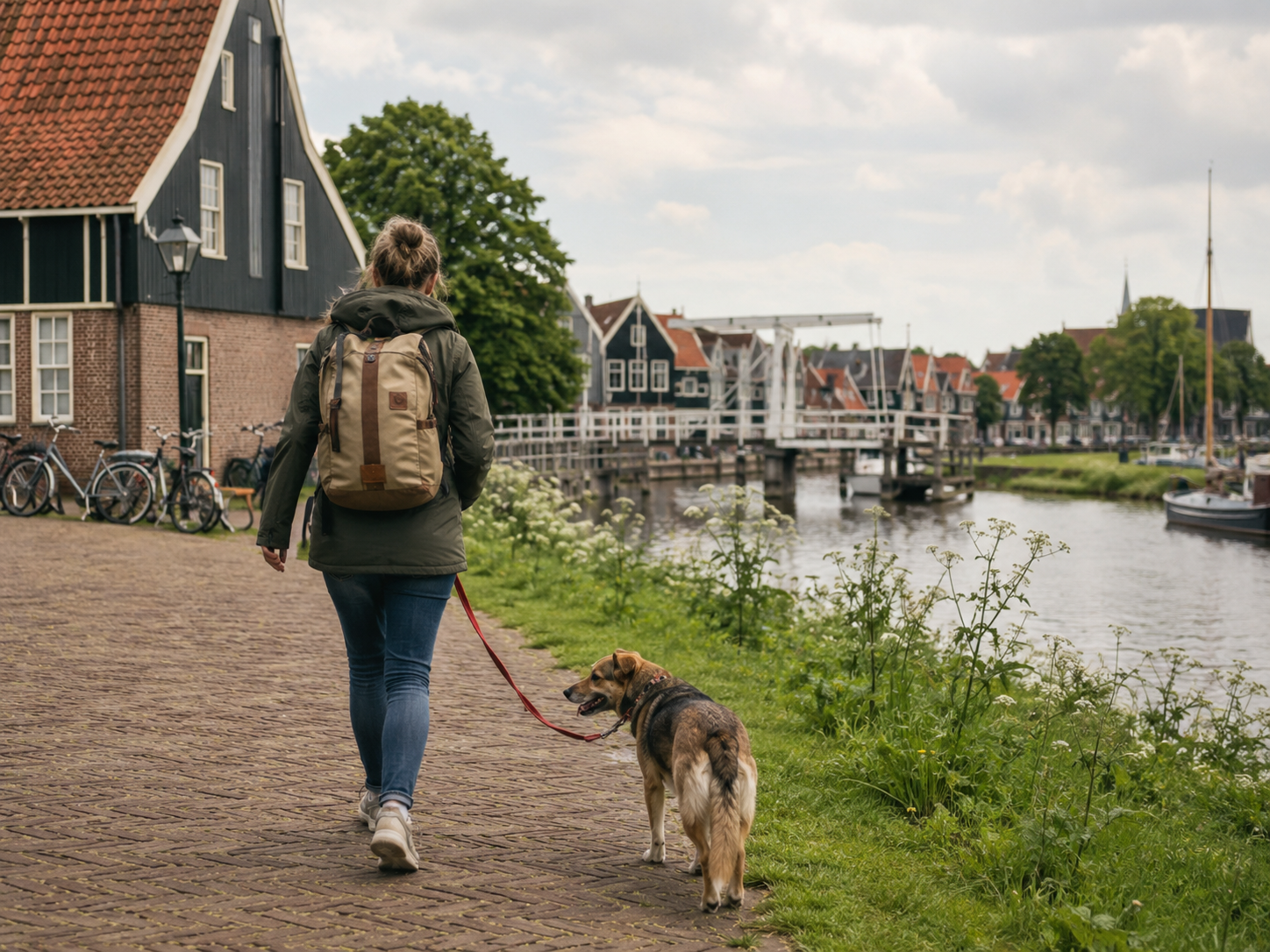


The Netherlands is a popular European destination for city breaks, seaside holidays and longer stays. Amsterdam, Rotterdam, Utrecht, the North Sea coast, cycling routes, parks and reliable transport make it a country where traveling with a dog is fairly straightforward. From a veterinary standpoint, the key point is that the Netherlands is an EU member state.
If you’re traveling to the Netherlands from another EU country, standard EU rules apply: a microchip, a valid rabies vaccination and an EU Pet Passport. If the dog is arriving from a non‑EU country, it’s an entry into the European Union and the rules are stricter.
This article covers ordinary, non‑commercial travel with a dog accompanying its owner or an authorized person. If a dog travels as cargo, for sale, for a change of ownership, or as part of a larger number of animals, different rules may apply.
Table of Contents
Quick overview
For a trip to the Netherlands with a dog, what matters most is where your dog is coming from.
If you’re traveling from another EU country, your dog needs:
- a microchip or an older, readable tattoo applied before 3 July 2011,
- a valid rabies vaccination,
- a waiting period of at least 21 days after the first rabies vaccination,
- EU Pet Passport.
If the dog is arriving from a non‑EU country, you also need to consider:
- a veterinary health certificate for entry into the EU,
- a declaration that the trip is non‑commercial,
- entry via an approved point of entry for travelers with pets,
- a rabies antibody titer test if the dog is coming from a country for which the EU requires it.
The Netherlands is not among the countries that require mandatory treatment against Echinococcus on entry. This obligation applies mainly to Finland, Ireland, Malta, Norway and Northern Ireland.
Entry requirements for bringing a dog to the Netherlands from an EU country
If you’re traveling to the Netherlands from another EU country, you’re traveling under the EU’s common rules for dogs, cats and ferrets.
The dog must have:
- a microchip,
- a valid rabies vaccination,
- EU Pet Passport.
The microchip must be implanted before the rabies vaccination. If the dog was vaccinated before being microchipped, that vaccination may not be considered valid for travel.
After the first rabies vaccination there is a mandatory 21‑day wait before travel. Only then is the vaccination considered valid. For on‑time boosters, the 21‑day wait does not apply.
The EU Pet Passport is the primary travel document for dogs traveling within the EU. It includes the dog’s identification, owner details, rabies vaccination, and any other veterinary records.
Interested in this destination? Would you like to visit it with your dog? Check the entry requirements directly in BorderCooler®.
Bringing a dog into the Netherlands from a non‑EU country
When a dog arrives in the Netherlands from a non‑EU country, it is entering the European Union. In that case, EU rules for the entry of dogs from third countries apply, and they are stricter than travel between member states.
The dog must have:
- a microchip,
- a valid rabies vaccination,
- a veterinary health certificate for entry into the EU,
- a declaration that the trip is non‑commercial,
- a rabies antibody titer test if arriving from a country for which the EU requires it.
The veterinary health certificate is issued by the official veterinarian in the country of departure. For entry into the EU, the certificate is valid for 10 days from the date of issue. Within that period, the dog must be checked at an approved point of entry, such as an airport, seaport or land border. For travel by sea, this period is extended by the duration of the voyage.
After a successful entry check into the EU, the certificate can also be used for onward movement within the EU for up to 4 months, or until the rabies vaccination expires, whichever comes first.
When a rabies antibody titer test is required
A rabies antibody titer test is required when entering the EU from countries the EU does not consider lower risk for rabies.
In practice, that means that for some non‑EU countries a microchip, rabies vaccination and health certificate are enough, while for others a titer test is also required.
The test is performed on a blood sample in an approved laboratory and must follow a valid rabies vaccination. If you’re traveling to the Netherlands from outside the EU, always check in advance whether the country of departure is one for which the EU requires the titer test.
If a dog is traveling from the EU to a non‑EU country and is then due to return to the Netherlands or another EU country, check before you go whether the EU requires a rabies antibody titer test for re‑entry from that country. If it is required for your route, the most practical approach is to do the test before leaving the EU and have the result recorded in the EU Pet Passport.
At the time of writing, a titer test is not required for a dog entering the EU from, for example, the following countries and territories:
United Kingdom, Northern Ireland, Switzerland, Norway, Iceland, Liechtenstein, Andorra, Monaco, San Marino, Vatican City, Canada, United States of America, Australia, New Zealand, Japan, Argentina.
This is not a complete list. Always check the current list of countries and territories for which the EU does not require a rabies antibody titer test before you travel.
Where entry checks happen when arriving from a non‑EU country
If a dog enters the Netherlands from a non‑EU country, it must arrive via an approved point of entry for travelers with pets. This is where your dog’s documents and identity are checked.
On arrival in the Netherlands, you must declare your dog to customs as goods to declare. Customs will verify the microchip, health certificate and other documents. If the dog meets EU requirements, quarantine is not required. If it does not, the official NVWA veterinarian takes over and may decide on quarantine or returning the dog to the country of origin.
If you enter the EU through a country other than the Netherlands and only then continue to the Netherlands, the check takes place in the first EU country on your route. The onward journey to the Netherlands is then movement within the EU.
Traveling to the Netherlands with a dog by ferry from Great Britain
For travelers coming to the Netherlands from Great Britain, the ferry is the most common choice. Three companies run direct ferry routes to the Netherlands:
Stena Line – Harwich–Hook of Holland (Hoek van Holland). The most popular route for dog owners traveling from southern England. The overnight crossing takes around 7–9 hours; daytime sailings are shorter. Dogs can travel in onboard kennels or in a pet‑friendly cabin. Access to the car deck during the crossing is not permitted.
DFDS Seaways – Newcastle–Amsterdam (IJmuiden). A longer crossing; dogs travel in onboard kennels or in a pet‑friendly cabin.
P&O Ferries – Hull–Rotterdam (Europoort). An overnight crossing; dogs must be accommodated in onboard kennels or in a pet‑friendly cabin.
On all ferry routes from Great Britain to the Netherlands, EU veterinary rules apply on entry — that is, the health certificate for entry into the EU and any other requirements depending on whether the dog has a valid EU Pet Passport. Carrier policies can differ, so always check them before booking.
Practical rules for staying in the Netherlands with a dog
In general, the Netherlands is a pleasant country for traveling with a dog, but rules vary by city, accommodation, carrier, park, beach and season.
In larger cities you’ll find plenty of parks, veterinarians, pet shops and accommodation that welcomes dogs. That said, entry with a dog to indoor areas of restaurants, shops or museums is not guaranteed. Terraces, parks and canal‑side walks are usually easier than interiors.
Always confirm accommodation directly. A simple “pet‑friendly” filter in a booking system isn’t enough. Check your dog’s size, any fees, whether you may leave the dog alone in the room, and the rules for common areas.
The Netherlands is a nation of cyclists. In cities, watch the bike lanes, e‑bikes, scooters and traffic, which can be confusing for a dog at first. Keep your dog close and don’t walk in the bike lane.
On North Sea beaches, rules change by location and season. Outside the main summer season, visiting with a dog is usually easier; in peak season there may be time or zone restrictions. Check the specific beach’s rules before you go.
For travel by train, tram or bus, check the carrier’s rules. Small dogs in a carrier or on a lap may be treated differently from larger dogs on a leash. For longer journeys, remember your dog must cope with busy stations, platforms and public transport.
When to start preparing
If you’re traveling from the EU
If you’re coming to the Netherlands from another EU country and your dog already has a microchip, a valid rabies vaccination and an EU Pet Passport, preparation is usually simple. Most importantly, check that the vaccination will remain valid for your entire trip, including the return, and confirm your carrier’s rules.
If you’re traveling from a non‑EU country
If the dog is traveling from outside the EU, start preparations earlier. Check whether you need a titer test, which health certificate is used, who endorses it, and through which point you can enter the Netherlands or the EU.
A titer test cannot be arranged at the last minute. The blood draw is done no sooner than 30 days after the rabies vaccination. Processing in the laboratory usually takes from several working days to several weeks, depending on the lab. If the test is required for your route, handle it well in advance.
Summary
Traveling to the Netherlands with a dog is fairly simple when coming from the EU. Your dog needs a microchip, a valid rabies vaccination and an EU Pet Passport. Mandatory treatment against Echinococcus is not required for entry into the Netherlands.
If the dog is arriving from a non‑EU country, you must follow the EU’s entry rules: the health certificate, a declaration that the trip is non‑commercial, a possible titer test, and entry via an approved point of entry.
For travelers from Great Britain, the main ferry options are Stena Line (Harwich–Hook of Holland), DFDS (Newcastle–Amsterdam) and P&O (Hull–Rotterdam).
Beyond documents, think about the practical side of the trip. Check the rules of your carrier, accommodation, public transport, parks and beaches. The Netherlands is great to enjoy with a dog, and it works best when you’ve sorted the basics and expectations before you go.