
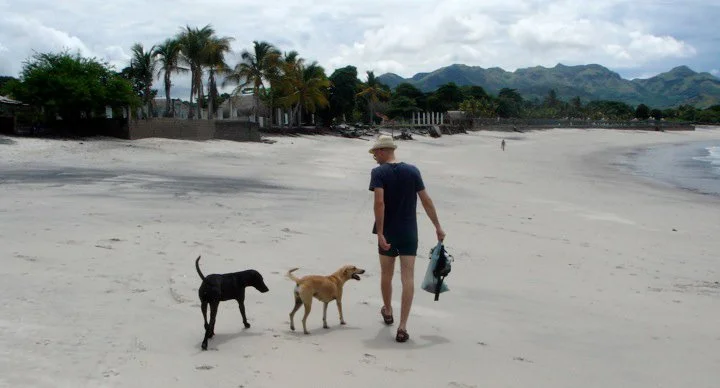


Panama sits between two oceans, is known for the Panama Canal, tropical nature, islands, mountains, rainforests and modern Panama City. Traveling with a dog to Panama is possible, but it requires careful paperwork before you go.
When traveling with a dog to Panama you need to plan for two things: entry into Panama and the return home. Entry rules are set by the Panamanian Ministry of Agriculture, MIDA (Ministerio de Desarrollo Agropecuario). Return requirements are governed by the country the dog is returning to after Panama.
This article covers a standard non-commercial trip with a dog traveling with its owner or an authorized person. If a dog travels as cargo, for sale, for a change of ownership, or travels unaccompanied (not on the same transport as the owner), different rules may apply.
Table of Contents
Quick overview: what you need to enter Panama with a dog
To enter Panama with a dog, you’ll primarily need:
- valid rabies vaccination,
- parasite treatment within 30 days before travel — documented on the certificate,
- a veterinary health certificate issued and endorsed in the country of departure,
- an apostille or consular legalization of the health certificate by a Panamanian consulate,
- the Home Quarantine Request form sent 3 to 5 days before arrival,
- a document check on arrival at Tocumen Airport,
- cash payment on arrival – at the time of writing USD 130 for home quarantine and USD 25 for MIDA entry procedures; confirm the amounts before you travel, as they may change.
For your return home, the rules of the destination country apply. If a dog is returning from Panama to the EU, plan for a rabies antibody titer test — a blood test that confirms antibody levels after vaccination — because Panama isn’t on the EU’s list of countries exempt from this requirement. For a return to the USA, Panama is not on the list of countries with high dog-rabies risk, which simplifies the process.
Documents and entry requirements for taking a dog into Panama
To enter, Panama requires a health certificate endorsed by the competent veterinary authority of the country of departure, a valid rabies vaccination, and document verification by a Panamanian consulate or via apostille.
Before you travel, prepare:
- valid rabies vaccination,
- treatment against internal and external parasites within 30 days before travel — documented directly on the health certificate,
- a veterinary health certificate for entry to Panama,
- an apostille or consular legalization of the certificate by a Panamanian diplomatic mission,
- the Home Quarantine Request form,
- the EU Pet Passport or a vaccination card if traveling from the EU,
- your airline’s or other carrier’s rules.
A standard vaccination booklet without an officially endorsed health certificate is not enough. The certificate must be endorsed and legalized in a way Panama accepts. EU countries are signatories to the Hague Convention, so for travelers from the EU an apostille should be sufficient — confirm this in advance with the veterinary authority of the country of departure or a Panamanian consulate.
Interested in this destination? Would you like to visit it with your dog? Check the entry requirements directly in BorderCooler®.
Rabies vaccination before traveling to Panama
A dog must have a valid rabies vaccination to enter Panama. Panama requires vaccination from 3 months of age, and at least 30 days must have passed since the first vaccination. Animals younger than 4 months cannot enter Panama.
If the dog will return to the EU or the USA after a stay in Panama, the rabies vaccination must follow microchipping — the dog should be microchipped first and then vaccinated. If the vaccination is recorded before the microchip is implanted, it can complicate the return.
Treating a dog for parasites before traveling to Panama
Treatment against internal and external parasites is mandatory for entry into Panama. It must be performed within 30 days before travel by a licensed veterinarian and documented directly on the health certificate.
Panama is not a country for which the EU requires the well-known 24–120 hour echinococcus treatment on return. That applies only to selected countries such as Finland, Ireland, Malta, Norway and Northern Ireland.
Regardless of the formal requirement, treatment before travel also makes practical sense once you’re in Panama. Panama is a tropical country with ticks, fleas, mosquitoes and other parasites — discuss protection against them with your vet, as well as prevention of leishmaniasis, which is transmitted by tiny biting sand flies. The risk is higher in rainforest areas, by rivers and outside cities — which is not uncommon on a trip to Panama.
Veterinary health certificate and apostille for Panama
The veterinary health certificate is the key document for a trip to Panama. It confirms the dog’s health status, rabies vaccination, parasite treatment and the dog’s fitness to travel.
The certificate is arranged in the country of departure — issued by a licensed veterinarian and endorsed by the competent veterinary authority. After endorsement, it must be legalized by a Panamanian consulate or via apostille. A certificate issued by a vet without further endorsement is not sufficient.
When planning your timeline, allow enough days for all steps: issuing the certificate, endorsement by the authority, and apostille or consular legalization. The whole process can take several working days up to a week.
Home Quarantine Request and your dog’s inspection on arrival in Panama
Before arriving in Panama, email the Home Quarantine Request to camzoonosis@gmail.com and cam@minsa.gob.pa, 3 to 5 days before arrival. Attach the documents you’ll present at entry: the health certificate, document legalization, vaccination booklet or proof of vaccination, and a copy of the owner’s passport.
On arrival at Tocumen Airport, MIDA veterinarians will check the microchip, vaccination records, parasite treatment, and the health certificate. Veterinary checks take place daily from 8:00 to 22:00. If a dog arrives outside these hours or on a public holiday, it may be held in a kennel at the airport until a veterinarian arrives. Factor this into your flight planning.
If the requirements are met, the dog is returned to the owner and continues to home quarantine. Home quarantine lasts 40 days — the dog should stay indoors or within the stated residential address, and during this period contact with household dogs, cats and native exotic species should be avoided. This is important when planning your trip: if you intend to move around Panama, the 40-day quarantine makes it much more difficult. Panama is better for a longer stay in one place than for a quick road trip with a dog.
The fee for home quarantine is USD 130 and a further USD 25 is paid for MIDA entry procedures — both are paid in cash on arrival at Tocumen Airport. Confirm the amounts before you travel, as they may change.
Don’t rely on receiving a confirmation email for the Home Quarantine Request. Travelers report that confirmation from MINSA often doesn’t arrive. We recommend contacting the veterinarian at Tocumen Airport in advance to confirm that your documents are in order. Contact details can change over time, so verify the current email and phone directly with MINSA, MIDA or Tocumen Airport. At the time of writing, a listed contact for MIDA at the airport is: +507 238-4234.
If the requirements are not met, the dog may be refused and sent back to the country of origin on the same airline.
Traveling to Panama from the EU with a dog?
For travel from the EU to Panama, the basics are an EU Pet Passport, a microchip and a valid rabies vaccination. The EU Pet Passport is useful as proof of identification and vaccination, but by itself it isn’t enough for entry into Panama.
In practice, when traveling from the EU, prepare:
- an EU Pet Passport with identification and rabies vaccination recorded,
- a veterinary health certificate issued or endorsed by the competent veterinary authority of the country of departure,
- an apostille on the health certificate,
- the Home Quarantine Request sent 3 to 5 days before arrival,
- a titer test — if the dog will return to the EU, arrange it before leaving the EU and have the result recorded in the EU Pet Passport.
Panama is not on the list of countries for which the EU waives the titer test. If the dog is to return to the EU after staying in Panama, doing the test before leaving the EU greatly simplifies the return.
Traveling to Panama from the USA with a dog?
For travel from the USA to Panama, a specific process applies, managed by APHIS (Animal and Plant Health Inspection Service) within the USDA.
Specific steps:
- the health certificate must be issued by a USDA-accredited veterinarian within 10 days before travel,
- the certificate must be endorsed through APHIS — electronically via the VEHCS system or physically at USDA Veterinary Services,
- after APHIS endorsement, the certificate must be stamped and signed by the Panamanian consulate or embassy in the United States before travel,
- the Home Quarantine Request is sent 3 to 5 days before arrival.
APHIS provides an up-to-date international health certificate for Panama on its website. The electronic route via VEHCS is fully accepted today. Panama does not require an import permit for dogs traveling from the USA.
Entering Panama with a dog overland from Costa Rica
Panama and Costa Rica share land border crossings, the busiest being Paso Canoas. Overland entry to Panama with a dog via this border is technically possible, but traveler experiences are inconsistent.
Some travelers report that health certificates issued in Costa Rica were not recognized on the Panamanian side and officials demanded new Panamanian documents or fees. Others crossed without major problems. The outcome can depend on the particular officer at the border and current rules.
If you plan to enter Panama with a dog by land, we recommend contacting MIDA in advance to check the current requirements for overland entry. The same documents as for air entry — a health certificate, apostille, vaccination — should be prepared for a land crossing as well.
Flying a dog to Panama and carrier rules
When traveling to Panama, the airline plays a major role. Panama’s rules are one thing, the carrier’s rules are another.
A carrier may have its own conditions for transporting a dog, for example:
- whether the dog may travel in the cabin or only in the hold,
- which crate dimensions or types are permitted,
- the maximum weight of the dog including the crate,
- whether documents must be submitted in advance,
- whether restrictions apply by size or breed,
- whether a dog can be transported when connecting through a specific airport.
These rules are separate from state veterinary requirements. Even if a dog’s documents are in order, a carrier may refuse transport if its operating conditions are not met.
When to start preparing for a trip to Panama with a dog
Start preparations well in advance. First confirm which health certificate your country’s veterinary authority will issue or endorse and how apostille legalization will work. Then check the rabies vaccination, your carrier’s rules, and the conditions for returning home.
In practice, prepare in particular:
- valid rabies vaccination,
- parasite treatment within 30 days before travel — documented on the certificate,
- a veterinary health certificate endorsed by the competent authority,
- an apostille or consular legalization by a Panamanian diplomatic mission,
- the Home Quarantine Request sent 3 to 5 days before arrival,
- cash for fees on arrival,
- the airline’s rules,
- the rules for returning home.
Returning home from Panama with a dog
When returning a dog from Panama, Panama’s rules don’t apply — the rules of the country you’re entering do. Check in advance what documents your dog will need to return home.
The country of return may require, for example:
- valid rabies vaccination,
- microchip identification,
- a veterinary health certificate,
- import documentation,
- entry via a specified checkpoint,
- a rabies antibody titer test, if required by the rules of the country of return.
If you will continue from Panama to another country with your dog, follow the rules of that destination country.
Returning from Panama to the EU with a dog
If a dog returns from Panama to the EU, it’s an entry into the Union from a non-EU country. Panama is not on the list of countries for which the EU waives the rabies titer test.
For a return from Panama to the EU, a dog mainly needs:
- a microchip,
- valid rabies vaccination,
- a rabies antibody titer test,
- an EU Pet Passport or the relevant veterinary health certificate for entry into the EU,
- a declaration of non-commercial movement if using a veterinary health certificate,
- entry via an approved point of entry for travelers with pets.
If the dog normally lives in the EU, is traveling to Panama and will return with an EU Pet Passport, arrange the titer test before leaving the EU and have the result recorded in the passport. If the rabies vaccination then remains continuously valid, you’ll greatly simplify the return to the EU.
If the test is missing and the dog is already in Panama, the return to the EU can become significantly more complicated. The test must follow a valid rabies vaccination, the sample must be analyzed in an approved laboratory, and if the test is performed in Panama the dog cannot enter the EU earlier than three months after the blood draw.
Returning from Panama to the USA with a dog
For a dog returning from Panama to the USA, CDC (Centers for Disease Control and Prevention) rules apply. Panama is not on the list of high-risk dog-rabies countries, which simplifies the process.
For dogs that have only been in countries with low or no dog-rabies risk (including Panama), a single requirement applies from 1 August 2024: complete the CDC Dog Import Form before arriving in the USA. The form is filled out online and you’ll receive confirmation by email.
In addition, a dog entering the USA must meet these conditions:
- be at least 6 months old,
- have a microchip readable by a universal scanner,
- appear healthy on arrival.
If the dog has also spent time in a high-risk country in the past 6 months, the requirements are much stricter and include a U.S. rabies vaccination certificate endorsed by a USDA-accredited veterinarian before leaving the USA. The CDC publishes the current high-risk list and detailed procedures on its website.
Practical tips for staying in Panama with a dog
Panama can be rewarding with a dog, but it isn’t equally straightforward everywhere. Panama City offers more services, veterinarians, pet shops and accommodations that are used to hosting pets. Outside the capital, infrastructure can be much simpler.
Always confirm accommodation directly. A “pet-friendly” filter in a booking system isn’t enough. Check your dog’s size, any fees, whether you may leave the dog alone in the room, and the rules for common areas.
In the tropical climate, think about heat, humidity and plenty of water. A dog may handle Panama’s climate worse than a typical European summer. Plan walks for early morning or evening and avoid hot asphalt.
In natural areas, by rivers, in the jungle or on the coast, watch out for wildlife, insects, snakes and parasites. Keep your dog under control and don’t let it run up to unknown animals.
For domestic travel, check rules with each carrier. On buses, domestic flights, boats or in rental cars, rules for dogs can differ.
Summary
Traveling with a dog to Panama is possible, but it requires thorough preparation. Your dog needs a veterinary health certificate, a valid rabies vaccination, parasite treatment documented on the certificate, document legalization by apostille or a Panamanian consulate, and a submitted Home Quarantine Request.
On arrival at Tocumen Airport, MIDA veterinarians will check the documents. If everything is in order, the dog continues into a 40-day home quarantine. Fees on arrival are paid in cash — verify the amounts in advance directly with MIDA or MINSA. If the documents don’t meet requirements, the dog may be returned to the country of origin.
For the return home, the rules of your destination country apply. If a dog is returning to the EU, a titer test is required — ideally arrange it before leaving the EU. For return to the USA, Panama isn’t classed as high-risk; completing the CDC Dog Import Form before arrival is sufficient.
Frequently asked questions about traveling to Panama with a dog
What is the Home Quarantine Request and when should I send it?
The Home Quarantine Request is a form used to request home quarantine instead of institutional quarantine. Email it to camzoonosis@gmail.com and cam@minsa.gob.pa, 3 to 5 days before arrival. Without this form, your dog may be placed in a government quarantine facility for 40 days on arrival.
How long is home quarantine in Panama?
Home quarantine lasts 40 days. The dog should stay indoors or at the stated residential address, and during this time contact with household dogs, cats and native exotic species should be avoided. This greatly limits movement around the country — Panama is therefore better for a longer stay in one place than for traveling across the country with a dog.
What fees must be paid on arrival in Panama with a dog?
At the time of writing, the fees are USD 130 for home quarantine and USD 25 for MIDA entry procedures. Both are paid in cash on arrival at Tocumen Airport. Confirm the amounts before you travel, as they may change.
Is a titer test required for entry into Panama?
No. Panama does not require a titer test for entry. A titer test is required only for return to the EU — and it’s best to arrange it before leaving the EU.
What do I need to return to the USA from Panama with a dog?
Panama is not a high-risk dog-rabies country, so the process is relatively straightforward. Complete the CDC Dog Import Form online before arriving in the USA. Your dog must be microchipped, older than 6 months, and appear healthy. If it has also spent time in a high-risk dog-rabies country in the past 6 months, the requirements are much stricter — the CDC publishes the current procedure.