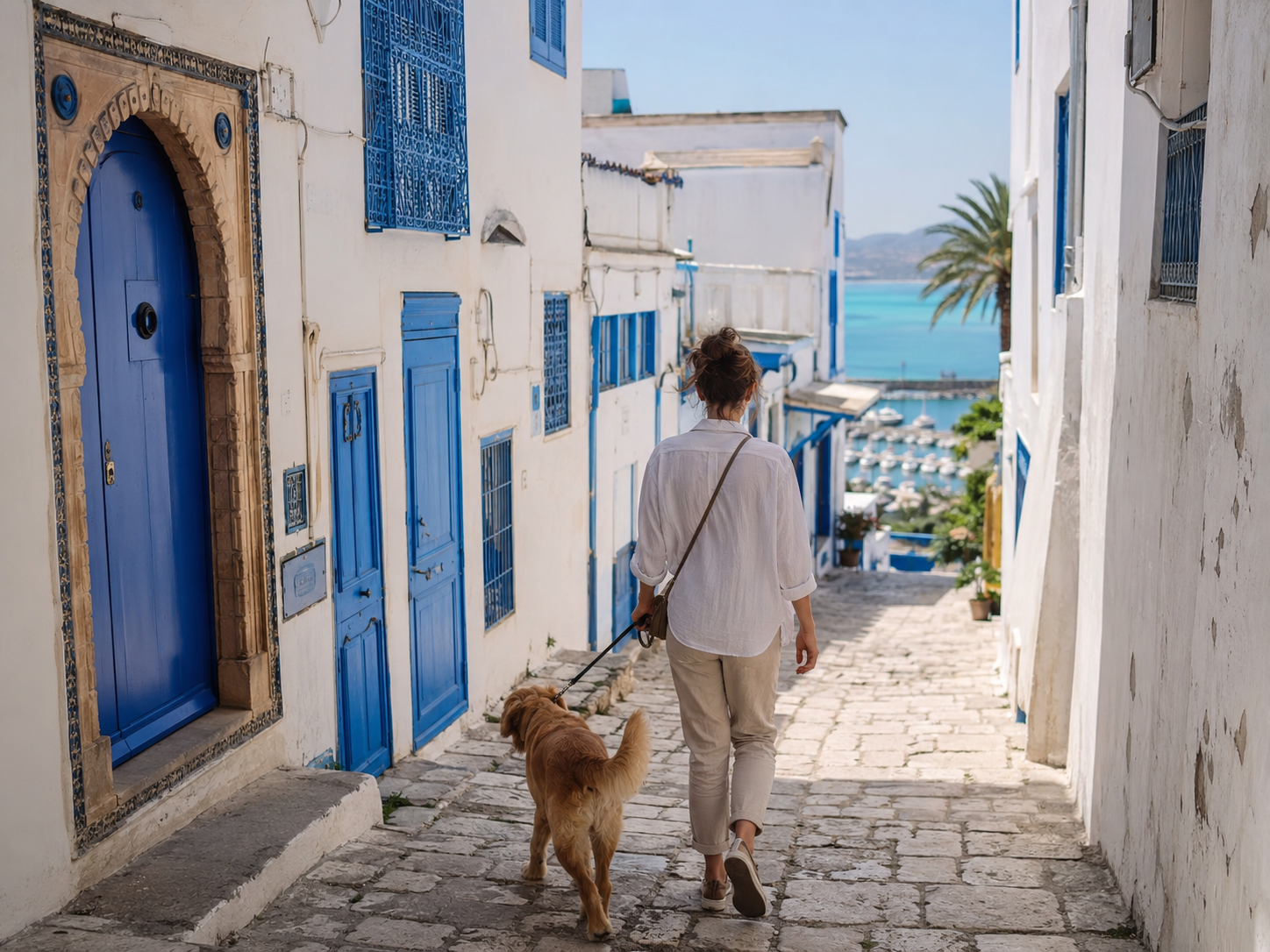


For many travelers, Tunisia is an accessible gateway to North Africa. You’ll find coastal resorts, medinas, desert landscapes, ancient sites, the island of Djerba and places where European holiday infrastructure meets a markedly different cultural setting. Traveling to Tunisia with a dog is possible, but plan ahead and don’t rely solely on the rules you know from traveling within the EU.
When taking a dog to Tunisia, you’re dealing with two things: entry to Tunisia and the return home. Entry rules are set by the Tunisian veterinary authorities. The return is governed by the country your dog will re-enter after Tunisia.
This article covers a typical non-commercial trip where a dog travels with its owner or an authorized person. If a dog travels as cargo, for sale, for a change of ownership, or unaccompanied on a different means of transport, other rules may apply.
Table of Contents
Quick overview
To enter Tunisia with a dog, you’ll mainly need:
- a valid rabies vaccination — administered between 30 days and 12 months before arrival in Tunisia
- a veterinary health certificate — issued within 12 days before departure and endorsed by the official veterinarian of the country of departure
- dog identification — a microchip isn’t mandatory, but it’s recommended
- the carrier’s rules, especially when flying
A titer test is not required for entry to Tunisia — this applies regardless of the country of departure. An import permit is not required for a standard non-commercial trip with a dog accompanied by its owner.
On the way back from Tunisia, the rules of the country you’re entering apply. If a dog is returning from Tunisia to the EU, you need to factor in a rabies antibody serology (titer) test — a blood test that verifies antibody levels after vaccination — because Tunisia is not on the EU list of territories exempt from this requirement on return.
Entry conditions and documents
Tunisia has fairly clear entry requirements for dogs. The key document is a veterinary health certificate issued by a licensed veterinarian in the country of departure and endorsed by that country’s competent veterinary authority.
Before you travel, have ready:
- a valid rabies vaccination — administered between 30 days and 12 months before arrival in Tunisia
- a veterinary health certificate — issued within 12 days before departure and endorsed by the official veterinarian of the country of departure
- dog identification — a microchip isn’t mandatory for entry to Tunisia, but it’s practically essential for returning to the EU; if your dog doesn’t have one, arrange it before leaving the EU
- an EU Pet Passport if traveling from the EU — a useful document confirming identification and vaccination
A titer test is not required for entry to Tunisia. An import permit isn’t needed for a standard personal trip either. By air you’ll arrive via Tunis–Carthage International Airport. Tunisia is also accessible by ferry — routes from Marseille or Genoa are operated by companies such as CTN, Corsica Ferries or Grimaldi Lines, and pets can travel if you meet the carrier’s conditions.
Certain breeds are not allowed to enter Tunisia: Pit-bull, Rottweiler, Tosa, Mastiff and Boerbull. If your dog is a different breed with similar traits, check this in advance.
Interested in this destination? Would you like to visit it with your dog? Check the entry requirements directly in BorderCooler®.
Rabies vaccination
Your dog must have a valid rabies vaccination. The certificate must show the vaccine was administered between 30 days and 12 months before arrival in Tunisia. If it’s older than 12 months or newer than 30 days, it doesn’t meet the requirement.
If your dog is microchipped, the vaccination should follow the chip — chip first, then vaccinate. If the vaccination is recorded as given before microchipping, it can complicate the trip, especially when returning to the EU, where a microchip is mandatory.
For a first rabies vaccination, allow for timing: a blood draw for a potential titer test for return to the EU is possible no earlier than 30 days after vaccination. If you plan to return to the EU, arrange the serology before leaving the EU.
Veterinary health certificate
A veterinary health certificate is mandatory for travel to Tunisia. It confirms the dog’s identification, rabies vaccination and health status before travel. It’s issued by a licensed veterinarian in the country of departure and must be endorsed by the competent veterinary authority.
For trips from the EU, check with the veterinary authority in your country which form to use for entry to Tunisia. An EU Pet Passport or a standard vaccination booklet alone is not sufficient — the certificate must meet Tunisian requirements and be officially endorsed.
The certificate must be issued within 12 days before departure. When planning, allow enough time for endorsement by the official veterinarian and logistics — don’t start just a couple of days before your flight.
Flights, ferries, and carrier rules
When traveling to Tunisia, check the carrier’s pet rules before buying a ticket — each carrier has its own conditions. By air you’ll enter via Tunis–Carthage International Airport. Ferries operate from Marseille or Genoa — for example CTN, Corsica Ferries or Grimaldi Lines.
Carriers may set their own conditions for transporting a dog, for example:
- whether the dog may travel in the cabin or only in the hold
- what crate dimensions or types are allowed
- the maximum weight of the dog including the crate
- whether documents must be submitted in advance
- any restrictions by size or breed
These rules are separate from government veterinary requirements. Even if your dog’s paperwork is in order, the carrier may still refuse transport if its operational conditions aren’t met.
Returning home from Tunisia
When a dog returns from Tunisia, the rules are set not by Tunisia but by the country you’re entering. Check in advance which documents your dog will need to come home.
The country of return may require, for example:
- a valid rabies vaccination
- identification by microchip
- a veterinary health certificate
- import documentation
- entry via a specific control point
- a rabies antibody titer (serology) test, if required by the country of return
If you’ll continue from Tunisia to another country with your dog, follow that destination’s rules.
Returning with a dog from Tunisia to the EU
If a dog is returning to the EU from Tunisia, it’s an entry into the Union from a non‑EU country. Tunisia is not among the territories for which the EU waives the rabies antibody titer test.
For a return from Tunisia to the EU, your dog mainly needs:
- a microchip
- a valid rabies vaccination
- a rabies antibody titer test
- an EU Pet Passport or the appropriate veterinary health certificate for entry to the EU
- a declaration of non-commercial movement if using a veterinary health certificate
- entry via a designated travelers’ point of entry for pets
If the dog normally lives in the EU, travels to Tunisia and will return with an EU Pet Passport, arrange the titer test before leaving the EU and have the result entered in the passport. If you then keep the rabies vaccination continuously valid, you’ll greatly simplify the return to the EU.
If the test is missing and the dog is already in Tunisia, returning to the EU can become significantly more complicated. The test must follow a valid rabies vaccination, the sample must be examined in an approved laboratory, and if the test is performed in Tunisia the dog cannot enter the EU earlier than three months after the blood draw.
Parasite prevention
Tunisia is not a country for which the EU applies the familiar 24–120 hour echinococcus treatment window on return. That applies only to selected destinations, for example Finland, Ireland, Malta, Norway and Northern Ireland.
Regardless of any formal requirement, treatment before traveling to Tunisia makes practical sense. Tunisia has ticks, fleas and other parasites that can transmit disease. In warmer, coastal and rural areas this advice is especially relevant.
It’s also worth discussing prevention against leishmaniasis, which is transmitted by tiny biting flies. Risk varies by region, season and travel style, but caution is wise especially during evenings and nights and for dogs that spend a lot of time outdoors.
Practical tips for staying in Tunisia with a dog
Tunisia can be rewarding with a dog, but not always straightforward. Attitudes to dogs vary by region, type of accommodation, setting and the individual person. In tourist areas, travel with a dog can be easier, but access to indoor restaurants, shops or accommodation shouldn’t be taken for granted.
Culturally and religiously, Tunisia differs from much of Europe. Some people may be more reserved about dogs, especially indoors, around food or in more traditional communities. That doesn’t mean you can’t travel with a dog — just be considerate and don’t expect the same level of dog-friendly infrastructure as in some European countries.
Always confirm accommodation directly. A simple “pet friendly” filter in a booking system isn’t enough. Check your dog’s size, any fees, whether you can leave the dog alone in the room, and rules for shared spaces.
Cities, markets and medinas can be full of people, noise, scooters, cats and strays. A dog that struggles with crowds may be stressed in such environments. Plan shorter walks, choose calmer times of day and avoid the biggest crush.
You may encounter stray dogs and cats in Tunisia. Most situations are uneventful, but keep your dog under control and don’t let it run up to unfamiliar animals.
When to start preparing
Start planning a few weeks before departure. The key timing is the vaccination — it must be administered at least 30 days before entry, which you need to factor in.
In practice, prepare:
- a valid rabies vaccination — administered between 30 days and 12 months before arrival
- a veterinary health certificate — issued within 12 days before departure and endorsed by an official veterinarian
- an EU Pet Passport if traveling from the EU
- the carrier’s rules
- the rules for returning home
If your dog will return to the EU after a stay in Tunisia, arrange the titer test well in advance. The blood draw is done no earlier than 30 days after rabies vaccination, and if the test is carried out in Tunisia the dog cannot enter the EU until three months after the blood draw. The most practical approach is therefore to complete the test before leaving the EU.
Summary
A trip to Tunisia with a dog is administratively quite straightforward. Your dog needs a valid rabies vaccination administered between 30 days and 12 months before arrival, and a veterinary health certificate issued within 12 days before departure and endorsed by an official veterinarian. A titer test or import permit isn’t required for a standard personal trip.
By air you enter via Tunis–Carthage Airport. Traveling by ferry is also possible — check the rules with your chosen carrier. Some breeds — Pit-bull, Rottweiler, Tosa, Mastiff and Boerbull — are not allowed to enter Tunisia.
For the return to the EU, the titer test is key — it’s best to arrange it before leaving the EU. Beyond paperwork, think about airline rules, accommodation, local attitudes to dogs and parasite prevention.