


When you start looking into flying with a dog, most questions are very practical. If it’s your first time, it’s natural to focus on airline rules, carrier dimensions and the cost of transport. How much does a dog’s ticket cost? Can they fly in the cabin? What size should the carrier be? What veterinary papers do you need? We cover those topics in detail in our complete guide to flying with a dog.
All of that matters. But there’s a more fundamental question to ask first: is this specific flight a safe, sensible choice for your dog?
Flying with a dog isn’t only about meeting an airline’s rules. Just as important is whether your dog’s health, temperament, age and overall condition are suited to this kind of trip.
Flying with a dog isn’t automatically dangerous. It also isn’t entirely neutral. For one dog, a well‑planned nonstop flight can be a manageable part of the journey. For another, the very same trip could mean unnecessary stress or a health risk.
Our goal here isn’t to scare you. We want to look at flight safety with a dog in practical terms: what the available statistics say, which dogs tend to be higher risk, why sedation isn’t a simple fix, and how you can reduce risk as much as possible.
Is flying with a dog safe?
There’s no single answer for everyone. Safety depends on several things at once: your dog’s health, age, breed, temperament, the way they travel, flight length, weather, number of connections, and how experienced the specific airline is with animal transport.
A short, direct flight with a healthy, calm dog who’s used to a crate is a very different scenario from a long journey with multiple layovers in hot weather with a dog who’s never been crated and struggles with separation.
It also matters whether a dog flies in the cabin or in the hold. The cabin can feel safer because your dog is near you, but that doesn’t mean it suits every dog. The hold understandably inspires more caution because your dog is out of sight. Even there, the biggest risks are often not the time in the air itself, but the handling, waiting before loading, transfers, delays and extreme temperatures.
The better question isn’t just whether flying with a dog is safe, but whether this particular flight is a better choice for your particular dog than the available alternatives.
What the statistics say about incidents in animal air transport
Data can help when assessing risk. The best publicly available figures come from the United States, where the Department of Transportation tracks incidents in the air transport of animals. These reports cover animal deaths, injuries and losses during air travel.
In 2024, U.S. carriers reported 10 animal deaths, 3 injuries and 0 lost animals. That’s 13 incidents among 161 335 animals transported.
At 10 deaths out of 161 335 animals transported, 2024 works out to roughly 0.62 deaths per 10 000 animals. In other words: about one reported death for every 16 000 animals transported in these U.S. data.
For comparison, in 2023 the same reporting showed 8 animal deaths among 124 593 animals transported. That’s about 0.64 deaths per 10 000 animals.
These numbers are useful, but read them with care. They’re not a global statistic for every dog on every flight worldwide. They are reported incidents within a specific U.S. system. They also don’t capture everything owners care about: a dog’s stress, delayed crate delivery, rough handling, or situations that never became formal reports.
Related reading: our article on what to do if your dog doesn’t arrive at the destination after a flight.
Available statistics suggest deaths during air transport of animals are rare. Yet if an incident happens to your dog, it’s not a statistic—it’s a very unpleasant and serious situation.
A low rate of reported deaths doesn’t mean zero risk. It suggests you shouldn’t demonize flying with a dog by default—but you should plan it responsibly.
Are you planning a trip abroad with your dog? Check the entry requirements for various countries directly in BorderCooler®.
Cabin or hold: the difference is about more than comfort
Owners often focus on whether a dog can fly in the cabin. That’s natural. When your dog is beside you, you feel more in control. You can see and hear them and respond, at least to a point.
The cabin, however, is only for small dogs that fit into an approved carrier. The carrier must be placed under the seat for the flight. For a crate‑trained dog who relaxes and rests, that can be manageable. For a larger, very active or anxious dog, the limited space can be a major problem. For practical tips, see our guide on how to choose a dog carrier for the aircraft cabin.
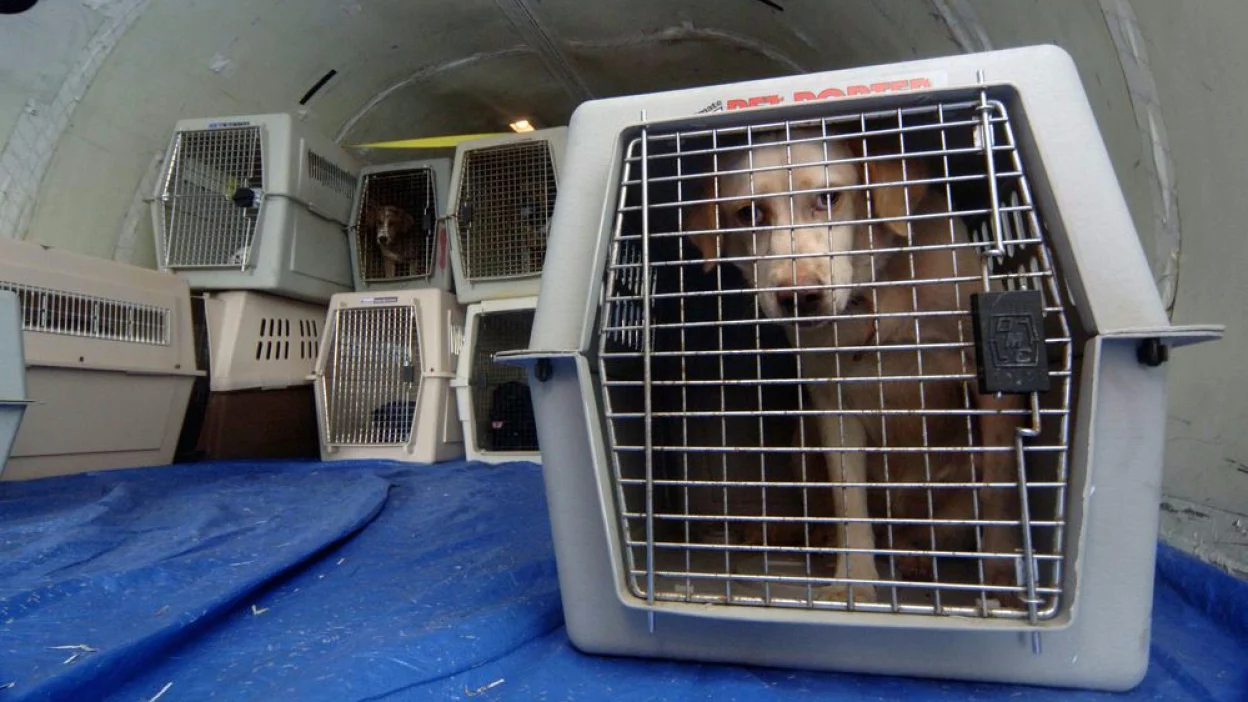
Travel in the hold is a different setup. A dog usually flies in a larger, solid crate where they can stand, turn around and lie down. On the other hand, they’re out of your sight, and the entire journey relies on correct handling, the airline’s procedures and the conditions at the airport. With this mode of travel the choice of crate is even more important, so we recommend our article on how to choose a dog crate for the aircraft hold.
International guidance on air transport of animals emphasizes choosing the right crate size, confirming transport in advance, checking the rules of the specific airline, and preparing your dog for time in the crate well before the trip.
If your dog flies in the hold, remember the critical moments may not be the minutes in the air. Consider where and how long your dog waits before loading, how the transfer works, whether it’s extremely hot or cold, and how quickly you collect your dog after arrival.
Which dogs have higher risk when flying
Not every dog is equally suited to air travel. Higher risk groups include brachycephalic (short‑nosed) breeds, older dogs, very young dogs, dogs with heart or breathing issues, dogs after surgery, overweight dogs, and dogs with marked anxiety.
If a dog isn’t medically or mentally ready to fly, the airline may not be the problem. The decision to fly might be.
Short‑nosed breeds—such as Pugs, French Bulldogs, English Bulldogs, Boston Terriers or Pekingese—may struggle with breathing and thermoregulation. Heat, stress or limited space can make these issues worse. For such dogs, be especially cautious when considering air travel; airlines often apply stricter rules.
Dogs with heart disease, chronic cough, tracheal collapse, epilepsy or other conditions can also be higher risk. In these cases, a flight shouldn’t be just an administrative task—it’s something to discuss with your vet.
Very anxious dogs are a category of their own. If your dog panics when crated at home, the airport and the flight won’t likely be easy. The solution isn’t just buying the right crate. You’ll need preparation, training and sometimes professional help.
Sedating a dog before a flight: why it isn’t a simple solution
Many people have an instinctive thought when flying with a dog: give them something to calm down, they’ll sleep through the flight, problem solved. It sounds logical, but in air travel it’s not that simple.
Veterinary bodies and airline guidelines are cautious about sedation. Sedatives and calming medications can affect breathing, blood pressure, thermoregulation, balance and a dog’s ability to respond naturally to body position. In the hold the problem is even greater, because your dog is out of sight and no one observes them as a vet would in a clinic.
That doesn’t mean every medication is off limits or that a stressed dog has no options. It means pre‑flight sedation should never be improvised. If stress is an issue, work on it with your vet in advance—ideally weeks before the trip, not the night before departure.
Don’t sedate your dog just to make them “quieter.” If flying or crating causes pronounced stress, that’s a reason for an early veterinary consultation, not an experiment on departure day.
There’s a difference between heavy sedation and an individually tailored anxiety treatment or behavioural plan. That decision belongs to a vet who knows your dog’s health—not to an online forum or a well‑meant tip at the airport.
Flight risk versus the risks of everyday activities with a dog
We tend to feel the risk of flying very acutely. That’s understandable. If a dog flies in the hold, you hand them over to someone else and have no direct control during the flight.
But flying isn’t the only risk we expose dogs to. Dogs are injured and die during activities we consider routine: traffic accidents, running into the road, travelling by car without restraint, overheating during a summer walk, hiking in high heat, or swimming in unfamiliar water.
A British VetCompass study on canine road traffic accidents reported that roughly 4 in 1000 dogs were involved in an RTA, and in more than a fifth of those cases the dogs died or had to be euthanised. That doesn’t mean car travel is automatically more dangerous than flying. It means we often underestimate everyday risks simply because we’re used to them.
It’s similar with heat. VetCompass research on heat‑related illness shows that while heatstroke is relatively rare in the general dog population, when it happens it can be serious. In one UK study, confirmed cases had a mortality of about 14%. Other research showed that common triggers included not only being left in a hot car, but also exercise in hot weather.
That context matters. Many owners fear flying, yet think nothing of a long summer hike, letting their dog run in the sun, or driving without proper restraint.
An airplane trip feels dramatic because you hand your dog over to someone else. A car journey or summer hike feels safer because you feel in control. That doesn’t make them risk‑free.
You can’t neatly rank these risks from smallest to largest. Airline stats track transported animals. Road accidents record dogs involved in incidents or cases captured in veterinary data. Heat‑related illness comes from clinical records. The methodology differs.
The practical takeaway is clear: don’t only ask whether flying with a dog is safe. Compare the specific flight with real alternatives. Sometimes driving is better. Other times a nonstop two‑hour flight is more sensible than a two‑day drive through heat, ferries and multiple borders.
The biggest risk often isn’t the flight itself
When planning a flight with a dog, we naturally focus on the airplane. In practice, the riskiest parts can be the logistics around it.
A very tight connection can be a problem. If baggage struggles to make the next flight, it’s even more stressful with a dog. Long layovers—waiting in an unfamiliar setting—or changing aircraft in very hot countries can also be risky.
Weather matters a lot. Heat and frost can determine whether an airline accepts a dog at all. Even if the cabin or hold is climate‑controlled, your dog still has to get to the plane and back to the terminal safely. Waiting on the apron and ground handling before departure and after arrival can be sensitive moments.
An unsuitable crate is another risk. A crate that’s too small can be physically and mentally taxing. A flimsy or poorly secured crate raises the risk of escape or injury. The crate must be large enough, sturdy, well ventilated and securely closed.
And then there’s preparation. A dog who meets their crate for the first time on departure day is far more likely to be stressed. If the crate is their only safe space during the flight, they need to be familiar with it in advance.
How to reduce risk when flying with a dog
You can’t remove risk entirely, but you can reduce it significantly with good planning:
- Choose a nonstop flight if you can. Every connection means extra handling, more waiting and another point where things can go wrong. For a dog flying in the hold, a direct route is often much better than a cheaper itinerary with multiple layovers.
- Avoid extreme temperatures. For summer or winter trips, consider not only the weather at your destination but also at your transit airports. A layover at a very hot airport can be riskier than the flight time itself.
- Verify the airline’s rules directly. A general article online isn’t enough. Each airline may have its own limits on breeds, temperatures, crate dimensions, aircraft type, number of animals on board, or how to book. For a first overview, our guide can help: Flying with a dog: conditions of well‑known airlines.
- Visit your vet before the trip. It’s not just about a stamp or certificate. Your vet should assess whether your dog is medically fit to fly—especially for seniors, short‑nosed breeds, or dogs with breathing or heart issues.
- Crate‑train well in advance. Ideally weeks or months before the trip. The crate shouldn’t be a punishment or a one‑off cage for the airport. It should become a place where your dog can lie down and rest calmly.
- Don’t give sedatives without veterinary advice. If your dog needs help with stress, address it early and with professional guidance.
- Have documents and ID ready. Your dog should be microchipped, with up‑to‑date contact details, clear crate labelling and, for international travel, the correct veterinary documents. Meeting the airline’s rules isn’t enough—you must also meet the entry requirements of your destination and any rules for the return trip.
- Collect your dog as soon as possible after landing. If they didn’t fly in the cabin, don’t delay pickup. After the journey they need calm, water, a chance to relieve themselves, and a quick check that everything is fine.
When it’s better not to fly with your dog
Sometimes the most responsible decision is not to fly. Or to postpone the flight, change the route, pick a different airline or choose another mode of transport.
As a rule, think twice when several risk factors stack up: your dog isn’t fully healthy, they don’t tolerate a crate well, the itinerary has multiple layovers, the weather is extreme, or the airline’s rules aren’t clear. A single issue can often be solved with good preparation. Several at once can turn a routine trip into an unnecessary risk.
The reason for the trip matters, too. You’ll decide differently for a move, a long stay or coming home than for a short holiday you could plan without flying. If the flight isn’t essential and there’s a simpler alternative, consider taking it.
Safe travel with a dog doesn’t mean nothing ever goes wrong. It means recognising the risks you can influence, and not putting your dog into a situation they aren’t ready for.
Conclusion: flying isn’t about bravery, but good judgment
Flying with a dog can be a sensible part of a trip—especially if your dog is healthy, well prepared, the route is simple and you know what you’re doing.
It’s not a decision to make based only on ticket price or the fact an airline technically accepts dogs. You also need to consider health, stress, weather, layovers, handling, the crate and the entry rules for your destination.
Available statistics don’t suggest deaths in animal air transport are common. But low numbers don’t mean the risk doesn’t exist. So treat flying with a dog like any other travel scenario: not with fear, but with preparation.
The right question, then, isn’t only whether flying with a dog is safe.
The right question is whether this specific flight, for your specific dog, in this specific situation, is the most sensible option.
If you can answer that honestly, you’re far more likely to make the right call.
Frequently asked questions about flying safely with a dog
Is it safer if a dog flies in the cabin?
Having your dog in the cabin gives you a greater sense of control because they’re beside you. That doesn’t mean the cabin suits every dog. The small space under the seat can be a problem for dogs who don’t tolerate a carrier well, are very stressed, or need more room.
Is the hold dangerous for a dog?
The hold isn’t automatically dangerous, but your dog is out of sight during the journey. The riskiest parts are often the handling, transfers, waiting on the apron, extreme temperatures and an unsuitable crate.
Can I give my dog calming medication before a flight?
Without veterinary advice, you shouldn’t give sedatives before a flight. Medications can affect breathing, balance, thermoregulation and a dog’s ability to respond naturally to stress.
When is it better not to fly with a dog?
Think carefully about flying if your dog has medical risks, is a short‑nosed breed, is very anxious, if temperatures are extreme, or if the route is complex with multiple layovers. It also matters whether the flight is truly necessary, or whether there’s an easier alternative.