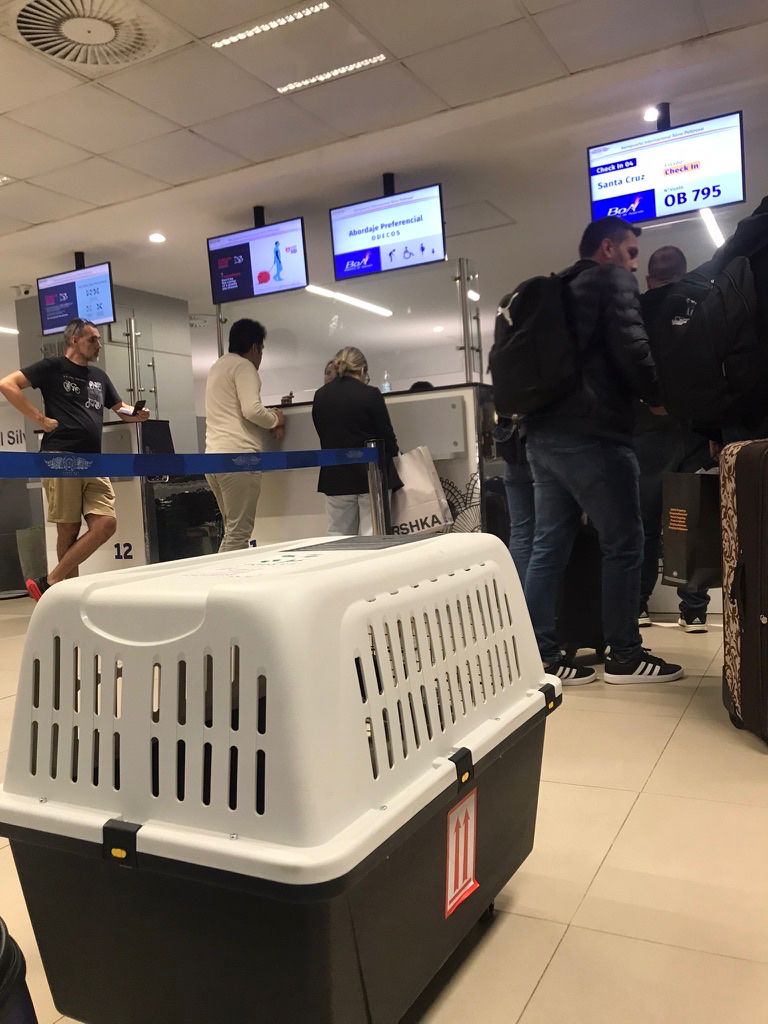


Flying with a dog in the baggage hold is always a bit more stressful than traveling with a dog in the cabin—or without one at all. And while most flights end without a hitch, there’s one scenario that worries almost every owner: you reach your destination airport, but the crate with your dog doesn’t show up.
First, one important point: whenever possible, travel with no connections. A nonstop flight greatly reduces the risk of your dog’s crate getting “stuck” at a transfer airport. But direct routes aren’t always available or affordable. That’s exactly when it helps to know what to do if something goes wrong.
This article sums up real travelers’ experiences, the most common scenarios, official airline procedures for lost or delayed baggage, and the legal framework that, in practice, also applies to dog crates.
Table of Contents
What might have happened
If your dog’s crate doesn’t arrive, it’s usually one of these scenarios:
- the crate wasn’t transferred to the connecting flight in time (tight connection, terminal change, ramp delays).
- the flight was rebooked or there was an aircraft swap and the crate was no longer accepted.
- the animal was offloaded during the layover for safety or weather reasons.
- on some transfers you must collect the crate and recheck it, but the passenger wasn’t aware.
That last point is surprisingly common. Some airlines and airports don’t transfer pets automatically during a layover; the owner must collect the dog and check it in again. It’s critical to know the exact procedure for your specific airline and transfer airport. Always ask at check-in about the exact handling for your pet.
How to tell if the dog really hasn’t arrived
Before you panic, check the following:
- Check all special-baggage claim points. Animal crates are often not delivered on the regular carousel.
- Ask at Lost and Found and oversize baggage. At many airports, that’s the likeliest place.
- Find out whether animal crates are released at a dedicated counter. Some airports handle them separately.
If the crate is still not available, move straight on to the official next steps.
Are you planning a trip abroad with your dog? Check the entry requirements for various countries directly in BorderCooler®.
What to do first: step by step
1) Do not leave the airport without filing a report
Deal with it while you’re still in the arrivals hall. With delayed or lost baggage, it’s crucial to report the issue immediately. With a live animal, that goes double.
2) Find your airline’s baggage service desk
Most airports have a counter in the baggage-claim area that handles delayed and lost baggage. If there isn’t one, ask airport staff where to go.
3) Have a Property Irregularity Report (PIR) issued
Ask to have a Property Irregularity Report (PIR) filed. It’s the official document—without it, resolving the case is much harder.
When completing it, insist that it clearly states this is not a suitcase but a crate with a live animal. Provide:
- the baggage tag number,
- your flight number and any connecting flight,
- a description of the crate (brand, color, dimensions),
- a photo of the crate and your dog, if you have one,
- your contact details and your address while in the destination.
4) Immediately request a physical check, not just “tracking in the system”
For regular baggage it’s often enough to report it in the system. With a dog, it’s important that someone actually goes to the areas where live animals are held and checks.
Ask them to contact:
- the department responsible for live animals (animal handling),
- the cargo/handling team,
- the relevant transfer airport.
The goal is simple: confirm exactly where the crate physically is and whether your dog is okay.
What happens to your dog if it stayed behind at the transfer airport
In practice, animals that don’t depart on the planned flight aren’t set aside “with the suitcases”. They’re usually moved to a controlled area designated for handling live animals.
Such areas are typically:
- protected from extreme temperatures,
- accessible only to trained staff,
- operating under procedures in line with the rules for transporting live animals (for example, the IATA Live Animals Regulations).
In practice, this usually means the dog is kept in a temperature-controlled space with ventilation, and staff monitor its condition. The crate should remain closed and sealed as it was at check-in. Walking the dog or taking it out of the crate generally isn’t planned—handling is kept to a minimum unless there’s a health issue or an emergency.
Even though these facilities are technically well equipped, it’s not a pleasant situation for the dog. It’s still a stressful environment—airport noise, unfamiliar smells, and handling by staff. The key point, however, is that the crate shouldn’t be left unattended out on the ramp but kept in the live-animal handling area, where the animal’s basic condition is monitored and safe-handling rules are followed.
If you manage to get a contact at the transit airport or cargo/handling, you can ask for confirmation that the dog has water and is okay. Not everyone will be able or willing to confirm this, but as the owner you have the right to ask.
How the dog gets to the final destination
The most common scenario is that the crate is loaded onto the next available flight to your destination.
Here’s where practical complications arise:
- not every aircraft type and route accepts animals in the hold,
- each flight allows only a limited number of animals,
- in extreme temperatures the airline may refuse transport,
- if different carriers are involved, the crate may not automatically transfer into the next airline’s system.
Depending on the route, the dog may arrive several hours later, the next day, or even later.
It’s important to find out whether they’ll deliver your dog to your address (as with baggage) or if you’ll need to collect it from the airport yourself.
EU legal framework: what it means in practice
If your flight falls under the Montreal Convention (which covers most international flights), transporting a dog in the hold is usually legally treated as checked baggage.
In practice, that means three things:
- you must report the issue immediately at the airport and have a Property Irregularity Report issued,
- you then need to submit an official claim within the stated deadline,
- the airline’s liability is capped by law.
In other words, if there’s a delay or damage, there are rules governing compensation. That doesn’t automatically mean a high payout. Each case is assessed individually.
If your dog is delayed, the priority is getting them back safely. Discussing compensation only makes sense once you know they’re okay.
Practical tips to reduce the risk
Before departure
- Prioritize nonstop flights whenever possible.
- Every connection adds risk.
- If you have to connect, allow plenty of time. Short layovers are the biggest enemy.
- Check the transfer rules: will the dog transfer automatically, or do you have to collect and recheck it?
- Label the crate clearly and legibly: dog’s name, your contact, final destination.
- Fit the crate with an automatic water dispenser.
- Leave a small portion of food in the crate’s storage compartment and clearly note this on the outside for staff.
- Keep printed or phone photos of your dog and the crate.
After arrival
- Head to baggage claim as soon as you land.
- If the crate doesn’t arrive, act immediately and ask for a Property Irregularity Report.
- Insist on a physical check and clear information on where the dog is.
- Be prepared for the dog to arrive on a later flight.
Conclusion
The thought that your dog might not reach the destination with you is a nightmare. In most cases, though, it’s simply a delay and the crate makes the next flight.
The most important thing is not to lose time: file a PIR, push for a real-world location check of your dog, and keep a clear communication channel with the airline.
If you’re planning a connecting flight with a dog and want to minimize the risk—or you’re already dealing with a specific case—write to us. We’ll help you navigate the steps and prepare so you can get through it with as little stress as possible.