
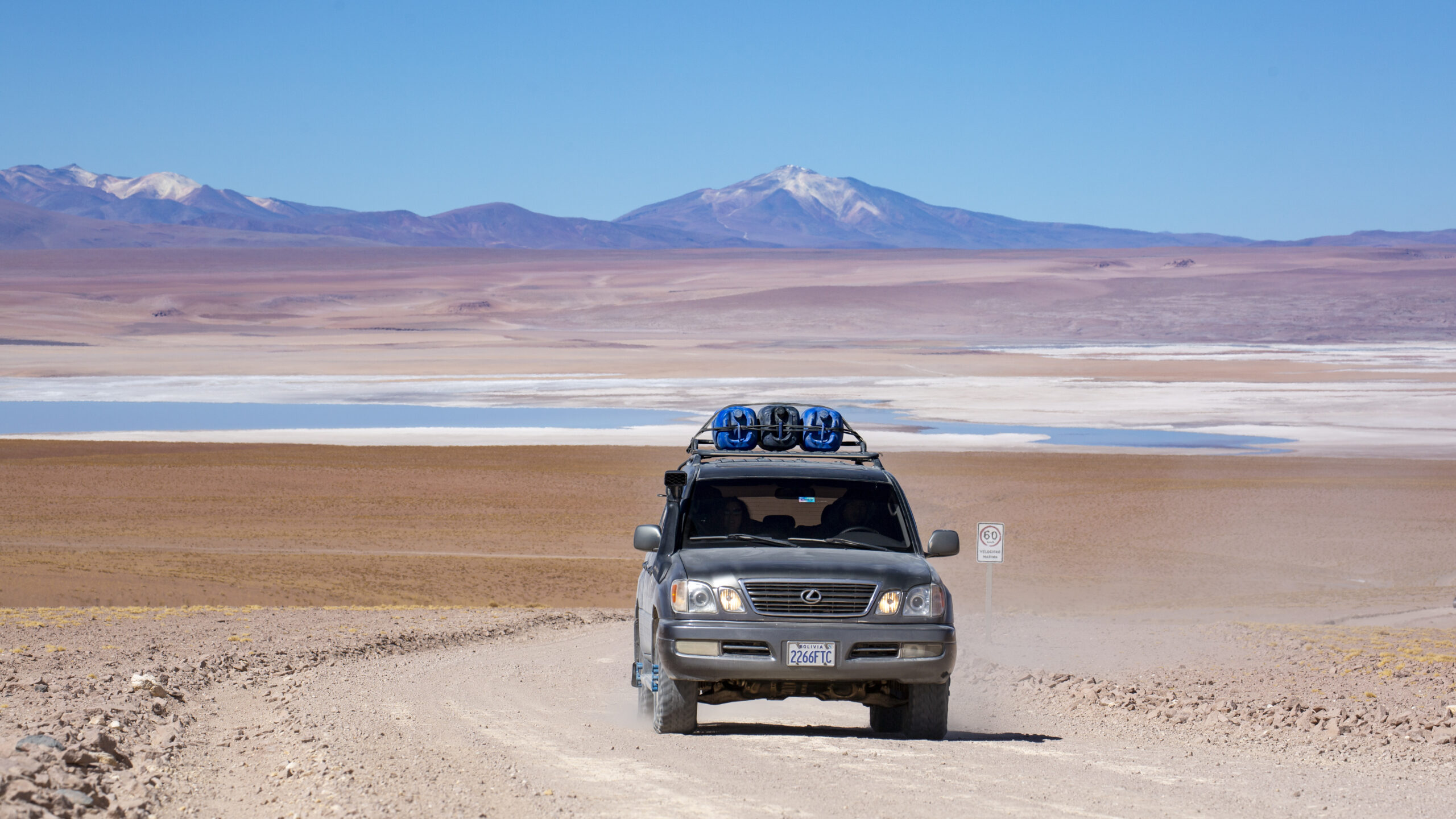


The Altiplano is a vast high plateau in South America, sitting roughly between 3,500 and 4,800 meters above sea level. It spans mainly Bolivia, northern Peru, northern Chile and, to a lesser extent, northwestern Argentina. It’s one of the highest inhabited regions on Earth, where thin air, fierce sun, freezing nights and long distances combine into an environment that’s as fascinating as it is unforgiving. The landscape is open, raw and at times completely empty; infrastructure is limited and help is often a long way off. That’s why choosing the right vehicle in the Altiplano really matters—it’s not just about comfort, but about moving safely and independently in terrain that punishes mistakes.
The Altiplano’s character and regional differences
Southern Bolivian Altiplano – salt, sand and isolation
The southern Bolivian Altiplano is among the region’s most iconic—and most demanding—areas. Vast salt flats, sandy and gravel stretches, and vast open spaces without clearly defined tracks dominate here. Tracks often vanish into the terrain, and you navigate more by the landscape than by maps or signs. Infrastructure is minimal and distances between settlements are great, making this a place where a reliable four-wheel drive really proves its worth.
Northern Altiplano (Peru and Bolivia) – more life and a gentler feel
The northern Altiplano, especially around Lake Titicaca, feels milder and more lived-in. The land is farmed, there are more villages and far more paved roads. Driving is technically easier than in the south and more accessible for less experienced drivers. Altitude is still high, though, which means noticeable power loss for engines and extra demands on both machine and driver.
Chilean Altiplano – dryness, volcanoes and harsh conditions
Chile’s slice of the Altiplano is extremely dry and distinctly volcanic. Road surfaces can be hard and sharp, which is tough on tires and suspension. The area is sparsely populated, exposed to strong winds and big temperature swings between day and night. While some roads may appear better built than in Bolivia, the terrain’s technical demands make this a place where a vehicle’s reliability is tested very quickly.
What makes the Altiplano tough on vehicles
Driving the Altiplano means high elevation, thin air and noticeable engine power loss, long stretches without fuel stations or workshops, and a lot of unpaved roads. In a single day you might face harsh sun, strong wind, sand, water crossings and night frosts. Your vehicle isn’t just transport here—it’s your safety net, shelter, and often the only way to get back if something goes wrong.
Interested in this destination? Would you like to visit it with your dog? Check the entry requirements directly in BorderCooler®.
The ideal choice: a classic 4×4 with low range
If you want to explore the Altiplano freely and without major limits, a proper four-wheel drive with low-range gearing is the best choice. It delivers better traction on sand and gravel, higher ground clearance, a tougher chassis and the ability to cope with water crossings and broken stretches.
Older, mechanically simpler vehicles without unnecessary electronics are a real advantage. In the Altiplano’s remote areas, service is scarce and modern systems that depend on diagnostics or specialized parts can become a serious problem if they fail. Simpler mechanics greatly increase your chances of an improvised fix in the field or in a small local workshop—often the decisive factor out here.
Practical comparison: Toyota Hilux vs. Toyota Land Cruiser on the Altiplano
On our last journey across the Altiplano we had the chance to try two iconic off-road models—the Toyota Hilux and the Toyota Land Cruiser—in different circumstances.
The Toyota Hilux was with us for almost our entire journey across Bolivia. Beyond the main roads we made repeated extreme climbs up the slopes of several volcanoes, including an ascent of Uturuncu, where we reached roughly 5,580 meters above sea level. The pickup offered a sensible level of comfort for three people and a dog. We kept daypacks on the rear seats and behind the front seats, with larger bags in the bed.
The drawback of this type of vehicle is that the bed is completely separated from the cab, making it hard to access luggage while driving. Even with a covered bed, we couldn’t fully keep dust out—it eventually got everywhere. Combined with relentless corrugations, the dust acted like fine sandpaper and some items picked up minor scuffs and abrasions.
We tried the Toyota Land Cruiser as passengers on a trip across the Salar de Uyuni. It’s a notably comfortable vehicle, and the luggage area is part of the cabin, eliminating both the dust issue and the access hassle. Although we didn’t take it on such extreme climbs in Bolivia as we did with the Hilux, from earlier experience on Socotra we know it’s exceptionally tough and reliable—few things stop it.
An SUV without 4×4? Only with big compromises
Standard SUVs with two-wheel drive can handle the main paved routes and runs between bigger towns, but their limits show quickly off the main routes. Low ground clearance, no low range and reduced power at altitude all raise the risk of trouble. If you keep to cities like La Paz and the fringes of the Salar de Uyuni area via the main highway, it’s manageable. But if you plan even modest detours, those compromises quickly turn into stress.
Manual or automatic at altitude
High elevation generally favors a manual gearbox. It gives better control of available power, lets you work the engine more precisely on climbs, and is mechanically less prone to failure. Automatics do work, but paired with a weaker engine they can feel sluggish and less predictable, especially off-road.
What to check when renting a car
When renting a car for the Altiplano, pay attention to details. A full-size spare, good tire condition, functioning four-wheel drive, a jack and basic tools should be a given. Equally important is confirming that the contract allows driving off paved roads. The cheapest option rarely turns out to be the best choice here.
Beware of the salt flats
Driving on the salt flats is undeniably a powerful experience, but you need to keep the risks in mind. Not every flat is drivable, and conditions depend heavily on the weather. During the rainy season many routes become completely impassable, and places that are safe when dry can quickly turn into traps.
Salt flats often suggest tempting shortcuts between points along their edges, but the margins are among the most treacherous sections. Edges tend to be soft and unstable, with a real risk of bogging down or breaking through the salt crust. The same risk applies to the shores of the so-called islands in the middle of the flats, which may look safe at first glance.
The salt itself deserves special attention. After longer drives it finds its way into every part of the undercarriage, accelerating corrosion of metal components. For this reason, it’s wise to treat the underbody before driving the flats and, above all, wash it thoroughly afterwards. In more populated areas that’s usually easy enough; in the Altiplano’s isolated corners it can be much harder. This is also why many rental companies explicitly forbid taking their vehicles onto the salt flats.
Summary: which car to choose for the Altiplano
The Altiplano isn’t a place to gamble with your equipment. A true 4×4 gives you freedom, safety and the ability to reach beyond where regular roads end. The Toyota Hilux and the Toyota Land Cruiser are both excellent choices here, each with its own strengths and trade-offs. Choose well and you can focus on what matters—the space, the quiet, the raw landscape and an experience that ranks among the most powerful in South America.