

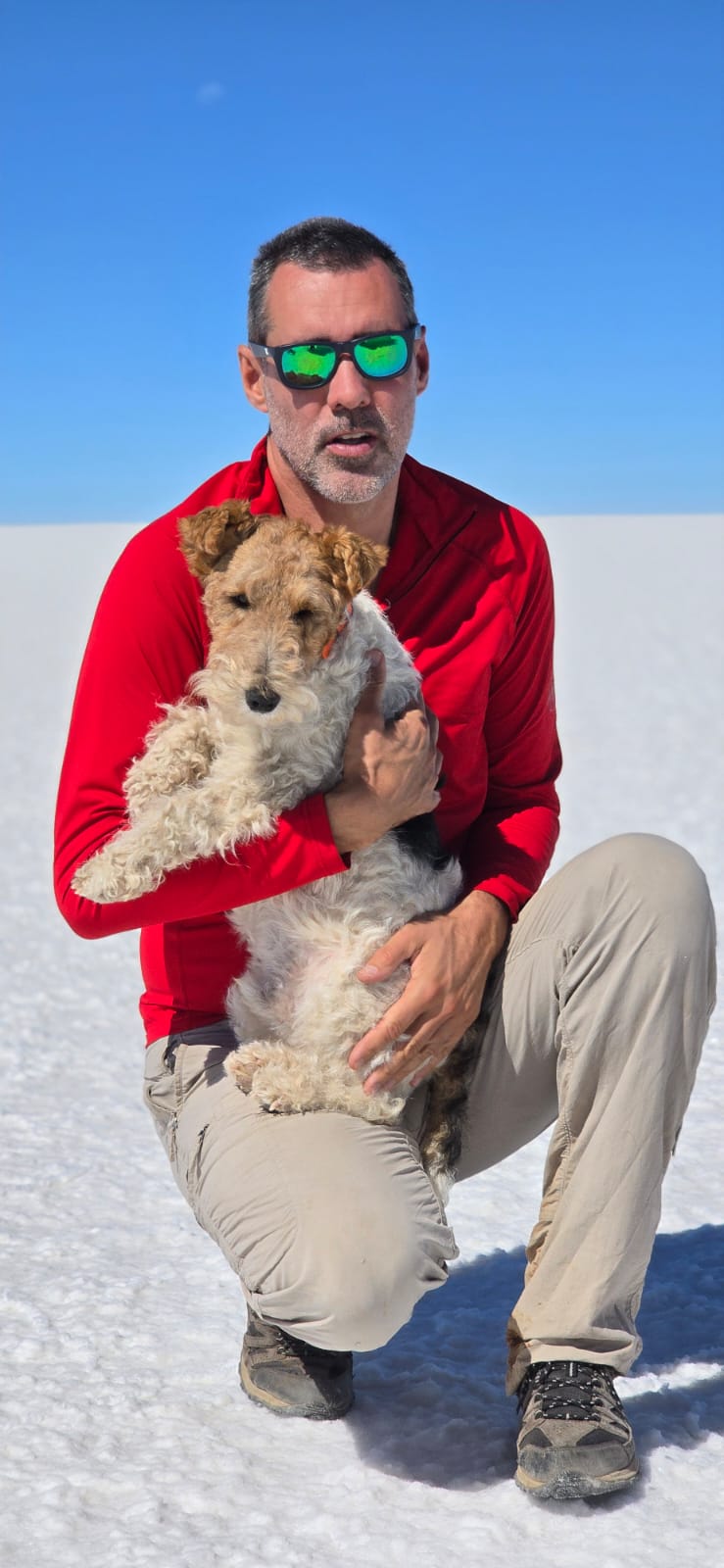
The Salar de Uyuni salt flats are among Bolivia’s most iconic sights and, for many, the main reason to come to this corner of the world. We didn’t want to miss this travel hotspot either — even with Ibo along for the ride. As it turned out, a trip to the Uyuni salt flats with a dog is entirely possible — you just need to accept a few compromises.
Coquesa – a quiet gateway to the northern flats
We spent the night before our outing in the village of Coquesa, right on the edge of the salt flats. Morning greeted us with a view of the majestic Tunupa volcano, which dominates the entire northern rim of Uyuni. The northern side is much less visited, which is a big plus for us — we like discovering places not yet saturated with tourism. It also means doing things a bit the “Bolivian way,” more hands-on — you won’t find tour agencies on every corner like in the town of Uyuni.
Since our rental car wasn’t allowed onto the salt flats (risk of getting stuck and salt damage), we arranged a guide with a suitable vehicle who would also take a dog — with help from our hotel — the day before. And it worked, via WhatsApp, literally at the last minute. For about 110 USD per person we got a guide, vehicle, all entry fees, and lunch. And Ibo? Not a problem — he could come along, of course for free. Perfect! In the morning, after breakfast at the hotel, our guide was already waiting in the parking lot with a polished Toyota Land Cruiser.
Caves and a museum – an intro to local culture and history
Our first stop was the Cueva de las Momias cave, just a few kilometers from our lodging, on the slopes of Tunupa itself. Inside you’ll find naturally mummified remains of the region’s original inhabitants. The place is modest but striking, and even here the views over the flats begin to open up.
Because it’s a spiritually significant site, we chose to leave Ibo in the car this time. The morning was pleasantly cool, so it wasn’t an issue. The entire visit, including a short hike, took about 45 minutes.
The program continued at the village’s small museum, where our guide explained local traditions and ways of life in Spanish. We didn’t catch every word, but the exhibits helped fill in the picture of life in this remote region. Ibo skipped this part too — museums just aren’t his thing. 😄
Interested in this destination? Would you like to visit it with your dog? Check the entry requirements directly in BorderCooler®.
Onto the flats – endless white horizons
As we drove onto the flats themselves, words failed us. An endless white plain in every direction, no bends or reference points — just pure emptiness. In the dry season the surface is hard as concrete; during the rains it’s covered by a few centimeters of water, creating the largest natural mirror on Earth.
Lunch in the middle of nowhere
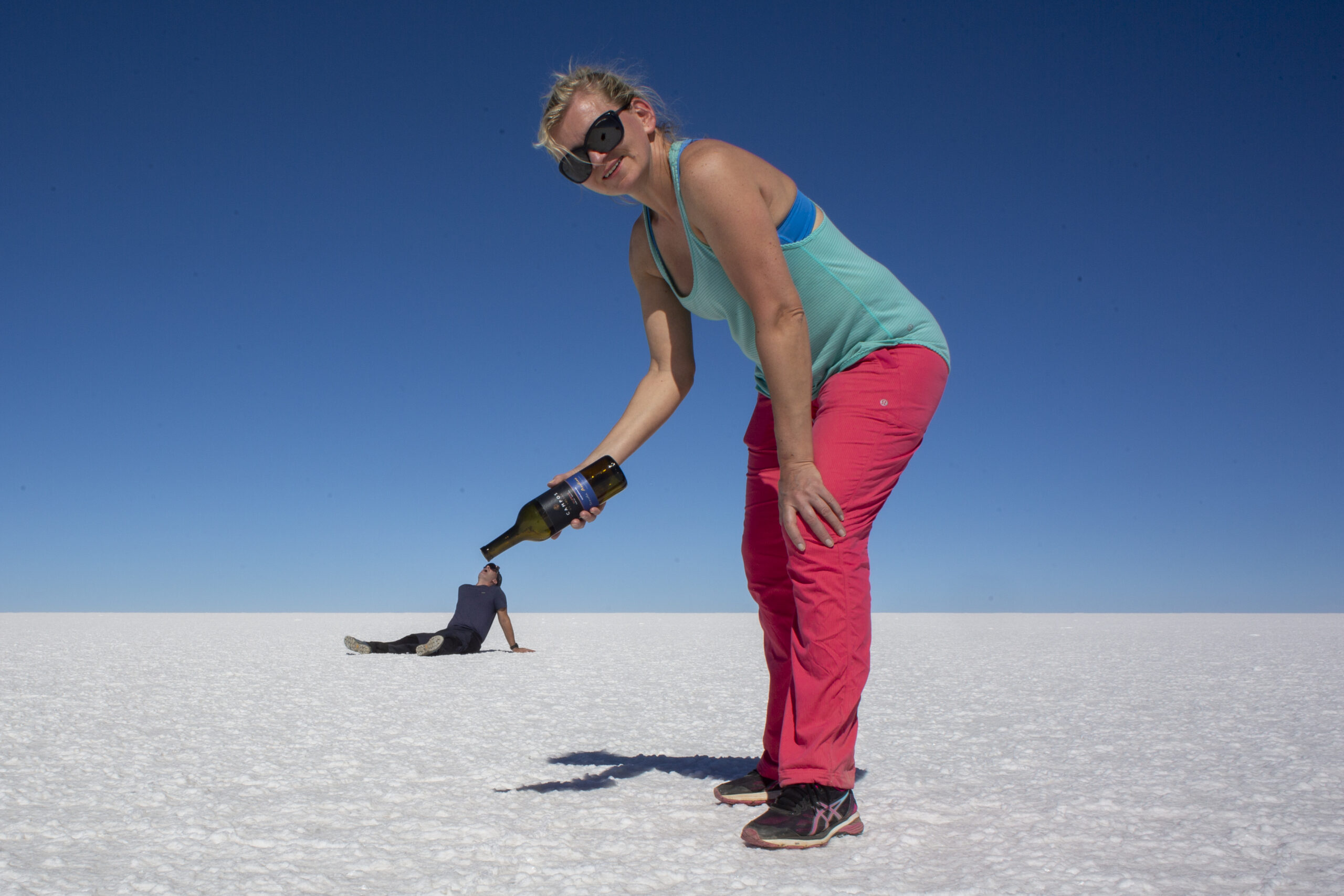
After a few kilometers our guide stopped in the middle of nowhere, set out a table and chairs, pulled out wine and beer, and served up a hot lunch. The fierce sun, absolute silence, and dead calm — a surreal experience you don’t get every day.
We only gave Ibo a short walk. The surface is pure salt, not ideal for his paws. If you’re heading here with a dog, we recommend packing protective booties — your pup will thank you, and they’ll let your dog enjoy the place without limits.
After an excellent lunch we took a few avant-garde photos. The endless white horizon begs for perspective play — and a glass of wine or beer does wonders for creativity. 😄
Isla Incahuasi – an island of thousand-year-old cacti
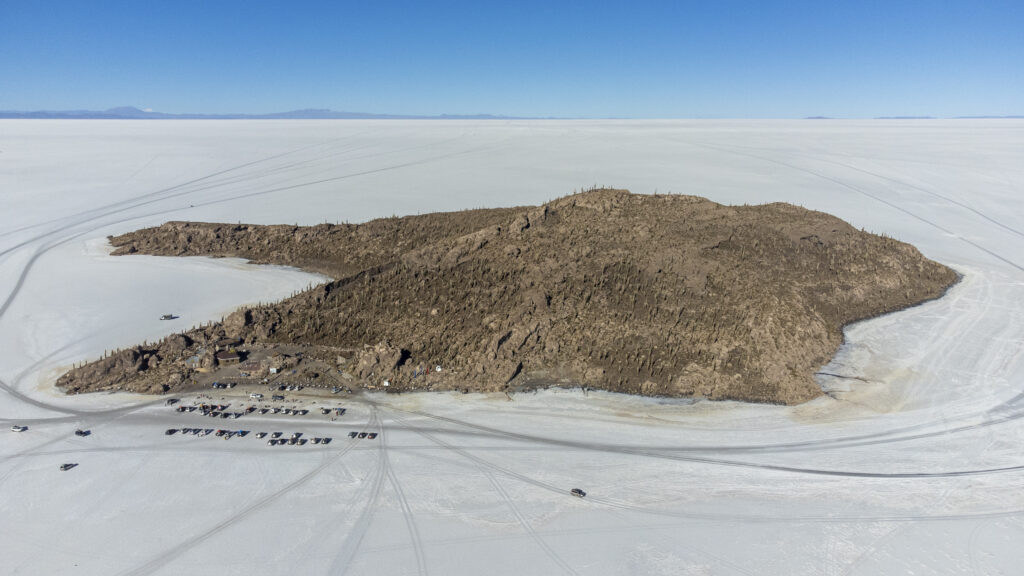
Our day was far from over. Our wheels — and especially our guide — took us to Isla Incahuasi, a coral island in the middle of the salt sea, studded with thousand-year-old cacti. It’s a complete contrast to where we’d come from. While the northern shore is quiet and almost undiscovered, Isla Incahuasi is probably the most visited spot on the entire flats (not counting the town of Uyuni).
Jeeps packed with tourists roll in from all sides, and in a moment we go from silence and emptiness to a lively place full of vehicles and people. The island has its own strong charm though — and it’s big enough that the bustle never feels overwhelming.
We hiked to the island’s highest point, also called Incahuasi, at 3,700 m a.s.l. It’s an easy route, about 20 minutes to the top. Even Ibo handled it with ease after spending most of the day snoozing in the car. Up top we met travelers from all over, and Ibo instantly became the star attraction — we hadn’t seen another dog all day. We ended up watching an Italian tourist photograph a Japanese tourist with our Slovak dog.
After a short rest and a cold beer at this stunning spot, we headed back to the car. Before returning to the “mainland,” we had one last short stop.
Cueva del Diablo – legends at the edge of the flats
We ended the day at a cave with the dramatic name Cueva del Diablo on Isla Phia Phia. From Isla Incahuasi it’s only a few minutes’ drive across the flats, yet suddenly everything is back to normal. No tourists, no cars — just us and a mysterious place at the end of the world.
According to legend the cave was a place of rituals and a hideout for spirits; today it’s a discreet yet striking photo spot with a gorgeous sunset view. A few last shots, back to the car, and within the next half hour or so we were at the hotel again — tucking into a llama steak as a tasty finale to the day.
Uyuni Salt Flats with a Dog? Why not?!
Salar de Uyuni showed us just how many contrasts one place can hold: the quiet of the north and the buzz of the tourist center, a private lunch in the middle of nowhere and, a few kilometers away, dozens of jeeps parked side by side. We confirmed that traveling in Bolivia with a dog is not only possible but also deeply rewarding. It does take a bit more planning and care, but that feeling when you’re standing together in the middle of the world’s largest salt flat is worth it all.
Good to know about the Salar de Uyuni
• Area: about 10,582 km² — larger than the entire Banská Bystrica Region
• Elevation of the flats: approx. 3,650 m a.s.l.
• Salt crust thickness: from 2 to 10 meters
• Annual visitors: around 300,000, mainly from Europe and Asia
• Best time to visit:
— dry season (June – October): geometric “salt tiles” and driving across the flats
— rainy season (December – April): the “mirror of the world” effect