
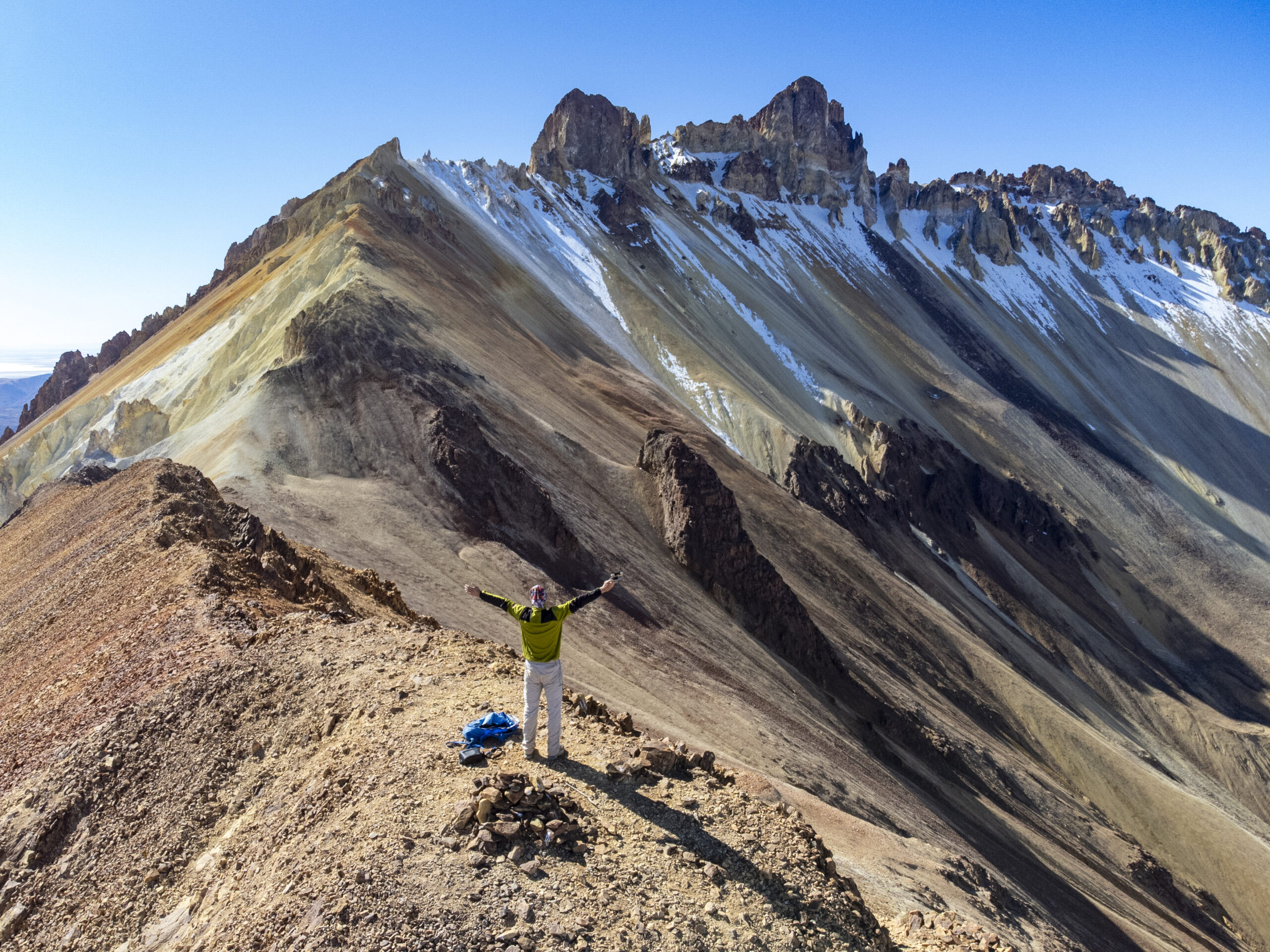


After a day on the endless Uyuni salt flats, we head out in the morning from our hotel near the village of Coqueza for another adventure. The plan: drive as close as we can to Tunupa Volcano, then continue on foot to the crater.
Turns out, nobody really does this here
Lesson learned from yesterday, we stop confidently at the information center right in Coqueza to find out what it would cost to drive toward the volcano. The older lady there doesn’t speak English and we don’t speak Spanish. She doesn’t understand what we want and tries to sell us a full package with a guide, food, and a lift to the foot of the volcano. Later we realize that what we were asking for simply isn’t on offer—people don’t usually head up Tunupa on their own.
So we drive on to the town of Tahua. The map shows a dirt track climbing up from there. We find it easily, but a locked gate stops us right at the start. There’s no way around it.
We head back to the village and, with the locals’ help, start looking for someone who can help. After a while we find him—he opens the gate and we can continue. We pay an entrance fee of about five euros.
Off-road by car to 4750 m n. m.
At first the road climbs only gradually, but the closer we get to the volcano, the rougher it gets. Thankfully, our Hilux is a true 4×4, so we press on. On some stretches we switch to low range; the car turns into a little tank and crawls over anything in its way. With every meter gained, the views over the Uyuni salt flats grow more impressive.
Despite my skepticism, we manage to drive up to about 4750 m n. m., roughly 150 vertical meters beyond the official end of the road. On the way we pass a campsite that’s, frankly, in pretty poor shape.
Hiking up to 5150 m n. m.
From the car, we continue on foot—straight into a steep climb on loose rock. A well-worn path rises gently to the ridge, but along the ridge it’s a different story. At this altitude the air is thin and we have to take frequent breaks. The views are indescribable; we’re snapping away like mad.
Just below the crater the terrain gets trickier and the route less obvious. We split—Braňo takes a break; the terrain isn’t really his thing. I can’t help myself and carry on toward the crater. I lose the path for a moment, but after a short search I’m back on track. A few tight switchbacks lead up to the rim of Tunupa’s crater.
Views worth the effort
The final meters feel endless, but I make it. I reach the crater—and set a new personal altitude record; I’ve never stood this high before. Every movement here takes effort; I’m out of breath after just a few steps.
Still, I pull out the drone to take it all in and capture the sweeping views. Behind me, the endless white of the Salar de Uyuni; in front, the vast crater of the sacred mountain Tunupa. The perfect reward.
A quick descent and a well-earned reward
Unlike the ascent, the way down is quick. We’re back at the car before dark, happy with how the day turned out, and we treat ourselves to a well-earned cold beer. We didn’t meet a single person on the trail, which made it feel even more special.
Feeling great, we drive the same track back to Tahua and then to the hotel.
Facts about Tunupa Volcano
- Elevation: approximately 5 321 m n. m.
- Location: the northern edge of the Salar de Uyuni salt flats
- Type: stratovolcano (long dormant)
- Sacred significance: in Aymara mythology, Tunupa is considered the region’s spiritual guardian
- Legends: one says the salt flats are Tunupa’s tears
- Tourist appeal: panoramic views of the Salar de Uyuni, high-altitude trekking, colorful rock layers inside the crater
- Starting points for the trek: most often Coqueza or Tahua