
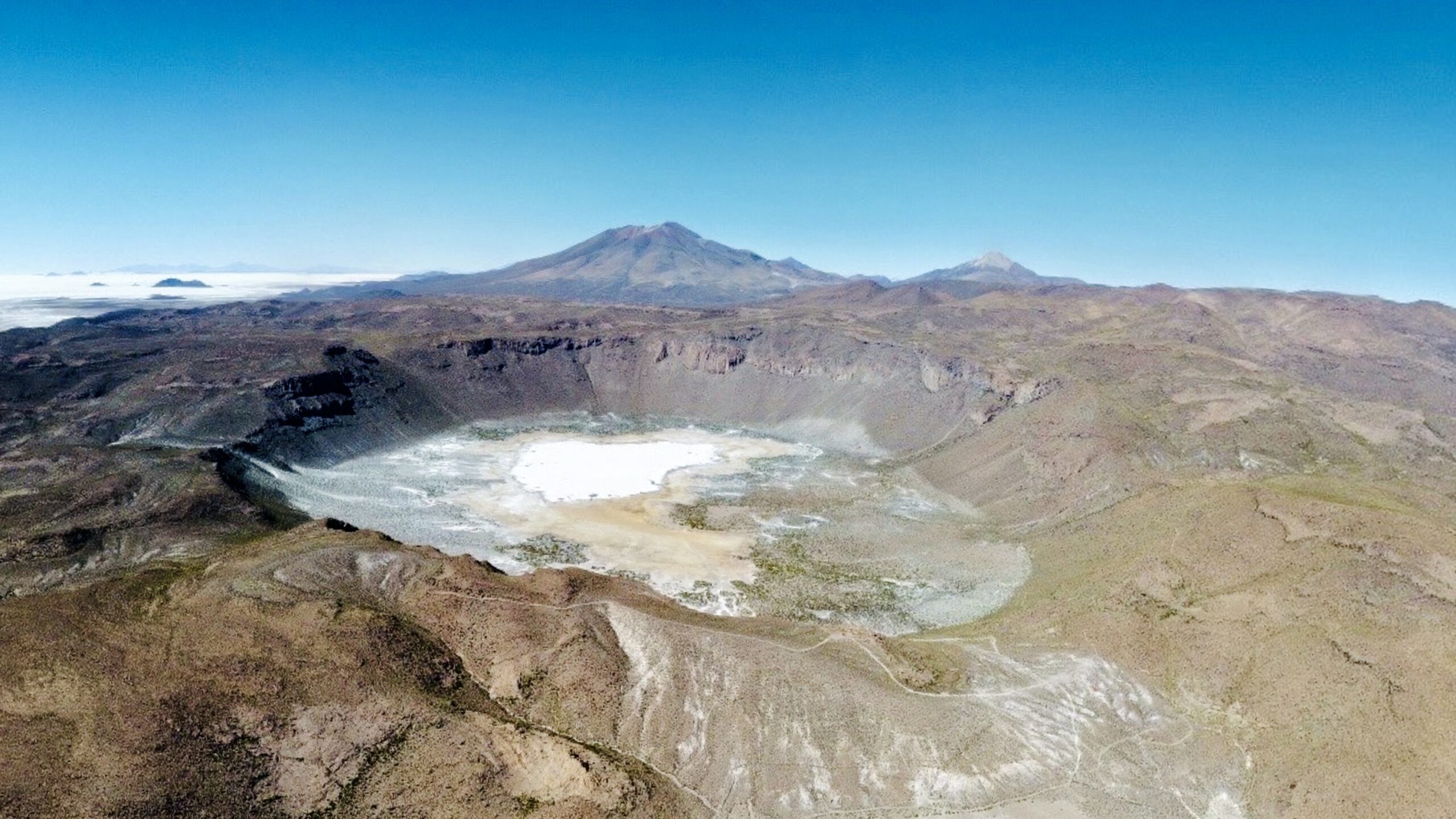


We spotted the Hoyada Ulo crater on the map before leaving our guesthouse in the village of Coquesa. We’d planned to work the visit into our travel day from Coquesa to Llica, but a tricky stretch of road threw our schedule off and we simply ran out of time.
Our next attempt came the very next day. We grab street food for breakfast right in Llica’s backstreets, stock up on supplies for the day, and set off in search of a little adventure.
On the map the crater looks truly monumental. That alone wouldn’t be unusual; the Altiplano is full of volcanoes and craters. But this one is different. It doesn’t sit atop any prominent volcano and it doesn’t follow that classic conical shape. Instead, it lies in the middle of relatively flat country—and that’s exactly what draws us in.
From above it appears almost perfectly circular. At first glance you might even think it isn’t volcanic at all, but the site of a meteorite impact.
The road to the crater
The road out of Llica is classic Altiplano—dusty, at times rocky, but passable. And of course there are the inevitable washboard sections that rattle the whole car no matter what speed you choose.
We don’t have any concrete expectations. It clearly isn’t a well-known attraction. We found very little about it online and hardly any photos. Which makes it all the more surprising when we suddenly come across a sign pointing to Hoyada Ulo.
We turn off the ‘main’ track and head for the crater. The road starts to climb, yet paradoxically it’s smoother than the one we were on. In a few minutes we’re on the rim. To our surprise there’s a small parking area and, a little farther off, an unfinished building—apparently the remnants of an attempt to make the site more visitor-friendly.
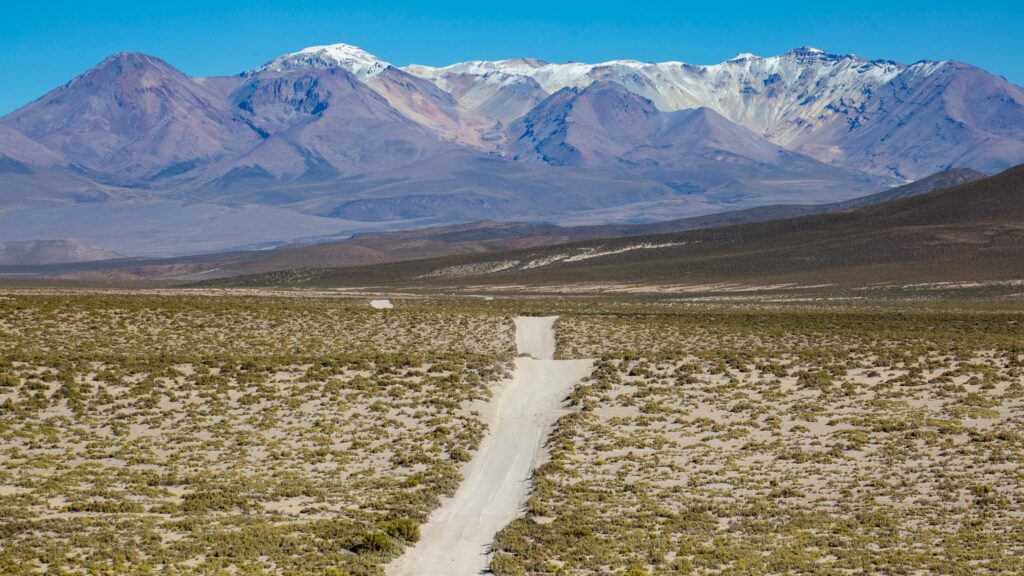
On the crater rim
We step out to have a look around. The crater itself is massive. Its scale catches us off guard, even though the map had hinted at something unusual. The rim rises gently above the surrounding plain, forming a broad circle. Walking the whole perimeter would likely be a full-day hike.
What’s striking is how undramatic the surrounding landscape looks. No obvious lava flows, no classic volcanic cones nearby. Hoyada Ulo simply sits in the middle of the plain, like something that doesn’t quite belong here.
The crater floor is essentially a little salt flat. The terrain is level; the margins carry a hint of vegetation, but the center is capped with a thin crust of salt. To grasp the crater’s full size you need a bird’s‑eye view, so Braňo and I send up our drones and shoot from every possible—and impossible—angle.
To make sure Ibo enjoys the stop too, we take a short walk to the unfinished building. There are rough paths laid out; the terrain is easy but dusty, which Ibo immediately puts to use with a good roll. This time we don’t even mind.
Interested in this destination? Would you like to visit it with your dog? Check the entry requirements directly in BorderCooler®.
The viewpoint above the crater
From the path we spot a track on the opposite slope leading from the parking area to a viewpoint a few meters higher. Braňo and I agree to drive up; Iva, unconvinced, opts to walk with Ibo. We split for a moment, heading for the same spot.
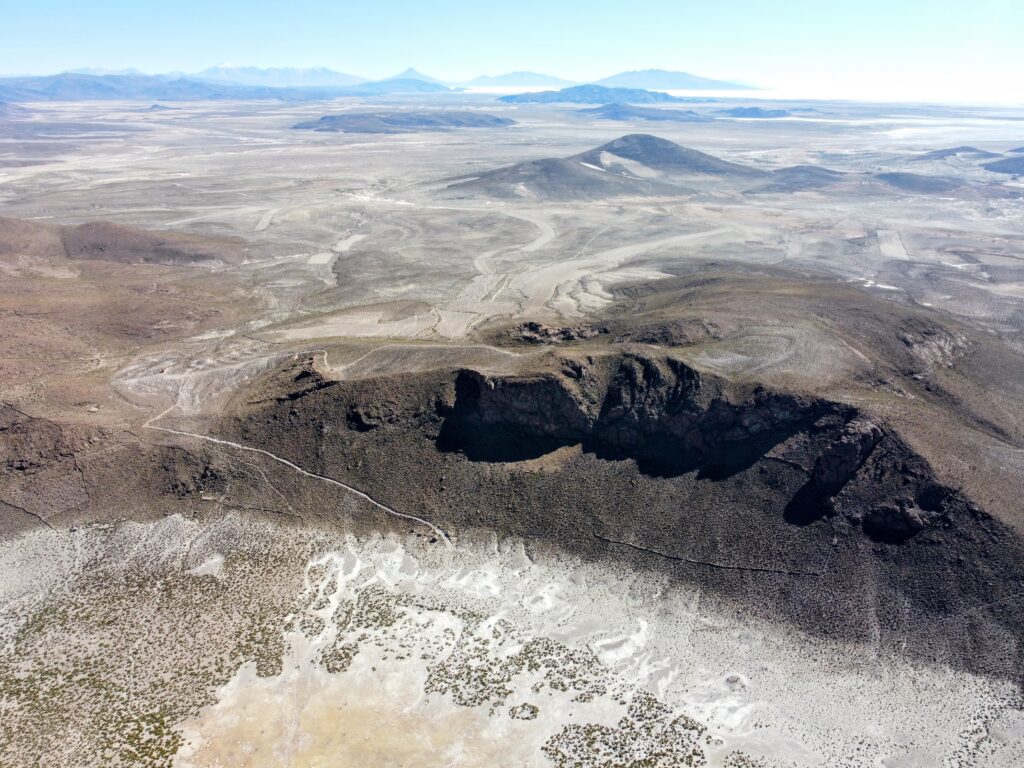
The drive up is more demanding—steeper and washed out in places. There are deep ruts, and wheel placement really matters. We’re on top in a few minutes, and Iva reaches us a little later.
The viewpoint offers a different take on the crater. We’re surprised to find a few stone benches and a table. From up here, there’s more to it than we expected.
When we feel we’ve taken it in, we all pile back into the truck and head for the parking area. We also give Iva a little demo of what the vehicle can do here: low range engaged, first gear, easing down the broken track. She’s a bit spooked at times, but eventually she sees the truck can handle it.
Shall we go to the bottom?
The moment we roll back into the parking area, Braňo comes up with a brilliant idea: ‘Let’s go down to the crater floor!’ Silence. I’m of two minds. There are plenty of other places around here worth a look, but getting down there might be a good experience too. It’s obvious the detour would make him happy, so we climb in again and I start along the track that drops toward the floor. We’d seen it from the drone, and it’s marked on the map.
I also realize we’re breaking a rule I learned skiing steep terrain: never go down what you haven’t first gone up.
My worries materialize fast. After the first bend the track turns into a tank proving ground—huge boulders, deep ruts, abrupt ledges. Going down, the truck just about copes, but how are we going to claw our way back up?
After roughly 100 meters I stop and ask Braňo to scout the route on foot. A few minutes later he’s back with bad news: it gets worse with every meter. He agrees the smartest move is to turn around and retreat.
Except our Hilux isn’t a VW Polo. On a steep, narrow, chewed‑up track there’s no way to turn a long rig. That leaves one option only—to reverse the entire gnarly section.

That proves almost impossible. From the cab my view backward is limited; leaning out the window I can only see the truck’s left side. I’m reversing without a clear sense of what I’m backing into. Stress spikes for all of us, which Ibo immediately senses and joins the action—as if he knows something important is going on. And he’s right.
If we can’t get the truck back up, then what? There’s no one around; the nearest town, Llica, is tens of kilometers away. Walking all that with a dog is unthinkable. Starlink gives us a sliver of comfort—we at least have a way to call for help. The question is from where and how fast it would arrive. We don’t want to find out. We have to get the truck back to the parking area at all costs.
We solve it as a team: Iva and Braňo stand outside the truck and guide me through the open front windows. I blend their directions with what I can see, half hanging out of the cab. Step by step—literally rock by rock—we inch our way back. It takes forever, but in the end it works.
The euphoria we feel as we finally nose back into the parking area is huge. A small bout of curiosity could easily have turned into a big problem. This time we had luck—and solid teamwork—on our side.
Final thoughts
Hoyada Ulo surprised us with its scale and with how out of place it feels in the middle of a flat plain. It also reminded us that in Bolivia you shouldn’t rely only on a map or drone footage.
The takeaway from the ill‑fated descent attempt is simple: going down is always easier than coming back up. And if you haven’t first tackled a section in the opposite direction, you’re probably risking more than you realize.
The crater floor remained untouched this time—and maybe that’s for the best. Not every place needs to be conquered at all costs. Sometimes it’s enough to know where to draw the line, and to turn back in time. If you end up here and feel tempted to visit the bottom, do it on foot.
Facts about Hoyada Ulo
- Official name: Cráter de Ulo (Hoyada Ulo)
- Location: Potosí Department, Daniel Campos Province, Bolivia
- Distance from Llica: approximately 9 km west
- Elevation of crater rim: approximately 4,000–4,020 m a.s.l.
- Crater diameter: approximately 2.5–2.6 km
- Floor character: salt pan (small salar) covering roughly 0.4 km²
- Type of landform: likely an erosional or volcanic depression (not a confirmed meteorite impact crater)