
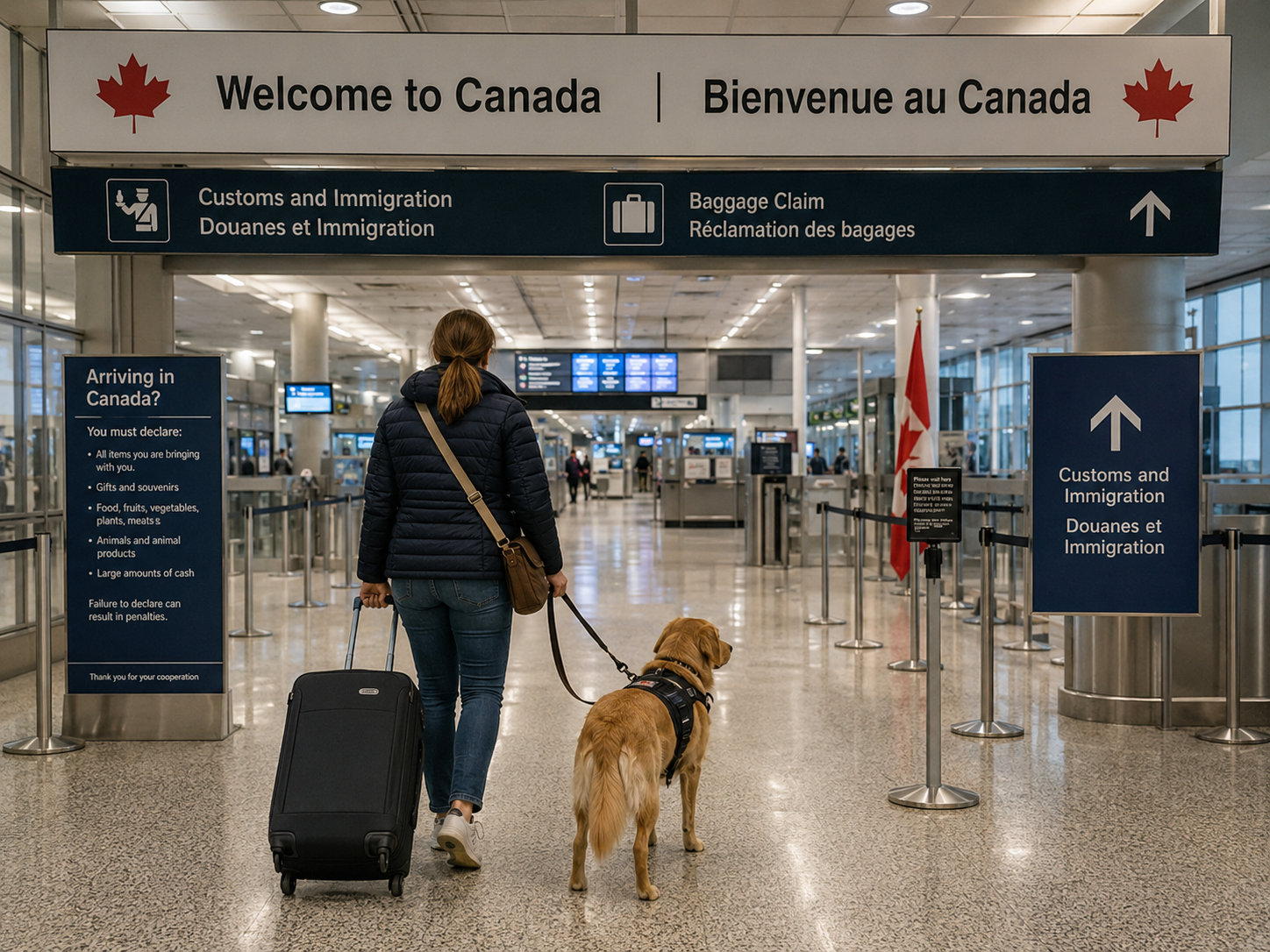


Canada is vast, safe, and very appealing to travelers. You’ll find Vancouver, Toronto, Montreal, the Rockies, national parks, lakes, the Atlantic coast, and long journeys across the country. Traveling to Canada with a dog is absolutely possible, but always check the rules based on the dog’s age, the purpose of travel, and the country your dog is arriving from.
When taking a dog to Canada, you’re dealing with two things: entry to Canada and the trip back home. Entry rules are set by the Canadian Food Inspection Agency (CFIA). Your return is governed by the rules of the country you’re going back to after Canada.
This article covers a typical non‑commercial trip with a dog traveling with its owner. If a dog is traveling for sale, adoption, a change of ownership, breeding, a dog show, or research, the rules are stricter and you must confirm them directly with the CFIA—this article alone is not sufficient for those cases.
Quick overview
For entry to Canada with a dog, the key factors are:
- the dog’s age,
- whether the dog is traveling with its owner,
- the country the dog is arriving from,
- whether it’s a standard non‑commercial trip or for a commercial/import purpose,
- a valid rabies vaccination or proof the dog comes from a country recognized as rabies‑free.
For an adult dog traveling with its owner, the most important document is usually a valid rabies vaccination certificate. For puppies, dogs younger than 8 months, commercial movements, or travel from higher‑risk rabies countries, additional rules may apply.
If the dog is returning home after a stay in Canada, the rules of the destination country apply. Returning from Canada to the EU does not require a rabies antibody titer test, because Canada is treated as lower risk for rabies.
Entry requirements and documents
For a typical non‑commercial trip with a dog to Canada, have proof of rabies vaccination ready. For personal travel, Canada doesn’t divide rules simply by continent; they hinge mainly on the dog’s age, purpose of travel, and the rabies status of the country the dog is coming from.
A rabies vaccination certificate must clearly identify the dog and be issued by a licensed veterinarian. It should include:
- identification of the dog,
- owner’s details,
- date of rabies vaccination,
- vaccine name,
- the validity period of the vaccination,
- the veterinarian’s signature and details.
The validity period must be explicitly stated in the document. If it isn’t, Canadian authorities will automatically treat the vaccination as valid for only 1 year from the date it was given.
The certificate should be in English or French. If it’s issued in another language, check in advance which form of translation Canadian authorities will accept.
Canada does not require a rabies antibody titer test for a standard entry. Nor is Canada one of those countries that require the familiar 24–120‑hour echinococcus treatment that some European countries mandate.
Carry all documents with you in original paper form—not just digital copies. Canadian border control may ask to see originals.
Interested in this destination? Would you like to visit it with your dog? Check the entry requirements directly in BorderCooler®.
Rabies vaccination
Dogs aged 3 months and older must have a valid rabies vaccination to enter Canada or meet the rules for a country that Canada recognizes as rabies‑free.
For travel from most countries, the most practical approach is to have a valid rabies vaccination certificate. The vaccination must still be valid on the day you enter Canada. If it expires during your stay, it can complicate your return home or onward travel to another country.
Canada also recognizes a special regime for countries the CFIA considers rabies‑free. At the time of writing, these include Australia, Fiji, Finland, Iceland, Ireland, Japan, New Zealand, Sweden, and the United Kingdom. For dogs from these countries, the CFIA accepts a Rabies Country‑Freedom Certificate in place of a vaccination certificate—this document confirms the dog comes from a rabies‑free country and meets the residency conditions. The rabies‑free list can change, so always verify it directly with the CFIA before you travel. In practice, however, most travelers find it simpler to travel with a valid rabies vaccination, which Canada always accepts.
Traveling to Canada with a dog from the USA
Crossing from the USA into Canada with a dog is among the simplest scenarios. For a personal pet over 8 months old, a valid rabies vaccination certificate is typically the main requirement. A health certificate is not required in this standard case.
That doesn’t mean there are no rules to follow. The rabies certificate must be legible, valid, and must clearly identify the dog. For air travel, commercial movements, puppies, or dogs younger than 8 months, the rules may differ.
If you’re traveling from the United States to Canada and plan to return to the USA, separately check the CDC’s current rules for dogs entering the United States. They apply regardless of whether you return by car, plane, or another mode of transport, and they’re independent of Canadian rules.
Traveling to Canada with a dog from the EU
For a trip from the EU to Canada, the foundation is a valid rabies vaccination and a document proving it. The EU Pet Passport is a useful travel document for a dog, but Canada isn’t an EU member state, so don’t assume the passport will automatically be treated the same way it is within the EU.
For travel from the EU, prepare in particular:
- an EU Pet Passport with an entry confirming a valid rabies vaccination,
- or a separate rabies vaccination certificate in English or French,
- your carrier’s rules, especially for air travel,
- the rules for returning to the EU or the country your dog will go back to after Canada.
Canada does not require a titer test for a standard personal trip. Returning from Canada to the EU also doesn’t require a titer test, provided the dog has valid identification, a current rabies vaccination, and travels under EU rules.
Dogs under 8 months of age
Take extra care with dogs younger than 8 months. Canada has specific rules for young dogs based on age, whether the owner is accompanying the dog, the purpose of travel, and the country of origin.
Puppies younger than 3 months generally aren’t vaccinated against rabies, so their age and origin are assessed instead. Dogs aged 3 to 8 months may need a valid rabies vaccination and, in some cases, additional documents.
If you’re traveling with a puppy or young dog, don’t rely on the general rules for adult dogs as your only source. Before you go, check your exact combination—dog’s age, country of departure, owner accompaniment, and purpose of travel—via CFIA tools or with the relevant veterinary authority.
Checks on arrival in Canada
On arrival in Canada, your dog’s documents may be checked by border or veterinary authorities. For a typical trip with a dog, keep the documents handy so they’re available at entry.
Checks may focus on:
- the rabies vaccination certificate,
- the dog’s identification,
- the dog’s age,
- the purpose of travel,
- documents required for puppies or special movements.
Carriers may have their own rules beyond government requirements. For air travel, check the conditions for transporting a dog in the cabin, in the hold, or as cargo before you buy your ticket.
Returning home from Canada
When a dog returns from Canada, Canada’s rules no longer apply—it’s the destination country’s rules that do. Before you travel, confirm which documents your dog will need to return home.
Your destination country may require, for example:
- a valid rabies vaccination,
- microchip identification,
- a veterinary health certificate,
- import documentation,
- entry via a designated checkpoint,
- a rabies antibody titer test, if required by the destination country.
If you’re continuing from Canada to another country, follow the rules of that next destination. Canada’s entry rules don’t determine what your dog will need for entry elsewhere.
Returning with a dog from Canada to the EU
If a dog is returning from Canada to the EU, that’s an entry into the Union from a non‑EU country. Canada is on the EU’s list of countries for which a rabies antibody titer test is not required.
For a return from Canada to the EU, a dog will mainly need:
- a microchip,
- a valid rabies vaccination,
- an EU Pet Passport or the relevant veterinary health certificate for entry to the EU,
- a declaration of non‑commercial travel if using a veterinary health certificate,
- entry via an approved point of entry for travelers with pets.
If a dog normally lives in the EU, travels to Canada, and returns with an EU Pet Passport, check the microchip and the validity of the rabies vaccination before leaving the EU. You don’t need a titer test when returning from Canada to the EU.
If the dog doesn’t have a usable EU Pet Passport, entry to the EU from Canada requires the veterinary health certificate for dogs, cats, and ferrets arriving from a non‑EU country. It must be issued before entry to the EU and accompanied by a declaration of non‑commercial travel.
Returning with a dog from Canada to the USA
If you’re traveling with a dog between Canada and the USA, pay special attention to your return to the United States. The CDC sets the rules for dogs entering the USA, and as of 2024 they are stricter than in the past.
For a return from Canada to the USA, the rules depend mainly on where the dog has been in the last 6 months. If the dog has only been in low‑risk or rabies‑free countries, the process is simpler. If the dog has spent time in a high‑risk rabies country within the last 6 months, re‑entering the USA via Canada can become significantly more complicated. In that case, the dog isn’t eligible to enter the USA directly from Canada—it must either remain in Canada for 6 months or enter the USA directly from the original high‑risk country.
Before you travel, check the CDC’s current rules, especially requirements for the dog’s age, microchip, online form, vaccination, and any additional documents.
Practical rules for staying in Canada with a dog
Canada is generally a friendly place to travel with a dog, but rules vary by province, city, park, carrier, and accommodation.
In big cities you’ll find plenty of parks, veterinarians, pet stores, and accommodation that welcomes dogs. That said, entry with a dog isn’t always allowed inside restaurants, shops, or public buildings. Patios, parks, and outdoor activities are usually easier than indoor venues.
Always confirm accommodation directly. A simple pet‑friendly filter in a booking system isn’t enough. Check size limits, fees, whether you may leave the dog alone in the room, and the rules for shared areas.
When visiting national and provincial parks, check the specific park rules. Dogs often must be on a leash, and some trails, beaches, or protected areas may have restrictions. In nature, be mindful of wildlife—bears, moose, coyotes, porcupines, and other animals your dog should not encounter.
Canada involves long distances and big regional differences. On long drives, plan for breaks, water, temperatures, and safe overnight stops. In winter the challenges can be freezing temperatures, road salt, and snow; in summer, heat, ticks, mosquitoes, and long hours in the car.
When to start planning
For a trip to Canada with a dog, start by checking your exact situation in CFIA tools: the dog’s age, country of departure, purpose of travel, and whether the dog is traveling with its owner.
Practically speaking, prepare above all:
- a valid rabies vaccination or documentation under the rabies‑free country regime,
- a vaccination certificate in English or French stating the validity period,
- your carrier’s rules,
- the rules for returning home,
- for young dogs or special movements, any additional CFIA‑required documents.
If you’re traveling from the EU to Canada and back, check before leaving the EU that the microchip is readable, the EU Pet Passport is in order, and the rabies vaccination will remain valid for the entire trip. You don’t need a titer test when returning from Canada to the EU.
Canada lets you verify entry conditions for your exact combination—dog’s age, country of departure, and purpose of travel—on the CFIA website via the AIRS (Automated Import Reference System) tool. It’s the official system that shows the precise requirements for your case.
Summary
For a standard non‑commercial trip with an adult dog, traveling to Canada is fairly straightforward. The key document is a valid rabies vaccination certificate, or proof under the rabies‑free country regime recognized by Canada.
For puppies, dogs younger than 8 months, commercial movements, adoption, or a change of ownership, the rules differ and you need to verify them separately with the CFIA.
For the return trip, the destination country’s rules apply. If a dog is returning from Canada to the EU, a titer test isn’t required, because Canada is treated as lower risk for rabies.