
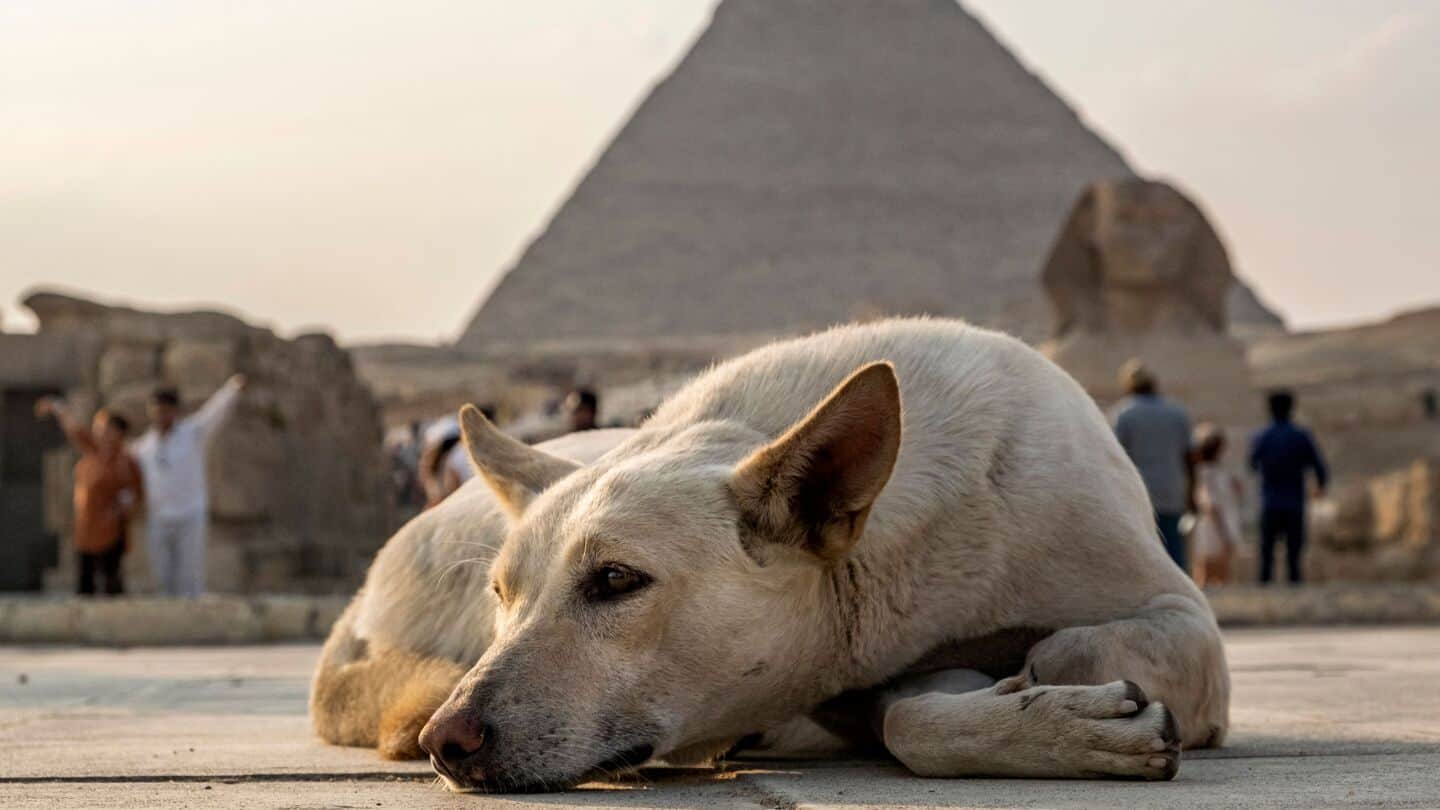


Egypt draws travelers with its pyramids, Cairo, Luxor, the Red Sea, desert landscapes, and an atmosphere unlike Europe. Traveling to Egypt with a dog is possible, but when planning, think not just about entry into the country but also about the return home.
When traveling with a dog to Egypt, there are two things to sort out: entering Egypt and returning home. Entry rules are handled by the Egyptian veterinary authorities and the entry points. The return is governed by the rules of the country your dog is going back to after Egypt.
This article covers standard, non‑commercial travel with a dog accompanying its owner or an authorized person. If the dog is traveling as cargo, for sale, for a change of ownership, or traveling unaccompanied (not in the same means of transport), different rules may apply.
Table of Contents
Quick overview
To enter Egypt with a dog, you will mainly need:
- a valid rabies vaccination administered at least 30 days before entry,
- a veterinary health certificate issued and endorsed according to the rules of the country of departure,
- compliance with your carrier’s rules for air or other transport.
Egypt does not require a rabies antibody titer test on entry. For the journey home, requirements depend on the country you’re returning to—and for return to the EU or the United Kingdom (UK) a titer test is mandatory.
General entry requirements for dogs entering Egypt
Egypt requires a valid rabies vaccination and a veterinary health certificate endorsed according to the rules of the country of departure.
The certificate must be issued and endorsed by the competent veterinary authority of the country of departure—confirmation from a private veterinarian alone is not sufficient. Egyptian sources state that the certificate is valid for 14 days from the date of issue.
Rabies vaccination must be administered at least 30 days before entry and be no more than 12 months old. For a first vaccination, plan at least a 30‑day lead time before you travel.
A microchip is not listed as a mandatory entry condition in the available Egyptian sources. From a practical standpoint, however, it is strongly recommended—it links your dog to its documentation. It will also be essential for transit through the EU or for returning to most countries.
If you are flying or using a ferry or another carrier, check their conditions in advance. State veterinary rules and airline or shipping company rules are different things—you must meet both.
Interested in this destination? Would you like to visit it with your dog? Check the entry requirements directly in BorderCooler®.
Entering Egypt with a dog from the EU
From the EU, your dog needs a valid rabies vaccination and a veterinary health certificate endorsed by the national veterinary authority of the country of departure. The EU Pet Passport is useful as supporting proof of identification and vaccination, but on its own it is not sufficient for entry to Egypt.
When traveling from the EU, prepare:
- a valid rabies vaccination,
- a veterinary health certificate endorsed by the national veterinary authority,
- the EU Pet Passport as a supporting document.
If your dog will return to the EU after staying in Egypt, it’s best to arrange the rabies antibody titer test before leaving the EU—more in the return section.
Entering Egypt with a dog from the United Kingdom and the USA
United Kingdom
The United Kingdom has its own certificate for exporting dogs to Egypt—form 3900EHC, signed by an Official Veterinarian (OV) appointed by the relevant UK authority. This certificate replaces the standard veterinary health certificate.
When traveling from the United Kingdom, prepare:
- a valid rabies vaccination,
- the 3900EHC certificate signed by an Official Veterinarian,
- your carrier’s rules.
Return conditions to the United Kingdom are in the section on returning home below.
USA
The Egyptian Embassy in the USA states that the certificate must be endorsed by the USDA, then legalized by the U.S. Department of State, and finally authenticated by the Egyptian Embassy in the USA. This is a multi‑step process that should be started well in advance.
When traveling from the USA, prepare:
- a valid rabies vaccination,
- a veterinary health certificate endorsed by the USDA and the U.S. Department of State,
- authentication of the document at the Egyptian Embassy in the USA.
Return conditions to the USA are in the section on returning home below.
Arrival in Egypt and document checks
Air travel
Most travelers arrive in Egypt by air. On arrival, your dog’s documents are presented at the point of entry at the international airport. Have your veterinary health certificate, proof of rabies vaccination, your dog’s identification documents, and any paperwork required by your carrier ready.
State veterinary rules and airline rules are different things—a carrier may have its own conditions for crate dimensions, maximum weight, or breed restrictions. Check your carrier’s rules before buying tickets. For layovers, consider whether the transit country has its own veterinary requirements.
Ferries
There is currently no way to reach Egypt from Europe by passenger ferry—there are no regular services between European ports and Egypt.
Ferry links do exist on the Red Sea. One active route is Aqaba (Jordan) – Nuweiba (Egypt), operated by Arab Bridge Maritime. This can be relevant for combined journeys via Jordan or when arriving from the Middle East. Check the current status, carrier conditions, and the veterinary rules of your country of departure before you travel.
General rules for returning home from Egypt
When returning a dog from Egypt, what matters is the country you are returning to, not Egypt. Check in advance which documents your dog will need to come home.
Egypt is a country with rabies present, so many countries require a rabies antibody titer test on return. A titer test is not required to enter Egypt—however, it is mandatory when returning to the EU and the United Kingdom. For the USA, specific CDC rules apply.
Returning from Egypt to the EU with a dog
Egypt is not on the EU list of countries exempt from the rabies antibody titer test. To return from Egypt to the EU, a dog needs:
- a microchip,
- a valid rabies vaccination,
- a rabies antibody titer test—a blood test that verifies antibody levels after vaccination—performed in an EU‑approved laboratory,
- an EU Pet Passport or the relevant veterinary health certificate for entry to the EU,
- entry via an approved point of entry for travelers with pet animals.
Blood must be drawn no sooner than 30 days after rabies vaccination, and the result must reach at least 0.5 IU/ml. The three‑month waiting period after the blood draw does not apply to the return of an animal that normally lives in the EU, if its passport confirms a favorable test result performed before it left the EU.
If a dog is traveling from the EU to Egypt and will return to the EU, the most practical approach is to do the titer test before leaving the EU and have the result recorded in the EU Pet Passport. If the vaccination then remains valid, returning to the EU is much simpler.
If the titer test is missing and the dog is already in Egypt, returning to the EU can become complicated—the test must follow a valid vaccination, and the dog cannot enter the EU until three months after the blood draw.
Returning from Egypt to the United Kingdom and the USA with a dog
United Kingdom
Egypt is not on the list of countries for which the United Kingdom waives the rabies antibody titer test. Blood must be drawn no sooner than 30 days after vaccination, and the result must reach at least 0.5 IU/ml. The most practical option is to arrange the titer test before leaving the UK and have the result documented in the relevant veterinary paperwork.
USA
According to the CDC, Egypt is a high‑risk country for canine rabies. Stricter conditions therefore apply on return. A U.S. dog needs the Certification of U.S.-issued Rabies Vaccination form (if vaccinated in the USA before departure) or the Certification of Foreign Rabies Vaccination and Microchip form. Always check the CDC website before you travel, as CDC rules can change.
Leishmaniasis and other health risks
Egypt is among the countries where leishmaniasis in dogs is common. Cases have been recorded across the country, including Cairo and its surroundings—the cutaneous form occurs mainly in the Nile Delta, the Suez Canal zone, and Sinai. It is transmitted through the bites of sand flies (phlebotomines), which are active from dusk to dawn.
Before you go, consult your veterinarian about prevention—repellent products and a vaccine against leishmaniasis are available. Protection against sand flies is more important in Egypt than in most other destinations.
Beyond leishmaniasis, discuss protection against ticks, fleas, mosquitoes, and other parasites common in Egypt.
Practical rules for staying in Egypt with a dog
Egypt can be very particular when you’re traveling with a dog. Conditions vary widely by city, type of accommodation, and setting.
Always confirm accommodation directly—don’t rely solely on a ‘pet‑friendly’ filter in a booking system. Check your dog’s size, any fees, and rules for common areas.
In Egypt, consider the heat, dry climate, and long transfers. Plan walks for early morning or evening, watch for hot surfaces, and carry plenty of water. In some areas you may encounter stray dogs—keep your own dog under control.
When to start preparing
Start at least a few weeks before departure—and even earlier for the U.S. certificate (a multi‑step process through the USDA and the Department of State).
Basic steps:
- valid rabies vaccination (at least 30 days before entry),
- a veterinary health certificate according to the country of departure,
- carrier’s rules,
- return rules for your home country.
If the dog will return to the EU or the United Kingdom, arrange the titer test before you leave.
Summary
Traveling to Egypt with a dog requires a valid rabies vaccination and a veterinary health certificate endorsed according to the rules of the country of departure. Egypt does not require a titer test on entry.
For the return home, conditions depend on your destination country. Returning to the EU or the United Kingdom requires a titer test—the most practical option is to arrange it before you leave.
Frequently asked questions about traveling to Egypt with a dog
Does a dog need a titer test to enter Egypt?
No. Egypt does not require a rabies antibody test for entry from any country. It may, however, be mandatory for your return home.
Is an EU Pet Passport enough for travel from the EU to Egypt?
No. An EU Pet Passport is a useful supporting document, but you also need a veterinary health certificate endorsed by the national veterinary authority.
Does a dog need a rabies antibody test to return from Egypt to the EU?
Yes. Egypt is not on the EU list of countries exempt from the titer test. The most practical approach is to do the test before leaving the EU.
Is a microchip mandatory for entry into Egypt?
Egypt does not list it as a mandatory entry requirement. It is recommended, and will be essential for returning to most countries—including the EU and the USA.
What certificate does a dog from the USA need to enter Egypt?
The certificate must be endorsed by the USDA, legalized by the U.S. Department of State, and authenticated by the Egyptian Embassy in the USA. It’s a multi‑step process—start well in advance.