
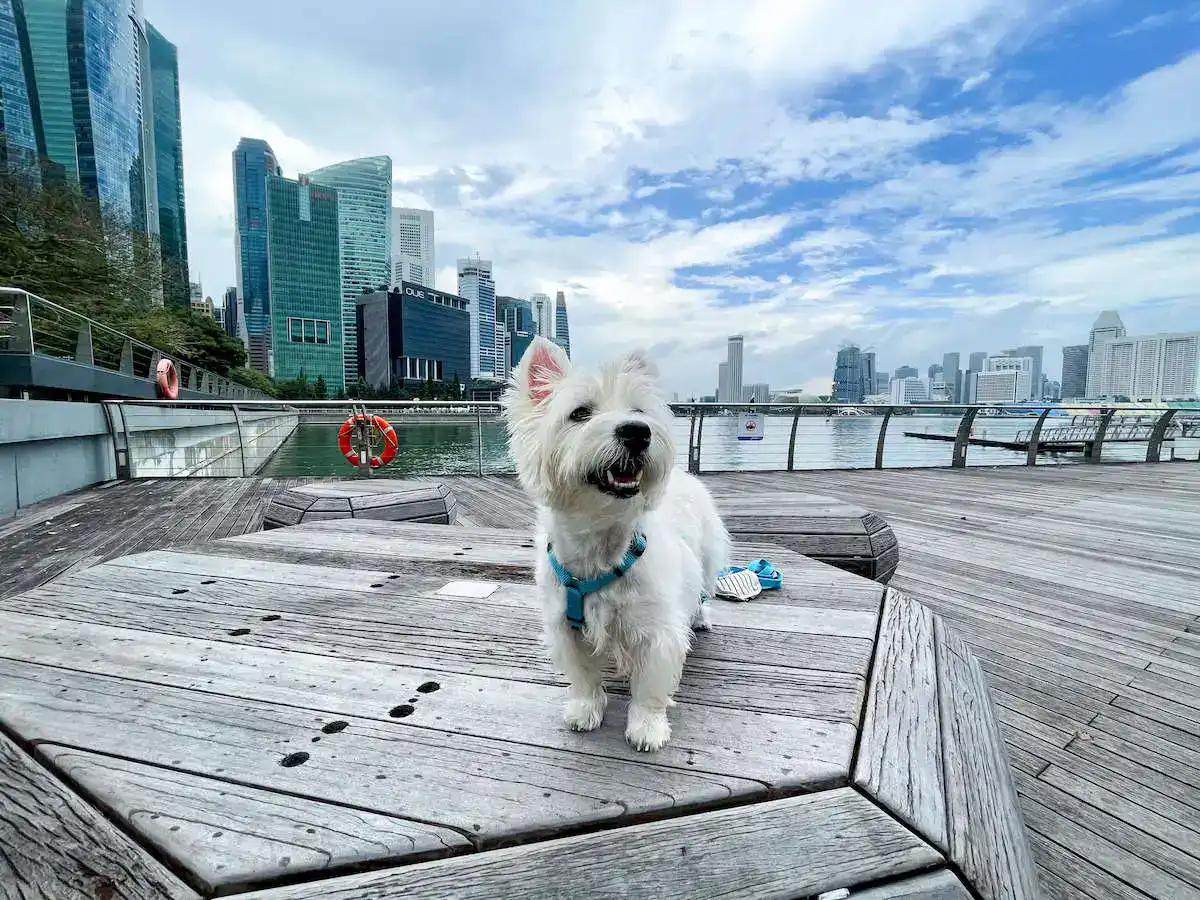


Singapore has very strict and detailed rules for importing animals. Travelling with a dog to Singapore is possible, but you need to plan well in advance. What matters is not only the country the dog is coming from, but also its age, breed, your housing situation in Singapore, veterinary requirements, the import licence and, for some countries, quarantine after arrival.
When travelling with a dog to Singapore there are two things to plan for: entry into Singapore and the return home. Entry rules are set by the Animal & Veterinary Service (AVS). The return is governed by the rules of the country your dog will enter after its stay in Singapore.
This article covers a standard non‑commercial trip with a dog travelling with its owner or an authorised person. If the dog travels as cargo for sale, a change of ownership or another commercial purpose, stricter rules may apply.
Table of Contents
Quick overview: what your dog needs for a trip to Singapore
For bringing a dog into Singapore, the key factors are:
- which country or region the dog is coming from,
- which rabies‑risk category Singapore assigns to that country,
- whether the dog’s breed is permitted,
- whether the dog is old enough to be exported,
- whether it meets the veterinary conditions for the relevant category,
- whether post‑arrival quarantine is required,
- whether you have arranged the local dog licence and then the import licence.
In general, you’ll need:
- an ISO‑standard microchip,
- veterinary conditions corresponding to the departure country category,
- rabies vaccination and a serological test, if required for the given category,
- core dog vaccinations,
- a quarantine reservation if needed,
- a dog licence in the PALS system,
- an AVS import licence,
- an AVS‑recognised pet agent to handle entry on arrival.
A dog must be at least 12 weeks old to be exported to Singapore.
Country categories for bringing a dog into Singapore
Singapore groups countries and regions by rabies risk into three categories. The entire process depends on this category.
In short:
- Schedule I – countries with the simplest regime, such as Australia, New Zealand, Ireland and the United Kingdom,
- Schedule II – countries with lower rabies risk and a milder regime, such as most EU countries, Canada, the USA, Japan, Hong Kong, Norway and Switzerland,
- Schedule III – all other countries and regions not listed under Schedule I or Schedule II.
These lists can change. Always check the current status of your specific country on the AVS website before you travel.
Interested in this destination? Would you like to visit it with your dog? Check the entry requirements directly in BorderCooler®.
Entering Singapore with a dog from Schedule I countries
The easiest regime applies to dogs from Schedule I countries, notably Australia, New Zealand, Ireland and the United Kingdom.
For these countries, Singapore does not require rabies vaccination or a serological test. If all other veterinary conditions are met, your dog does not need to go into quarantine after arrival.
That does not mean a ticket and a passport are enough. Your dog must be microchipped, of a permitted breed, you must be able to license it in Singapore, and an AVS‑recognised pet agent must handle the entry procedures on arrival.
Entering Singapore with a dog from Schedule II countries
Most EU countries, Canada, the USA, Japan, Hong Kong and Switzerland fall under Schedule II. The regime is stricter than Schedule I, but far simpler than Schedule III.
For dogs from Schedule II countries, you’ll generally need:
- a microchip,
- valid rabies vaccination,
- a serological rabies antibody test,
- valid core vaccinations,
- an import licence,
- potential home quarantine in specific situations.
AVS states that for Schedule II countries, post‑arrival quarantine is generally not required, but may be imposed for at least 10 days as home quarantine if:
- the dog arrives in Singapore more than 5 days after the owner,
- or it has been in the direct care of the owner or close family for less than 6 months.
If you plan to move from the EU to Singapore, don’t focus only on veterinary paperwork. What also matters is how long the dog has been in your care and whether it travels with you within a reasonable time window.
Entering Singapore with a dog from Schedule III countries
If the dog is coming from a Schedule III country, this is the strictest regime.
For these countries, expect:
- a microchip,
- rabies vaccination,
- a serological rabies antibody test,
- core vaccinations,
- an import licence,
- a confirmed quarantine reservation,
- at least 30 days of quarantine after arrival in Singapore.
AVS also notes that dogs and cats arriving from Schedule III countries will be vaccinated against rabies upon arrival in Singapore.
Microchip and identification
The dog must be identified with a microchip compliant with ISO 11784 or ISO 11785 Annex A. The microchip number must appear in all vaccination and treatment records.
If the numbers do not match, or the chip is unreadable, the entire import can derail. Under Singapore’s regime, the microchip is the fundamental link between the dog and all veterinary documents.
Rabies vaccination and serological test
For Schedule II and Schedule III countries, the dog must have a valid rabies vaccination accepted by AVS.
Key rules verified directly from the AVS certificate (DOGCAT 83-2):
- the blood draw for the serological test is performed at least 28 days after a valid rabies vaccination,
- the blood draw must be taken at least 90 days and no more than 12 months before the date of export to Singapore,
- the result must show an antibody level of at least 0.5 IU/ml,
- the sample must be tested at a WOAH rabies reference laboratory or at a laboratory in a Schedule I or Schedule II country approved by the relevant authority.
Allow plenty of time when you plan the trip. Preparing the serological test alone — from vaccination through the waiting period before the blood draw to the minimum 90 days before export — can take 4 to 6 months.
Core dog vaccinations
In addition to rabies, your dog must have valid core vaccinations. AVS states that dogs must be vaccinated against:
- distemper,
- infectious canine hepatitis (Canine Adenovirus type 1),
- parvovirus.
These vaccinations must be documented in your dog’s records on arrival in Singapore.
Quarantine after arrival
Quarantine depends on the departure country category.
- Schedule I – no quarantine if all conditions are met,
- Schedule II – generally no quarantine, but in some cases at least 10 days of home quarantine,
- Schedule III – at least 30 days of quarantine at the Animal Quarantine Centre (AQC).
If quarantine is required, you must reserve a place through the Quarantine Management System (QMS). A non‑refundable deposit equivalent to 10 days of quarantine and the transport from the checkpoint to AQC is payable at the time of booking.
Breeds that are not allowed
Singapore bans the import of certain dog breeds and their crossbreeds. The list is verified against Singapore’s WTO notification and AVS.
Banned breeds include:
- pit bull types and related breeds — American Pit Bull Terrier, American Staffordshire Terrier, Staffordshire Bull Terrier and American Bulldog,
- Akita,
- Boerboel,
- Dogo Argentino,
- Fila Brasileiro,
- Neapolitan Mastiff,
- Tosa,
- Presa Canario (Perro de Presa Canario),
- crossbreeds of these breeds.
For mixed or crossbred dogs, AVS may require a photo of the dog when you apply for a licence. Assessment is visual — DNA testing does not bypass the ban.
Housing in Singapore and the local dog licence
In Singapore, it’s not just about getting into the country. You also need to check whether your dog is allowed in your planned type of housing.
AVS states that before applying for an import licence you must first obtain a dog licence in the PALS system. In practice, that means you need to arrange the local licence in advance when importing a dog into Singapore.
The number of dogs and cats allowed in a property also depends on housing type. HDB flats have stricter rules than private housing, and no dog from the banned list is permitted there. This is important to sort out before you start the veterinary preparations — if the dog is not allowed in your housing type, the import process cannot start.
Import licence and timing
After obtaining the local dog licence in PALS, apply for the import licence via the GoBusiness Licensing Portal within 90 days before arrival.
An AVS import licence is valid for 90 days from the date of issue. AVS offers standard and express processing; a fee applies.
When planning, keep the sequence right:
- check the departure country’s rabies‑risk category,
- confirm your dog is allowed in Singapore and in your housing type,
- meet the veterinary conditions,
- obtain the dog licence in PALS,
- apply for the import licence,
- reserve quarantine if required,
- arrange arrival handling with an AVS‑recognised pet agent.
Arrival in Singapore and procedures on the ground
On arrival in Singapore, all personal pets must be handled by an AVS‑recognised pet agent. This applies to arrivals at Changi as well as other points of entry where AVS conducts import formalities.
CAPQ at Changi Airport carries out mandatory checks on animals arriving via the airport. If quarantine is required, the dog will be transferred to the Animal Quarantine Centre after import formalities are completed.
Returning home from Singapore
For a dog’s return from Singapore, it is not Singapore that decides, but the country the dog is entering. Check in advance which documents your dog will need to return home.
The country of return may require, for example:
- a valid rabies vaccination,
- microchip identification,
- a veterinary health certificate,
- an export licence,
- a rabies antibody serology test, if required by the country of return.
Returning with a dog from Singapore to the EU
If a dog returns from Singapore to the EU, it is an entry into the Union from a non‑EU country. Singapore is on the list of countries for which the EU does not require a rabies antibody titre test.
For return from Singapore to the EU, a dog will generally need:
- a microchip,
- a valid rabies vaccination,
- an EU Pet Passport or the relevant veterinary health certificate for entry into the EU,
- a declaration of non‑commercial travel if using the veterinary health certificate,
- entry via an approved point of entry for travellers with pets.
You do not need a serological test when returning from Singapore to the EU.
Returning with a dog from Singapore to the USA, Canada, Australia or another country
For return to the USA, check CDC rules. The CDC currently does not classify Singapore as a country at high risk for canine rabies, so the stricter high‑risk regime usually does not apply when returning. Always verify the specific requirements with the CDC before you depart.
For return to Australia or New Zealand, expect strict biosecurity. In the Australian system, Singapore is in Group 2, which means an import permit and post‑arrival quarantine. For New Zealand, check Singapore’s current category on the MPI website.
For return to the UK, British rules for entry of animals from outside the UK apply. Singapore is on the list of countries for which the UK does not require a titre test, but a certificate and valid vaccination are still needed.
Practical rules for staying in Singapore with a dog
Singapore may look strict at first glance, but it can be very comfortable for dog owners. The city is clean, well organised, and day‑to‑day life with a dog benefits from how predictably things work here — from rules and veterinary care to the urban environment.
That said, you do have to account for local constraints. A lot depends on where you live, your dog’s type or breed, and the rules for a given place or service.
As a rule of thumb, always check:
- the rules of your specific accommodation,
- the pet‑keeping conditions for your housing type,
- options for walks and access to parks,
- public transport and taxi rules,
- the local dog licence and any obligations after arrival.
A simple “pet‑friendly” filter in a booking engine is not enough. In Singapore, it often matters whether a particular dog is allowed under your housing type and local rules.
If you have the licence, housing and practical details sorted, staying in Singapore with a dog can work very well — especially for people who value order, cleanliness and clear rules.
When to start preparing
Start preparations for travelling to Singapore with a dog well in advance. Even just the combination of rabies vaccination, the serological test, the import licence and possible quarantine can take several months for Schedule II and III countries.
In practice, first check:
- which rabies‑risk category the departure country falls under,
- whether your dog’s breed is permitted,
- whether the dog is allowed in your planned housing type,
- whether you will need quarantine,
- which veterinary conditions apply to your category,
- whether you have secured an AVS‑recognised pet agent,
- what the rules will be for returning home.
Summary
Travelling to Singapore with a dog is possible, but it is one of the more paperwork‑heavy moves. The outcome depends on the country of departure, the dog’s age and breed, your planned housing in Singapore, and the AVS veterinary requirements.
For Schedule I countries, the regime is the simplest and without quarantine. For Schedule II, expect rabies vaccination, a serological test and, in some cases, home quarantine. For Schedule III, it is the strictest regime with at least 30 days of quarantine.
For returns to the EU, the advantage is that no serological test is required. For returns to other countries — the USA, Australia, New Zealand or the UK — always check the destination country’s rules in advance. Alongside Singapore’s veterinary rules, always arrange the local dog licence, the import licence and confirm your housing conditions.
Frequently asked questions about travelling to Singapore with a dog
Does a dog need quarantine to enter Singapore?
It depends on the country category. For Schedule I, generally no; for Schedule II, only in some cases; and for Schedule III, yes — at least 30 days.
Does a dog need a rabies antibody serology test to enter Singapore?
Not for Schedule I countries. For Schedule II and Schedule III countries, yes. The blood draw must be carried out at least 90 days and no more than 12 months before export, with a result of at least 0.5 IU/ml.
Can I handle my dog’s entry to Singapore entirely on my own?
An AVS‑recognised pet agent must handle the import formalities after arrival in Singapore. You can, however, complete much of the preparation yourself if you study the veterinary conditions, licensing and quarantine in advance.
Does a dog need a titre test to return from Singapore to the EU?
No. Singapore is on the list of countries for which the EU does not require a rabies antibody titre test.