


The Vatican is a sovereign state, but it doesn’t make sense to treat a visit with a dog like a trip to Thailand or Australia. There are two reasons.
First, for most visitors, the Vatican is accessible only one way—on foot from Rome in Italy. There’s no airport, border crossing, or sea entry. Second, veterinary requirements follow Italy’s rules.
If you’re planning to visit the Vatican with a dog, you’ll find the entry requirements for Italy in the article Traveling to Italy with a dog.
This article looks at the practicalities: where you can and can’t go with a dog in the Vatican.
St. Peter’s Square and outdoor areas
The Vatican’s outdoor spaces—including St. Peter’s Square and the surrounding area—are accessible to visitors with dogs. Dogs must be leashed and under control.
If your goal is to see the Vatican and its colonnades, snap a few photos, and soak up the atmosphere, this is the most realistic way to visit with a dog.
Expect the square and nearby streets to be very busy in peak season. For dogs that don’t handle crowds or heat well, this may not be a pleasant outing. We recommend early morning or late evening.
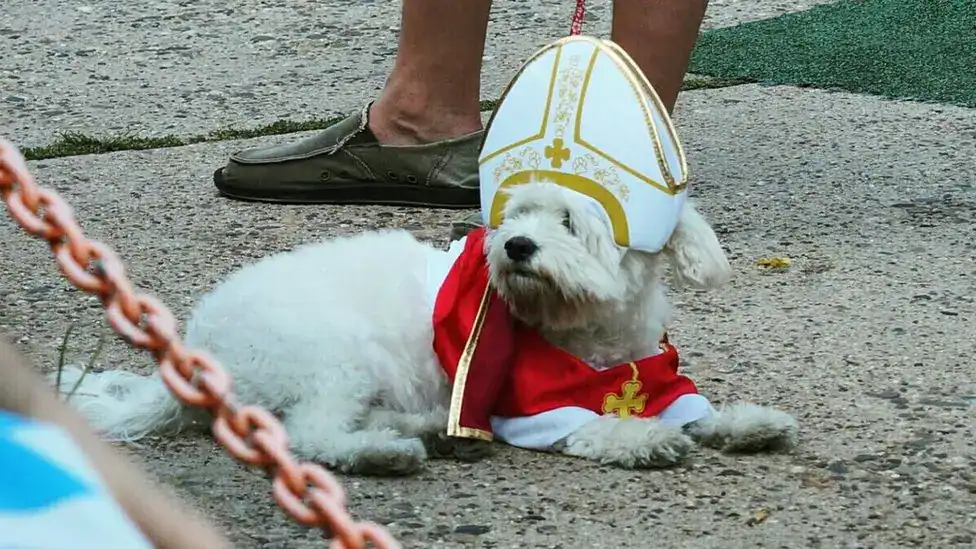
An interesting tradition is the blessing of animals, held in the Vatican on the feast of St. Anthony Abbot. The rite stems from an old Catholic tradition linked to St. Anthony, patron saint of domestic and farm animals. In the Vatican it takes place on St. Peter’s Square and Piazza Pio XII, with dogs, horses, and farm and household animals brought by worshippers and visitors.
St. Peter’s Basilica
Dogs are not allowed inside St. Peter’s Basilica. The basilica’s official rules state this explicitly. The same applies to climbing the dome.
Guide dogs for the blind or visually impaired are an exception.
If you plan to visit the basilica, your dog has to stay outside—which, with queues and summer heat, is far from ideal. Plan your day accordingly.
Interested in this destination? Would you like to visit it with your dog? Check the entry requirements directly in BorderCooler®.
Vatican Museums and the Sistine Chapel
Dogs are not allowed in the Vatican Museums, not even small dogs in a bag. Only guide dogs (leash and muzzle required) and animals admitted in advance for certified pet-therapy purposes are exempt—these cases must be arranged by email beforehand.
For most visitors the bottom line is simple: The Sistine Chapel and the museum complex are off-limits with a dog.
Practical tips for visiting the Vatican with a dog
Security screening at St. Peter’s Square
Entry to St. Peter’s Square involves airport-style security—bags and belongings go through an X-ray and visitors pass a metal detector. Dogs go through this screening with their owner.
According to the basilica’s official information, the wait for security averages 1.5 hours. For a dog that struggles with crowds or long periods standing in a queue, this is important to know in advance. If you’re only planning an outdoor visit and don’t intend to enter the basilica, you can avoid the queue for the interior.
When to go
The Vatican is busy year-round. The busiest time is Wednesday mornings during the Pope’s general audience—thousands gather on the square, which can be extremely uncomfortable for a dog. Also avoid Sundays at noon, when the Pope greets the faithful from the window.
The quietest times are early morning before 8:00, or late evening outside high season. During the main tourist season (May–September) the Vatican is crowded virtually all day.
Around the Vatican with a dog
It’s worth pairing the Vatican with a walk to nearby spots that are more comfortable for dogs.
Castel Sant’Angelo — a riverside fortress with a park, just a few minutes’ walk from the Vatican. The park is open to leashed dogs and free to enter. The Ponte Sant’Angelo, lined with Bernini’s statues, is one of the most beautiful spots nearby and fairly calm in the early morning or evening.
Tiber riverside (Lungotevere) — the promenade along the river from Castel Sant’Angelo offers shade, space, and a pleasant setting for a walk with your dog.
Borgo — a picturesque district between Castel Sant’Angelo and the Vatican, with narrow lanes and cafés and restaurants with outdoor seating. Dogs are a normal part of local life here.
Water for your dog
On St. Peter’s Square, around the obelisk, you’ll find nasoni drinking fountains with running water. These fountains are common across Rome and have a small bowl at the base specifically for dogs. The water is potable and runs continuously. In the summer months, this is practically the only way to water your dog on the square without carrying a larger supply yourself.
Visiting the Vatican with a dog works best as part of a wider plan in this part of Rome—the combination of the square, Castel Sant’Angelo, and a stroll along the riverfront makes for a pleasant circuit you can manage with a dog without major compromises. In summer, factor in the heat, minimal shade, and the square’s sunbaked surface.
Summary
You can only visit the Vatican with a dog in part. Outdoor areas, including St. Peter’s Square, are accessible. St. Peter’s Basilica, the dome, and the Vatican Museums do not allow dogs—only guide dogs and certain pre-announced special cases are exempt.
Follow Italy and EU rules for veterinary requirements. More in the article Traveling to Italy with a dog.
Frequently asked questions about visiting the Vatican with a dog
Can I take my dog to St. Peter’s Square?
Yes. The Vatican’s outdoor areas are accessible to dogs. Your dog must be on a leash and under control.
Can I take my dog into St. Peter’s Basilica?
No. The basilica’s official rules prohibit pets. Guide dogs are the exception.
Can I take my dog into the Vatican Museums?
No. Not even small dogs are allowed. Only guide dogs and pre-arranged pet-therapy cases are exempt.
Do I need special veterinary documents to visit the Vatican?
No. You follow Italy and EU veterinary rules. More in the article Traveling to Italy with a dog.