


Overnight bus journeys have a long tradition in South America and, for travelers, are often the most practical way to cover big distances. On our first trip to Argentina, we kicked things off with a roughly 12-hour ride from Córdoba to Salta.
We landed in Córdoba around noon, which left us a few hours before our evening departure. Even so, we had to move fast—there were a few important tasks to get through.
First steps in an unfamiliar city
From the airport we call a taxi straight to the bus station, the Terminal de Ómnibus de Córdoba. Our driver keeps sharing useful tips along the way—after all, it’s our first time in this city and this country.
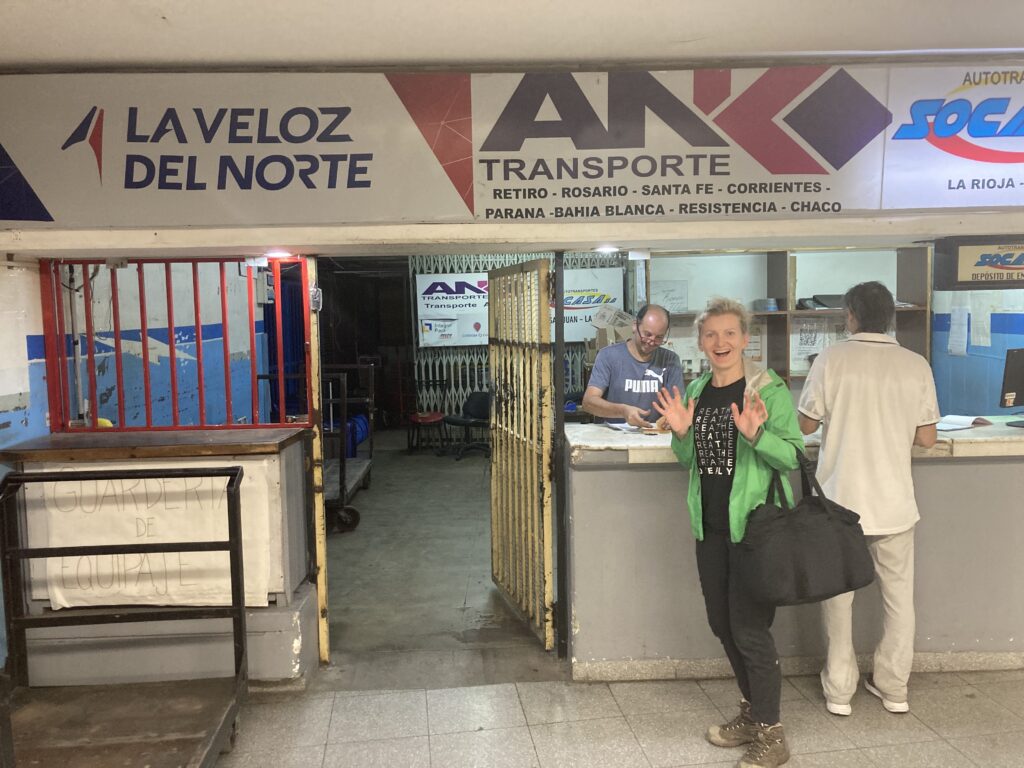
She drops us off and we head into the bowels of the station. Unlike the airport, this feels like uncharted territory. Two things complicate matters right away: our lack of Spanish and the luggage we have to drag everywhere with us.
With Western Union, tickets and a quick dinner still ahead, our first priority is the left-luggage office. There’s no way we’re doing this with heavy suitcases. After a few minutes of wandering we find it and, with relief, drop the bags that were slowing us down. A pleasant surprise: you pay the storage fee only when you pick the bags up—which suits us, as we don’t yet have a single Argentine peso.
Money, tickets and the language barrier
Next stop: Western Union, where we collect our first Argentine pesos at a favorable rate. Then it’s back to the station window to pick up our tickets reserved in advance.
The agent speaks only Spanish, so communication is a struggle. We also only have large bills, and she doesn’t have change. I try to save the day by offering small-dollar bills. She refuses at first, but a colleague suggests she take them. After all, this is a country where dollars fetch a great price on the informal market.
All set. We’ve got the tickets, a few basic instructions, and we’re hoping we’ll find the right bay and won’t miss the bus.
Chaos, but manageable
We grab a quick dinner at a nearby mall and return to the station to collect our bags. From there we head straight to the departure bays.
This is where the worst chaos in the whole station plays out. Everyone’s hunting for their bus, people are pushing along with big suitcases, and there’s a lively buzz of conversation that we don’t understand at all. We ask around with our limited Spanish and a lot of miming; locals reassure us we’re in the right place.
At last the bus pulls in and a line forms. One driver organizes the crowd while the other loads the baggage. There’s only one luggage hold, so the suitcases need to be arranged by passengers’ destinations.
When it’s our turn, we hand over the bags and get a small paper tag. The driver asks us for some money. We’ve no idea whether it’s a baggage fee or a tip—or how much he expects. We muddle through an agreement and, curious and hopeful, climb aboard.
Comfort, Argentine-style

The coach has two decks. The lower deck is for us and a handful of others—broad, cushy seats that recline almost flat. Not quite a bed, but very comfortable. Upstairs are standard seats.
The windows are dark-tinted, so by dusk the view is limited. Seats come with USB ports, which I’m very happy about, though it’s hard to say if that’s standard everywhere. There’s a small storage space by your feet and everything is laid out to make efficient use of space.
After a bit more boarding we set off. The bus slips out of the city quickly and steadily heads north.
Air‑con, stops and a night on the road
We quickly confirm what the internet had warned about. The bus is air‑conditioned—which is great—but the temperature is cranked to extremes, easily around 18 °C. Not ideal for sleeping.
Luckily we came prepared. In our carry‑ons we have light sleeping bags that quite literally save the night. Thanks to them we manage to get some rest.
Along the way the bus makes several short stops—usually at gas stations or small shops on the edge of towns and villages. Each stop is a chance to step out, stretch, grab a bite or use the toilet. They’re brief, just a few minutes.

There’s one longer stop in San Miguel de Tucumán, at the main bus terminal downtown. Some passengers get off, others get on. While these pauses make the journey more varied, they do disrupt any attempt to sleep for more than two or three hours at a stretch.
Even so, the ride passes fairly quickly and we end up sleeping through most of it. There’s no onboard entertainment system, so if you want a movie or something to pass the time, bring your own phone or tablet.
Arrival in Salta
At first light I pull back the curtain and the view is nothing like around Córdoba. The landscape is drier, less green, and on the horizon you can already make out the first hills of the Andes.
Soon after, we roll into the Terminal de Ómnibus de Salta. The overnight ride is behind us. Using our claim tag we collect the bags and hop in a taxi to the center.
Final thoughts
We’d rate the overnight bus from Córdoba to Salta as a mostly pleasant experience—easy enough to manage with a bit of preparation. There are more comfortable options, like domestic flights, but the bus remains a very cost-effective alternative, especially for longer distances.
It also gives you an authentic glimpse of the country and how locals travel. The night run, brief stops, the dawn light on a changing landscape and the first silhouettes of the Andes—those little moments that make traveling across Argentina more varied and more memorable.
Practical tips for bus travel in Argentina
- If possible, book your tickets online in advance. When you can, choose your preferred comfort level—especially for long hauls.
- Night buses are really cold—dress for it (hoodie, blanket, sleeping bag).
- Bring plenty of water and a small snack, plus a power bank.
- Keep basic details about your destination written down on paper—it makes communication with staff much easier.
- Have a clear plan for what you’ll do on arrival—where you’ll go from the bus station, which taxi you’ll call and where you want to be dropped off.