


Like many travellers, we’d long had our eye on the classic loop through Norway, Sweden and Finland with a return via the Baltic states. Summer 2024 finally felt right, so we set off on an unforgettable adventure — and of course brought our dog Iba along.
This itinerary follows our real journey and is written so you can use it as inspiration or as a ready‑made road trip plan. Each day is a short story in itself — we clearly distinguish what we actually did and what other options each place naturally offers.
We’ve covered many of the places mentioned in separate, in‑depth articles. You’ll find links to them throughout the itinerary.
Day 1
Shortly after lunch we leave Bratislava for a long push across the Czech Republic and Poland to the port town of Świnoujście on the Baltic Sea. Thanks to Poland’s excellent motorways we cover most of the distance smoothly, with minimal delays. In the evening we board the overnight ferry to Trelleborg, Sweden, and watch the mainland slip away.
Day 2
We arrive in Trelleborg in the morning and start the day with a quick breakfast in Malmö. Then we head to the Øresund Bridge (Øresundsbron), which links Malmö with Copenhagen, and admire this regional landmark — a monumental line that disappears elegantly on the horizon between sea and sky. Later we stretch our legs on Tylösand’s sandy beach, steeped in that distinct Nordic seaside vibe. By afternoon we slip inland to the quieter countryside around Borås, where we finally catch up on the sleep we missed on the ferry.
Day 3
We continue northwest to Smögen, a photogenic Swedish fishing village known for its wooden Smögenbryggan boardwalk and bright cabins. A stroll along the water sets the summer coastal mood. Then we cross into Norway, ferry across the Oslofjord and head inland to the Gautefall area in southern Norway.
Day 4
After a few intense driving days, we finally slow down. We settle into the Setesdalsheiene mountains by Lake Birtevatn. The place grabs us straight away — silence, mountains, forest and water: exactly the Norway we came for. We take short walks, explore the surroundings and camp under the northern sky.
Day 5
We hike up Kviptefjell (903 m) — not difficult, very rewarding — and look out over a mosaic of lakes and waterways rippling across Setesdalsheiene like a natural map of southern Norway. Back at the car we pack up and drive toward the Lysefjord. We find a cabin through inatur.no — Norway’s hut system proves simple and reliable once again.
Day 6
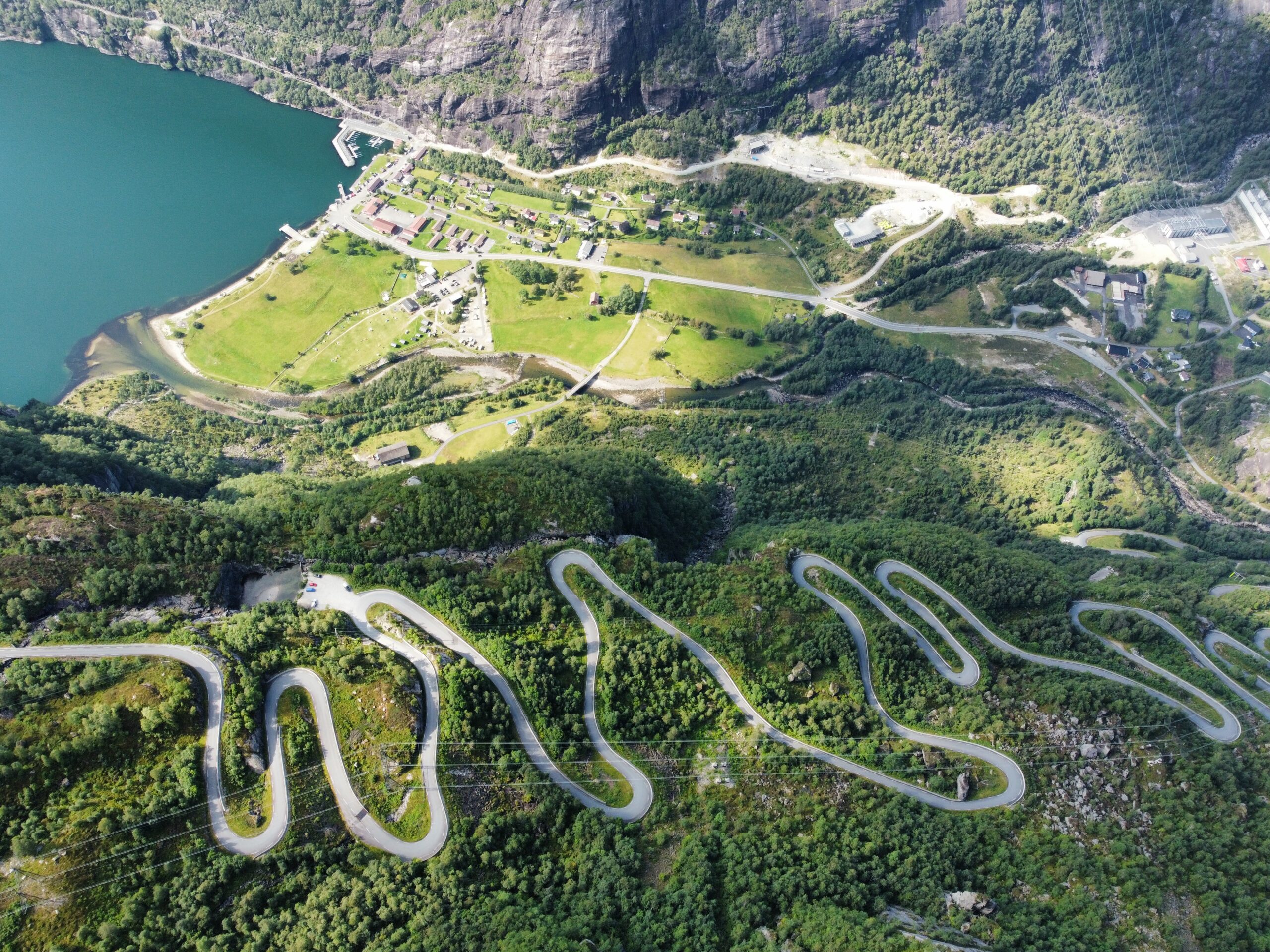
At first light we roll into Lysebotn, a tiny village at the very end of the fjord, reached by an iconic hairpin road. From here we set out on one of Norway’s most famous hikes — to Kjeragbolten, the legendary boulder wedged high above Lysefjord, an icon of the fjords and a dream for many travellers. The views are every bit as dramatic as we imagined. Afterwards we take the ferry from Lysebotn toward Lauvvik, gliding past Flørli and its famous ,444 steps, and in the evening we move on to the Tau area near Stavanger.
Day 7
From Tau we head north and take the silent, modern electric ferry between Hjelmeland and Nesvik — a crossing that feels almost futuristic. We stop at Blåsjø, Norway’s largest artificial lake, sprawled across a stark high‑mountain plateau and more like an inland northern sea than a classic reservoir. In the afternoon we visit the Stegastein viewpoint above Aurland and then drive through the Lærdal Tunnel (24.5 km), the longest road tunnel in the world — an experience that lasts longer than you expect.
Day 8
We cross the Sognefjellet pass on Road 55 and enter Jotunheimen, Norway’s highest mountains. We base ourselves by the Leirvassbu hut in the Leira valley. It’s rugged and majestic country; while there are plenty of tough routes, we keep a sensible pace and opt for a relatively easier goal — Kyrkja.
Day 9
We stay inland and mix rest with a resupply run. Along the way we make a detour to Lake Aursjøen in Dovrefjell–Sunndalsfjella National Park. Set at 856 m and ringed by mountains, the lake has a dramatic, austere feel.
Day 10
We drive to Åndalsnes, gateway to the popular Romsdalseggen ridge, one of Norway’s most photogenic and sought‑after panoramas. We take the Romsdalen Gondola and continue along the ridge toward Mjølvafjellet (1,216 m). Views over the Romsdalen valley, the Rauma river and surrounding glaciers are among the best on the route.
Day 11
After a long sleep we continue to Ålesund, famed for its Art Nouveau architecture and the viewpoint on Mount Aksla. Then we follow Road 659 across a string of islands, where sleek bridges and tunnels meet the traditional fishing world of Norway’s coast. We find quiet beaches, small harbours and an authentic shoreline far from the main tourist flow.
Day 12
On Harøya we climb Harøyburet (156 m) for open‑sea views. A ferry takes us back to the mainland and we continue to the Atlantic Ocean Road with its iconic Storseisundbrua bridge. We end the day in Kristiansund.
Day 13
A long driving day takes us through Trondheim and further north toward Harran. We mainly cover distance and rest — there are remoter goals still ahead.
Day 14
In the morning we catch the ferry to the island of Leka. Its geology is striking — slices of oceanic crust pushed to the surface give the landscape a completely different character. After a few hours of exploring we continue north to Mo i Rana.
Day 15
We drive on to Bodø with two standout stops. First, the Marble Castle (Marmorslottet) on the Glomåga river, where water has sculpted fantastical marble formations. Then we cross the Arctic Circle at the Arctic Circle Centre. In the evening we board the ferry from Bodø to the island of Værøy.
Day 16
On Værøy we roam the island’s northern side — dramatic cliffs, empty beaches — and climb Håen (438 m). The island feels wild yet peaceful. In the evening a ferry carries us to Lofoten, landing at Moskenes.
Day 17
After arriving on Moskenesøy at night, we find a camping spot near Reine. Later we hike Ryten (543 m), one of Lofoten’s classic viewpoints, where the famous view opens over Kvalvika Beach. We wind down the evening in Stamsund.
Day 18
We continue along the E10 toward Svolvær. There’s a stop in Henningsvær to see perhaps the world’s most iconic football pitch, then another at Vågan Church (the Lofoten Cathedral). We take a ferry to the island of Skrova to explore its beaches and the Skrova fyr lighthouse. The day ends with a drive to Narvik across the Hålogaland Bridge.
Day 19
We begin the return leg. Following the E10 we leave Norway for Sweden, pause at Masugnsbyns naturreservat, and cross the Arctic Circle again near Juoksengi. Evening finds us by the Torne river at Svansteins Beach.
Day 20
We enter Finland and aim for Rovaniemi, visit Santa Claus Village right on the Arctic Circle, then continue south toward Vaasa.
Day 21
We explore the Kvarken Archipelago (UNESCO), a unique natural phenomenon where the land rises slightly from the sea each year, creating new islets and shallows. Crossing the Raippaluoto Bridge, we reach Björkö and walk the easy Bodvattnet Nature Trail around the lake. The area is known for its post‑glacial land uplift — and its calm, unhurried feel.
Day 22
We drive to Helsinki and stroll around Market Square and Helsinki Cathedral. In the early evening we board the ferry to Tallinn.
Day 23 and 24
The morning is for Tallinn and its historic centre, crowned by the Alexander Nevsky Cathedral on Toompea Hill. Then we roll on through Latvia, Lithuania and Poland back to Slovakia. After 23 days, 8 countries and 8,340 kilometres, our Nordic road trip comes to an end.
Route at a glance
This 24‑day road trip through 8 countries blends fjords, islands, iconic roads, tunnels and select mountain hikes. Tweak the route to match your time, energy or interests — add more days in Lofoten, cut down on long transfers, or slot in tougher ascents in Jotunheimen.