
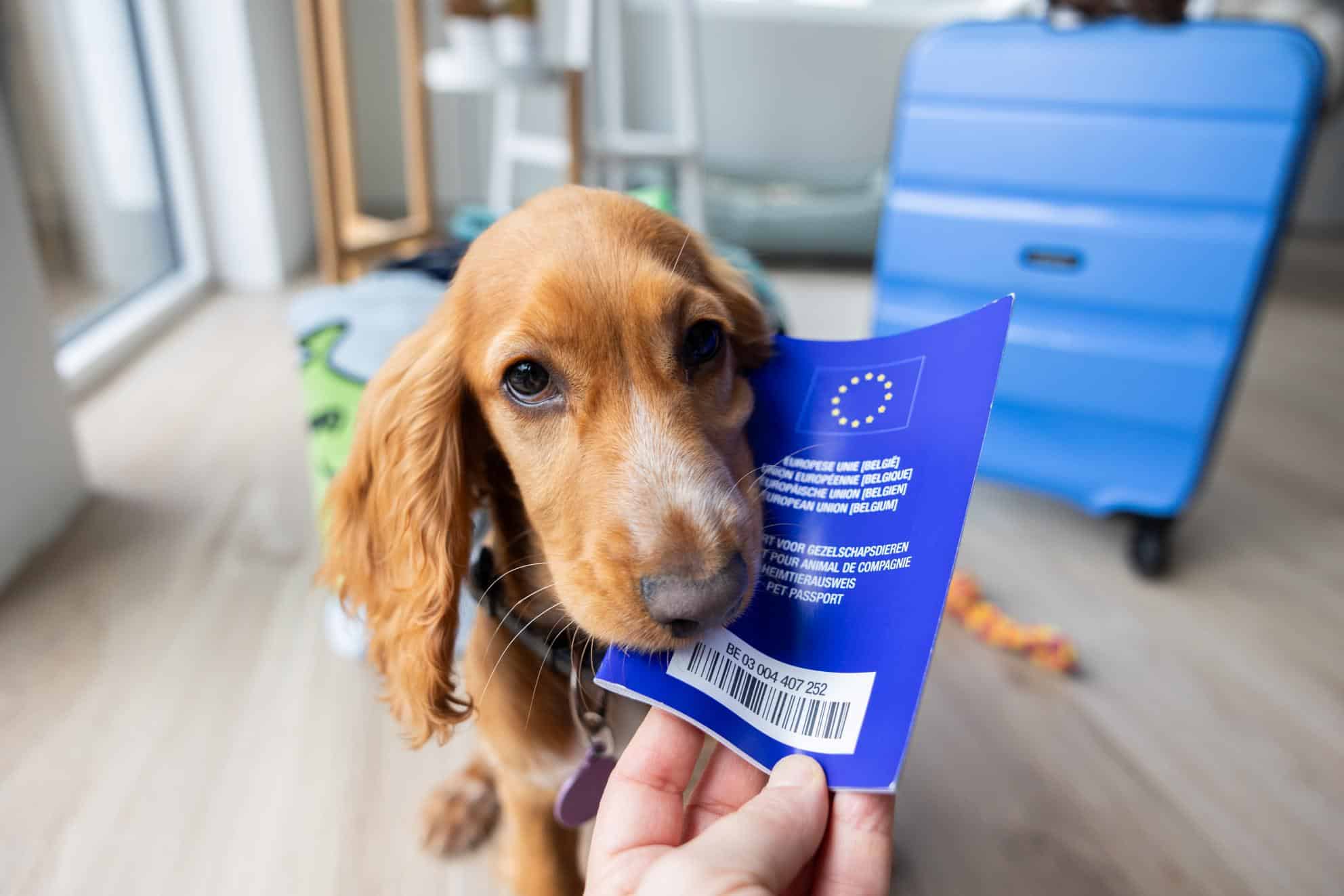


An EU Pet Passport for a dog from outside the EU? Is it even possible—and does it make sense?
This question comes up more often than you might think. And the answer isn’t entirely straightforward.
Traveling with a dog between non‑EU countries and the EU comes with clear rules, but in practice there’s plenty of confusion—especially about what the EU Pet Passport actually does.
We dug into the details and added our own experience from trips outside the EU.
What the EU Pet Passport is and who it’s typically issued to
The EU Pet Passport is an official veterinary document used for traveling with a dog within the EU.
It’s typically issued to dogs registered in EU countries or to dogs whose owners reside in the EU, as long as the basics are in place—an ISO‑standard microchip and a valid rabies vaccination.
An authorized veterinarian issues the passport, which includes the dog’s identification, vaccination details, and other medical records. It’s a practical booklet that lets you quickly see a pet’s medical history—especially administered vaccines, their validity, deworming—and notes on past illnesses or surgeries. Taken together, it gives a fairly complete picture of the animal’s healthcare.
Within the EU, it serves as the standard, simplest way to travel with a dog without extra paperwork.
It’s useful beyond the EU, too. Any vaccinations or other treatments can be recorded by a vet even if they happened outside the EU. We’ve had this done in Paraguay and Bolivia, where local vets entered vaccinations and deworming into the EU Pet Passport—even though we were outside the EU.
Can a dog from a non‑EU country get an EU Pet Passport?
The short answer is yes—it can.
There’s one key condition: the dog must be physically in the EU (even temporarily) and must have been brought in legally.
In practice, that means you must meet all entry requirements beforehand—have a health certificate, an ISO microchip, a valid rabies vaccination, and, in some cases, additional requirements depending on the dog’s country of origin.
Once these conditions are met and the dog is in the EU, you can visit a veterinarian and request an EU Pet Passport.
This principle generally applies across the EU. The more “high‑risk” the country of origin (for example, countries outside the EU’s official list—so‑called unlisted countries), the stricter the entry requirements will be. The passport can still be issued in these cases, but expect more bureaucracy when entering the EU.
Are you planning a trip abroad with your dog? Check the entry requirements for various countries directly in BorderCooler®.
What are the benefits of an EU Pet Passport for dogs from outside the EU
At first glance it might feel unnecessary. In practice, though, the EU Pet Passport has several advantages in certain situations:
Clear, consolidated documentation
All key information (vaccinations, identification) is in one place. You’ll value this especially when visiting a vet in the EU—whether it’s a planned appointment or an unexpected one.
From experience, the EU Pet Passport works well outside the EU, too. In Paraguay and Bolivia, local vets readily recorded vaccinations and deworming in the passport. For them, it was a clear and trustworthy medical record.
Most veterinarians outside the EU are happy to work with this document because it lets them quickly understand the animal’s medical history without wading through a stack of local papers.
Simpler travel within the EU
If a dog has entered the EU legally, moving on within the EU is in most cases relatively straightforward—especially overland. Internal borders generally don’t involve systematic checks.
Things change with air travel, ferries, and random inspections. In those moments, the EU Pet Passport is practical: it’s a unified, widely recognized document that lets officials quickly verify the dog’s identity and basic compliance. Checks are clearer—and usually faster.
So the real benefit isn’t the literal “border crossing,” but the situations where you need to prove veterinary compliance.
Advantages when re‑entering the EU
The same logic applies when returning to the EU after the dog has already been there and obtained an EU Pet Passport. The passport helps mainly administratively—you have clear, trustworthy documentation (vaccination history, identification, records) that authorities can verify quickly without chasing down various local certificates.
Keep in mind the passport does not replace legal requirements. For some countries (the so‑called unlisted countries) a titer test may still be required when returning to the EU.
Who should consider getting an EU Pet Passport
An EU Pet Passport isn’t equally useful for everyone. In practice, it’s most worthwhile in these cases:
- Travelers within the EU – if you plan to move between several EU countries (especially by plane or ferry), a single document makes checks much easier.
- Longer stays in the EU – if you’ll be in Europe for a while, the passport simplifies vet visits and keeps medical records tidy.
- Returning to the EU – if you expect to come back to the EU, the passport serves as a clear record of your dog’s history that speeds up admin (you still need to meet all entry requirements).
- Travel outside the EU with a return – if the EU is only part of your route, the passport helps keep your documentation consistent across countries.
By contrast, it adds less value for a one‑off visit to the EU with no onward travel or return—your original entry paperwork will usually suffice.
How to get an EU Pet Passport once your dog is already in the EU
If the dog is already in the EU legally, getting an EU Pet Passport is fairly straightforward and mainly administrative. An authorized veterinarian in any EU country can issue it.
When applying for the passport, you’ll need to:
- have the dog physically present (the vet will scan the microchip)
- present proof of rabies vaccination
- show that the vaccination is still valid
- ideally bring the original veterinary health certificate or other entry documents from when the dog entered the EU
The vet will then check the details, enter them in the passport, and issue it. In practice, this usually takes under an hour—the passport is issued on the spot.
What to watch out for:
- the microchip must be readable
- vaccination details must be correct and legible
- vaccination dates must be continuous (i.e., the next dose must be given before the previous one expires; otherwise the vaccination is treated as a new course)
If these conditions are met, getting the passport is quick and straightforward.
The EU Pet Passport simply transcribes existing data into a standard format—it doesn’t create new “rights” or replace EU entry requirements. It won’t fix missing vaccinations or errors in your paperwork; if something is off, the passport won’t help in practice.
Conclusion
An EU Pet Passport can make traveling with a dog around Europe much easier—even if the dog comes from a non‑EU country.
It only helps, though, when the dog is properly prepared before entering the EU and all legal entry requirements are met.
It’s most valuable for people who stay in the EU with their dog for longer periods, return regularly, or pass through the EU often.