

Bolivia isn’t your typical holiday destination. There’s no coastline and the infrastructure isn’t exactly slick. Distances are on a different scale than in Europe. Many regions are sparsely populated, elevations often sit above 3,000 meters, and services we take for granted at home can be hundreds of kilometers away.
Traveling through a country like this with a dog means thinking a bit further ahead. Not because Bolivia is hostile to dogs, but because it is inherently demanding—its terrain, climate, and logistics. And that applies to people as much as to dogs.
On our road trip we traveled through cities, small villages, and the high-altitude expanses of the Altiplano. Our dog handled long drives, time at elevation, and stays in the warmer lowlands.
The country’s reality also included practical complications. During our visit we dealt with fuel shortages that could heavily influence route planning and the length of driving days. On the other hand, we also encountered the so‑called “blue rate”, which, when exchanging cash, helped lower overall travel costs. Bolivia blends a degree of uncertainty with some surprising upsides.
This experience showed us that Bolivia with a dog is possible. It just isn’t a carefree holiday. It’s a journey that requires preparation, flexibility, and respect for the country’s conditions.
Table of Contents
Is Bolivia a good destination for a dog?
There’s no single answer. It depends on the dog, your travel style and the regions you plan to visit. Bolivia is exceptionally diverse—from Amazon rainforest to volcanoes over 6,000 meters. With that kind of variety, a simple yes-or-no isn’t straightforward.
Active, healthy dogs used to movement, changing environments, and longer car rides generally manage Bolivia without major issues. More sensitive dogs, those with heart or respiratory problems, or very small breeds can struggle at higher elevations. Altitudes above 3,500 meters are demanding not only for people but for animals too.
Pace is a key factor. You can’t “do” Bolivia in a few days. Long stretches behind the wheel, limited options for stops, and occasional logistical hiccups mean your dog needs to wait calmly and handle long hours without unnecessary stress.
From our experience, if your dog is used to traveling and you’re ready to adapt the pace to their needs, Bolivia isn’t automatically a bad idea. But it’s not a country we’d recommend if you’ve never traveled with a dog before or if you’re not prepared to plan thoroughly.
Entry requirements for Bolivia with a dog and returning to the EU
When traveling outside the European Union, paperwork matters. Bolivia requires valid rabies vaccination, a veterinary health certificate issued shortly before travel, and supporting documentation. In practice it’s best to carry an international veterinary certificate in English or Spanish. In our dedicated article, we break down the entry requirements for taking a dog from the European Union to Bolivia, including specific timelines and documents.
For the return to the European Union, you must meet the rules for entry from third countries. The essentials are a valid rabies vaccination and, in some cases, a serological antibody test (the titer test) performed well in advance. We recommend handling the admin before leaving Europe.
Interested in this destination? Would you like to visit it with your dog? Check the entry requirements directly in BorderCooler®.
Getting around Bolivia with a dog
The most practical way to move around the country is with your own or a rented car. Distances are big, public transport is slow, and often unpredictable. On a road trip, your dog has a stable environment and you can adapt to their needs—stop when necessary, adjust the pace, or change the plan.

Long stretches mean hours in the car. Make sure there’s plenty of water, shade, regular breaks and safe restraint while driving. In the mountains, expect sudden weather shifts and significant elevation changes.
Public transport is more complicated. Smaller dogs in carriers are more often tolerated, while larger dogs can be an issue. Rules vary by region and operator and often depend on the driver’s discretion. If you plan to use buses, expect restrictions and a measure of discomfort.
Accommodation with a dog
In our experience, finding accommodation with a dog in Bolivia was surprisingly straightforward. In small hotels, guesthouses and family-run stays, a dog usually wasn’t a problem, and there was often no extra fee.
Complications tended to arise in pricier, more formal hotels with stricter rules. We recommend reaching out in advance and getting confirmation that your dog is accepted.
Dogs in cities, villages and the wild
In cities, expect busy traffic and the presence of stray dogs. Villages are calmer, but free-roaming dogs are common. High-altitude regions bring different challenges—cold nights, strong sun by day and very little shade.
We describe our experience walking a dog in Paraguay and Bolivia in a separate article. In practice, we found that the most important thing is caution and respect for the local environment.
While we could move with Ibo off-leash in most situations, that’s not a universal solution. In most cases, a leash is the wiser choice—not only for the dog’s safety, but out of respect for others and for wildlife.
National parks, the Altiplano and the jungle
Traveling with a dog in Bolivia, you’ll sooner or later end up in natural areas. The question of access to national parks is therefore very practical, not theoretical. Official rules don’t always allow dogs, and conditions vary by park.
From our experience, reality is sometimes more flexible than the formal rules. We entered the Reserva Nacional de Fauna Andina Eduardo Avaroa in the south without issues, even though entrances are controlled. In Parque Nacional Amboró we did two hikes and found that visitors with dogs seemed fairly common. On the other hand, we were refused accommodation with a dog at Refugio Los Volcanes in the same park. We also had no issues entering the area around Llica (Parque Nacional Llica).
But it’s not only about entry rules. The Altiplano means elevations often above 3,500 meters, thin air and big temperature swings between day and night. The jungle, by contrast, brings high humidity, insects and encounters with wildlife. Each environment places different demands on your dog.
Hiking with a dog
Bolivia offers plenty of hiking routes of varying difficulty. In our experience, many of them are doable with a dog, provided the dog is used to moving on trails and you respect the conditions.
Among the easier outings was the trek to the Chorro de San Luis waterfall, which follows a pleasant path with minimal elevation gain. Torre de Chochís offers a gentle ascent with rewarding views and terrain that’s relatively manageable for dogs.
On the tougher side, we did the ascent of Cerro Hualchisa near the town of Llica, where you need to account for altitude and dry, rocky ground. The hike up to the crater of the Tunupa volcano is theoretically possible with a dog, but only after thorough acclimatization and with close attention to their condition. The hike to the top of Isla Incahuasi in the Salar de Uyuni is shorter, but the elevation can still be challenging for some dogs.
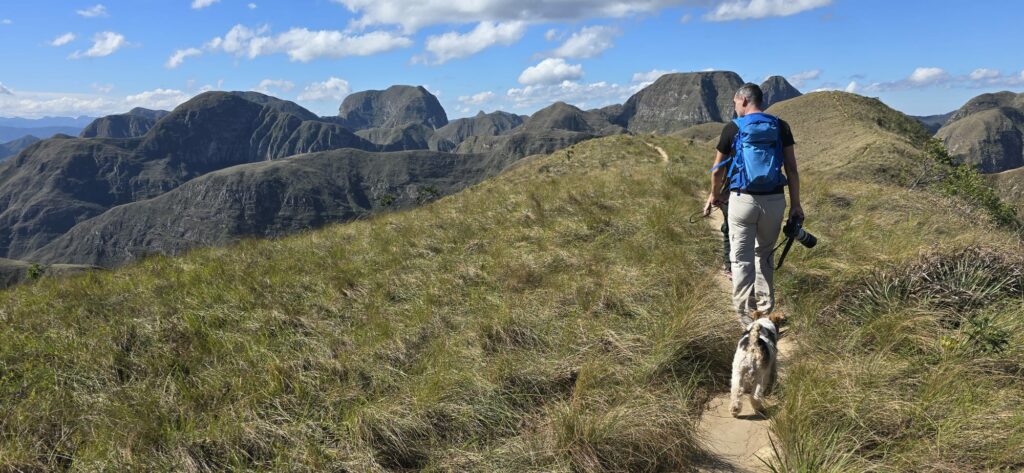
Another longer option is the Codo de los Andes trek, where you need to weigh the route length, water availability and return logistics. Hiking with a dog in Bolivia is feasible, but it should always be based on your dog’s real condition and current conditions on the ground.
Diseases and health risks
In lower regions, think about protection against ticks and mosquitoes. Tropical conditions can raise the risk of certain diseases. Good antiparasitic protection is essential.
In the wild, don’t underestimate larger fauna. In tropical and subtropical areas there are snakes, which can be dangerous for a dog—especially off-trail. Some regions are home to larger predators, though encounters are rare. A more likely risk is stray dogs or territorial livestock. Keep your dog under control and don’t let them roam out of sight.
At higher elevations, altitude itself can be an issue. Watch your dog’s behavior, breathing and overall energy. Gradual acclimatization and plenty of water are key.
Veterinary care is available mainly in larger cities and, in our experience, is of good quality. If you don’t speak Spanish, prepare for a language barrier. In remote areas, help is limited, so we recommend carrying a basic first-aid kit.
When to travel to Bolivia with a dog
The dry season is more stable in terms of travel and conditions for dogs. Roads are more passable and weather swings less extreme. The rainy season can bring flooded sections, mud and higher humidity in the lowlands.
When planning, factor in the region, elevation and temperatures. What’s pleasant in one part of the country can be demanding in another.
Bolivians’ relationship with dogs
As we traveled, we felt that locals’ attitude to dogs was generally positive, even caring. Dogs are a natural part of streets, villages and small towns, and often move freely in tough, sometimes harsh conditions.
People tend to help a dog in need. In the cold highlands or drier regions we repeatedly saw locals offer water or leftovers to strays. This everyday contact naturally builds a kind of empathy and also explains why dogs are seen as a normal part of public space.

That doesn’t mean attitudes are perfect everywhere or that stray-dog issues don’t exist. It’s more about the overall atmosphere we sensed—the dog isn’t an exotic problem or a disruptive presence.
With Ibo, we rarely felt unwelcome. If he sparked any emotion, it was curiosity. There aren’t many travelers with dogs here, so he could seem like an unusual addition to the local scene. Perhaps he was as exotic to some local dogs as they were to us. People always treated him politely and with respect.
Conclusion
Traveling to Bolivia with a dog is possible. With good planning, realistic expectations and a willingness to adapt the pace to your dog, it can even be surprisingly straightforward.
It will never be a Croatia-style destination with infrastructure built for effortless tourism. Bolivia asks for more preparation, more flexibility and greater respect for local conditions. The reward isn’t comfort, but the intensity of the experience.
It’s precisely the mix of long distances, high elevations and raw nature that makes Bolivia a place you don’t forget. And if your dog is used to traveling and you’re ready to think ahead, they can be a full part of the journey.
Bolivia with a dog isn’t the easiest choice. And that’s exactly why it’s among the most interesting.