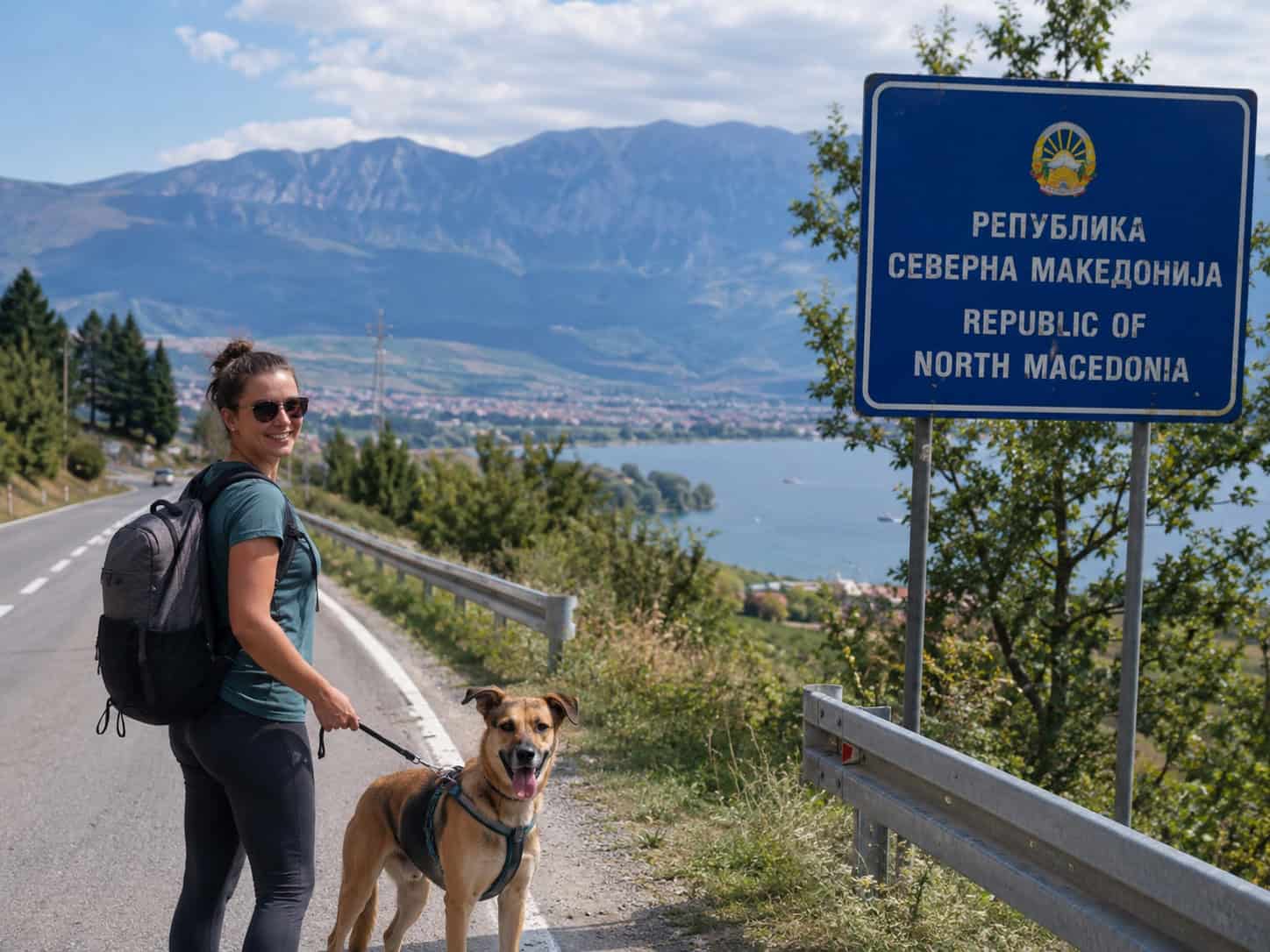


North Macedonia is a practical Balkan country for road trips and as a transit route to Greece, Albania or further into Southeast Europe. You’ll find Skopje, Lake Ohrid, mountains, monasteries and long road routes used by holidaymakers and travelers heading deeper into the Balkans. Traveling with a dog to North Macedonia is possible, but check in advance which country your dog is coming from and which documents you’ll need for the return as well.
When traveling to North Macedonia with a dog, you need to sort out two things: entry to North Macedonia and the return home. Entry rules are published by the local Food and Veterinary Agency (FVA). The return is governed by the rules of the country your dog will re‑enter after its stay in North Macedonia.
This article covers a standard non-commercial trip with a dog traveling with its owner or an authorized person. If a dog travels as cargo, for sale, for a change of ownership, or in larger numbers, different rules may apply.
Table of Contents
Quick overview: what a dog needs for travel to North Macedonia
What your dog needs to enter North Macedonia depends mainly on where it is coming from.
If you’re traveling from an EU country or from another country whose pet passport North Macedonia recognizes, your dog generally needs:
- a microchip or another approved permanent form of identification,
- a valid rabies vaccination,
- a pet passport or another accepted identity document, depending on the country of departure.
If the dog is coming from a country that uses a veterinary health certificate, you’ll also need:
- a veterinary health certificate,
- a serological rabies antibody test if the dog is coming from a country that is not on the recognized list,
- entry via an official passenger border crossing.
North Macedonia notes that treatment against echinococcus and ticks is recommended but not mandatory.
For import and transit, dogs, cats and ferrets generally must be older than 3 months. Younger animals may enter only under specific conditions, for example if they are traveling with their mother, on whom they still depend, or if they have been kept since birth at one location without contact with potentially infected wild animals.
Entry requirements for taking a dog to North Macedonia from the EU
For travelers coming from the EU, the process is fairly straightforward. The FVA states that dogs, cats and ferrets must have individual identification, valid rabies vaccination and an identity document in the form of an EU Pet Passport for countries on the relevant list.
In practice, when coming from the EU, make sure you have:
- a microchip,
- a valid rabies vaccination,
- an EU Pet Passport.
The microchip must be implanted before the rabies vaccination. If the dog was vaccinated before being microchipped, that vaccination may be problematic for travel.
For a first rabies vaccination, allow a waiting period of at least 21 days. Only then is the vaccination considered valid for travel.
Interested in this destination? Would you like to visit it with your dog? Check the entry requirements directly in BorderCooler®.
Entering North Macedonia with a dog from outside the EU
If a dog is entering North Macedonia from outside the EU, distinguish whether it’s from a country whose pet passport North Macedonia recognizes, or from a country that uses a veterinary health certificate.
The FVA states that dogs, cats and ferrets must have valid identification and a veterinary document. As an EU candidate country, North Macedonia has aligned its rules with European ones and relies on the list of countries under Regulation (EU) No 576/2013.
In practice, this means:
- dogs from EU countries travel with an EU Pet Passport — that’s sufficient; a titer test is not required,
- dogs from non‑EU countries on the EU list (for example the USA, UK, Canada, Australia, Japan and others) travel with a veterinary health certificate — a titer test is not required,
- dogs from non‑EU countries not on this list travel with a veterinary health certificate and must also have a titer test performed at least 3 months before travel.
When a serological rabies antibody test is required
A serological rabies antibody test is required to enter North Macedonia if the dog is coming from a country that is not on the recognized list under FVA rules.
The FVA explicitly states that for such countries, companion animals must have proof of an antibody test performed at least 3 months before movement.
In practice, this means:
- the blood sample is taken after the rabies vaccination,
- the result must confirm a sufficient antibody level,
- the test needs to be arranged well in advance, because the 3 months’ waiting period cannot be shortened.
If you are traveling to North Macedonia from the EU, this condition usually does not apply to a standard trip.
Entering North Macedonia with a dog from Albania, Turkey or elsewhere in the Balkans
For North Macedonia it makes sense to highlight routes across the Balkans. Many people enter the country by car from Albania, Serbia, Kosovo, Bulgaria, Greece or Turkey.
If the dog is coming from an EU country such as Greece or Bulgaria, the paperwork is simpler — the dog must have a microchip, valid rabies vaccination and an EU Pet Passport.
If, however, you are entering from a non‑EU country such as Albania or Turkey, you’ll need to follow the rules depending on whether the country is on the recognized list without additional testing, or whether a serological test is required.
For routes like these, check in advance:
- which document is used for your country of departure,
- whether a serological rabies antibody test is required,
- whether you’re entering through an official passenger border crossing,
- the rules of all transit countries on your route.
Where entry checks take place
The FVA states that the import and transit of companion animals take place through passenger terminals at official border crossings. Identity and document checks are carried out by customs officers and, where needed, by official veterinarians.
This applies to road travel and to transit through North Macedonia. So even if you’re only passing through, your documents must still be in order.
For air travel, check in advance which airport you’ll use and how the check is carried out in your specific case.
Practical rules for staying in North Macedonia with a dog
North Macedonia can be a pleasant country to visit with a dog, whether on a road trip or a shorter stay. Conditions vary by region, accommodation type and the specific town or city.
In larger cities and tourist areas you’ll find veterinarians, pet shops and accommodation that accepts dogs. Don’t assume dogs are allowed inside restaurants, shops, or sights.
Always confirm accommodation directly. A simple “pet‑friendly” filter in a booking system isn’t enough. Check the dog’s size, any fee, whether you may leave the dog alone in the room, and the rules for shared areas.
You may encounter stray dogs, especially away from the most touristed areas. Keep your own dog under control and don’t let it run up to unknown animals.
It’s also worth discussing prevention against leishmaniasis with a veterinarian. North Macedonia is among the Balkan countries where this disease occurs; the risk is higher especially in warmer months, during evenings outdoors and in lower‑lying areas.
In summer, plan for heat, long drives and plenty of water. Before you go, it’s worth asking your vet about protection against ticks, fleas and other parasites.
Returning home from North Macedonia
When a dog returns from North Macedonia, the rules are set not by North Macedonia but by the country it will be entering. Check in advance which documents your dog will need to return home.
Your country of return may require, for example:
- a valid rabies vaccination,
- identification with a microchip,
- a veterinary health certificate,
- import documentation,
- entry via a specific checkpoint,
- a serological rabies antibody test, if required by the country of return.
Returning to the EU with a dog from North Macedonia
If a dog is returning from North Macedonia to the EU, that’s an entry into the Union from a non‑EU country. North Macedonia is on the list of countries under Regulation (EU) No 576/2013 for which the EU does not require a serological rabies antibody test. This applies provided the dog travels directly to the EU without transiting a country outside this list.
For re‑entry from North Macedonia to the EU, a dog generally needs:
- a microchip,
- a valid rabies vaccination,
- an EU Pet Passport or the relevant veterinary health certificate for entry to the EU,
- a declaration of non‑commercial movement, if a veterinary health certificate is used,
- entry via an approved point of entry for travelers with companion animals, if required in your case.
If a dog normally lives in the EU, travels to North Macedonia and returns with an EU Pet Passport, before leaving the EU make sure the microchip and rabies vaccination are in order. You do not need a serological test to return to the EU.
When to start preparing
Traveling from the EU
If you’re traveling to North Macedonia from an EU country and your dog already has a microchip, valid rabies vaccination and an EU Pet Passport, preparation is usually straightforward. Check that the vaccination will remain valid for the entire stay, including the return, and review your carrier’s rules.
Traveling from a non‑EU country
If your dog is traveling from outside the EU, start preparations earlier. Check whether you need a veterinary health certificate, whether a serological test applies to your country, and how you will enter the country.
If the test is required, remember it must be done at least 3 months before the animal’s movement. This cannot be arranged at the last minute.
Summary
Traveling to North Macedonia with a dog is fairly simple when coming from the EU. Your dog needs a microchip, valid rabies vaccination and an EU Pet Passport.
If the dog is coming from outside the EU, check whether a passport or a veterinary health certificate is used, and whether a serological rabies antibody test is required for that country.
For a return from North Macedonia to the EU, the key advantage is that the EU does not require this test for North Macedonia — the country is on the relevant list under Regulation (EU) No 576/2013. Beyond the paperwork, think about the practical side of the trip, your carrier’s rules, and what it’s like to stay with a dog on the ground.
Frequently asked questions about traveling to North Macedonia with a dog
Does a dog need a titer test to enter North Macedonia?
Usually not when coming from the EU. A titer test is mainly required if the dog is coming from a country outside the recognized list under FVA rules.
Is an EU Pet Passport enough for travel from the EU to North Macedonia?
Yes. For a standard non‑commercial trip from the EU, the EU Pet Passport is the dog’s core travel document, alongside a microchip and valid rabies vaccination.
Is a serological test required for a dog returning from North Macedonia to the EU?
No. North Macedonia is on the list of countries under Regulation (EU) No 576/2013 for which the EU does not require a rabies antibody test.
Can I just transit the country with a dog?
Yes, but even in transit your documents must be in order. The FVA notes that transit of companion animals goes through passenger terminals at official border crossings, and documents are checked by customs authorities and, where needed, by official veterinarians.