

Heading off to a dream destination but don’t want to leave your dog at home or in a kennel? Bring them along. Flying with a dog can sound mysterious and daunting, but today it’s relatively straightforward. You will, however, need to think about a few things you’d never deal with when traveling without a pet.
This article is based on several trips we’ve taken with our dog Ibo. Because his weight means he has to travel in a crate in the aircraft hold, a large part of this guide focuses on that option. It also covers most of the steps you’ll need if your dog travels in the passenger cabin.
Table of Contents
Choosing a destination and time of year
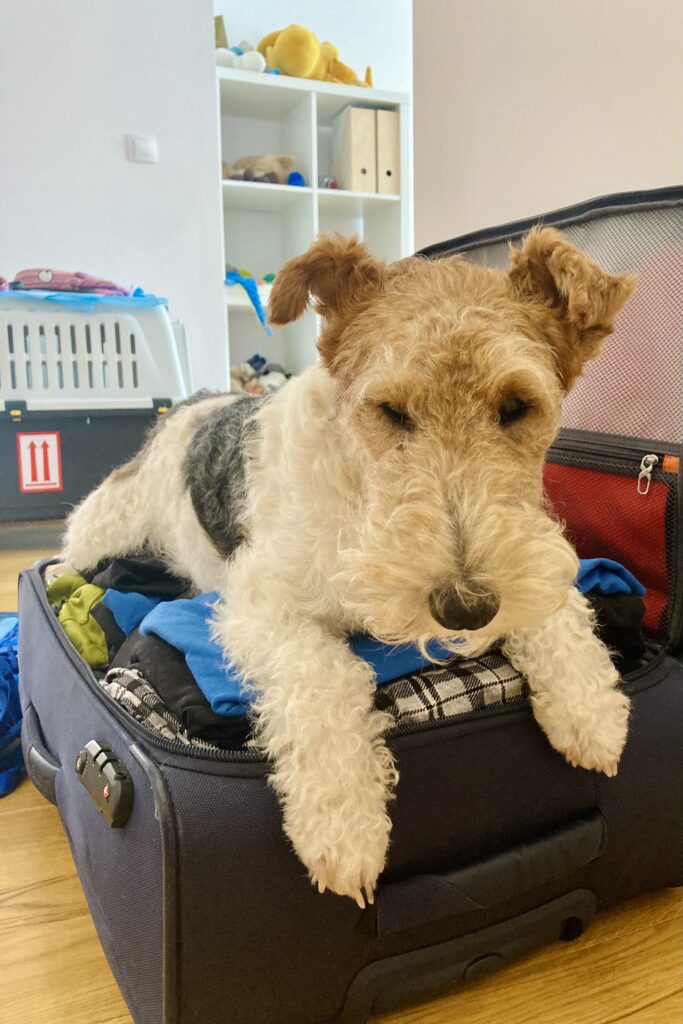
Before any trip, consider where you’re going and whether the country is safe for a dog. This assessment should include not only the current security situation, but also cultural and religious context. Not every culture views dogs the way we do—for example, in some Muslim countries dogs are considered unclean, which can influence the attitude of the public, hotels, or carriers.
Beyond social factors, factor in the climate at your destination. Long flights can expose dogs to sudden weather changes. Tropical heat may be appealing to humans, but not every breed tolerates high temperatures well.
Think about weather at your transfer points too. While terminals and aircraft are usually climate-controlled, a dog traveling in the hold can spend quite some time on the tarmac before loading, exposed to rain, wind, heat, or frost. We’re not saying you should avoid such destinations, but it’s wise to prepare both yourself and your dog for possible complications.
Preparing your dog’s veterinary paperwork
If you’re heading outside the EU, assembling veterinary paperwork can take time—ideally start at least 2 to 3 months before departure. Many steps, such as antibody tests or post-vaccination waiting periods, are time-bound. In some cases, a state veterinarian’s signature and round stamp are required.
It’s often worth getting the documents officially translated into the language of your destination, which can take a few days to a week. We recommend buying tickets only after all required tests have been processed successfully and your paperwork is complete, signed by a vet, and translated if needed.
The main components of the health paperwork include:
Pet passport
Issued by a veterinarian, this document contains your dog’s vaccination record, identification (microchip), and health details. All tests and vaccinations related to the trip must be properly recorded, and dates must meet the entry rules of your destination. Some countries require, in addition to entries in the passport, a specific form or a confirmation from the Regional Veterinary and Food Administration (RVPS), which issues bilingual certificates.
Valid vaccinations
The rabies vaccine is essential, and depending on the destination, other vaccines may be required. In most cases, vaccination must be administered at least 21 days before travel. Also check the requirements for your return home.
Rabies antibody titer test
Some countries require proof that your dog has sufficient antibodies against rabies. The test is done from a blood sample and can take 2 to 4 weeks to process, sometimes longer. It’s performed at least 30 days after vaccination and at least 3 months before entry. Timing is crucial.
Additional tests based on destination
Certain destinations may require screening for diseases such as leishmaniasis. Requirements vary by country, so build them into your planning.
Parasite treatment
Some countries (e.g., Finland, Ireland, the United Kingdom) require proof of deworming prior to entry.
Veterinary health certificate
Some airlines or countries require a recent certificate (usually within 5 days before departure) confirming the dog is healthy and fit to travel.
Important notice
Always verify the exact entry conditions for traveling with a dog directly with the embassy or on the destination’s official websites.
On our site we’re gradually adding general information and real-world notes from our trips with a dog. Right now we have a more detailed overview of entry rules from the EU to South American countries, to Norway, and to the countries of the former Yugoslavia.
Are you planning a trip abroad with your dog? Check the entry requirements for various countries directly in BorderCooler®.
Buying tickets
We recommend buying tickets only after your dog’s health paperwork is fully prepared. Before choosing an airline, check whether they carry dogs and under what conditions.
We’ve found it best to book by phone. That way you can secure your ticket and your dog’s at the same time and avoid finding out there’s no remaining pet spot on your flight.
Before you call, have ready:
- your dog’s weight,
- the crate’s weight and dimensions.
Adding a dog increases the cost of your ticket. Depending on the airline and flight length, it can be up to 350 EUR per segment.
You’ll also find a detailed overview of well-known airlines and their pet policies on our site.
Preparing your dog for the flight
Start preparing a few weeks before you travel.
Crate training: begin with short stints and gradually extend them.
Getting used to noise and motion: simulate airport-like conditions.
Consult your vet: discuss any calming aids with a professional.
Adjust feeding before the flight: don’t feed your dog for several hours pre-flight, make sure there’s water available, and take a proper walk beforehand.
Getting to the airport and airport procedures
Getting to the airport
Arrive with plenty of time. Add at least 30 extra minutes to your usual buffer.
Check-in
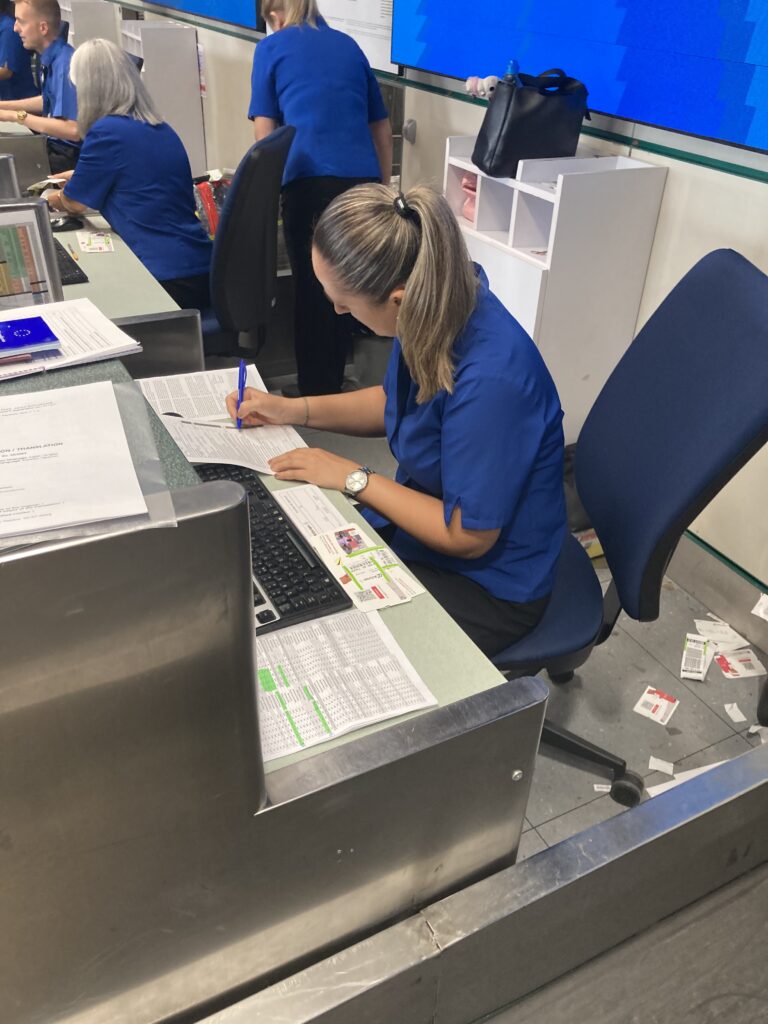
You’ll present your tickets and your dog’s veterinary documents. You may be asked to sign a declaration attesting to your dog’s health and compliance with transport requirements.
Use check-in to gather as much information as possible—where and when to hand over your dog, where to collect them at your destination, and similar details.
Last walk before the flight
This usually happens before entering the departures hall. Your dog should be comfortable with the buzz and noise around the terminal.
Security screening
Procedures vary by airport and by how your dog is traveling.
Handing your dog over for transport
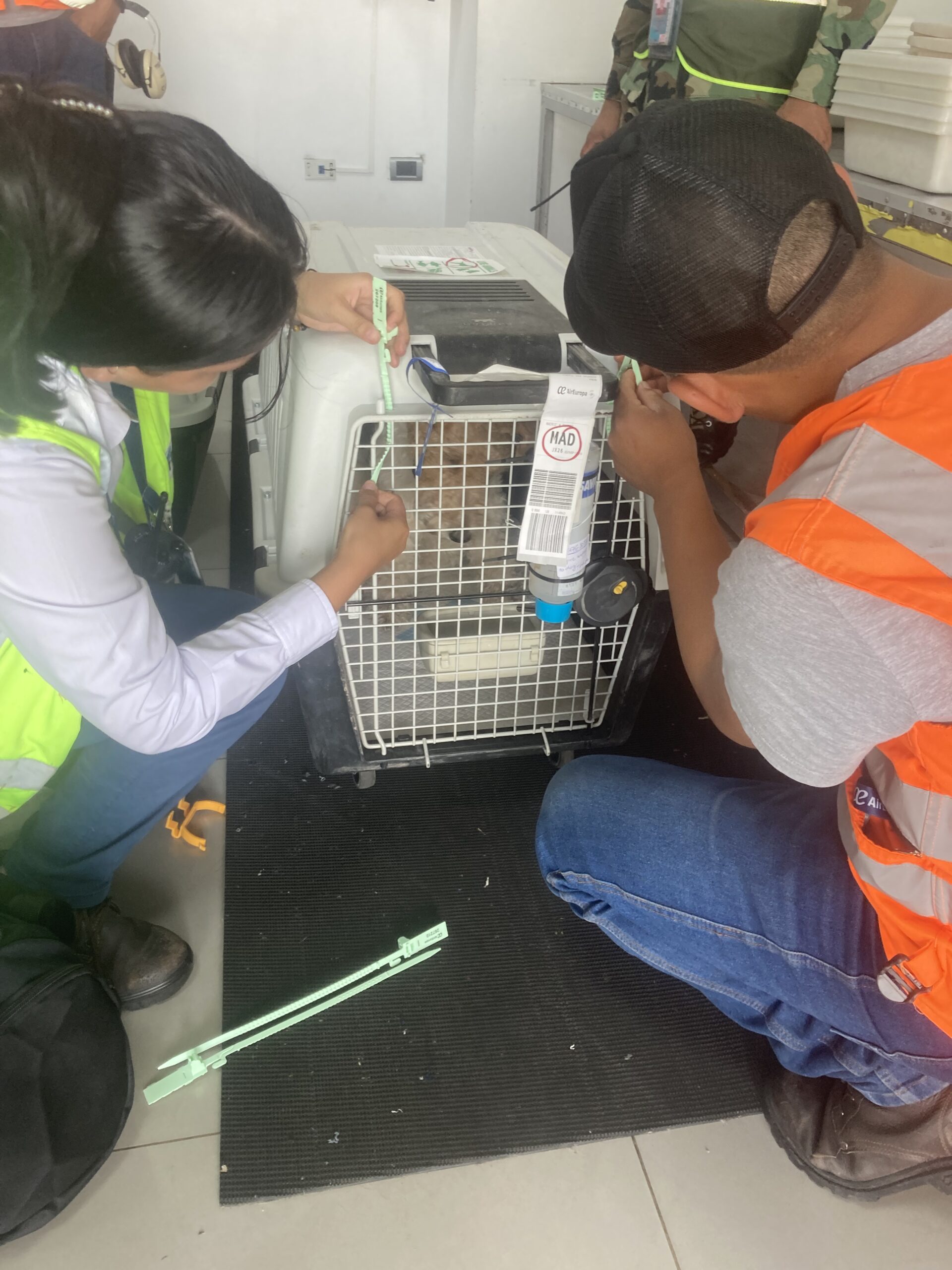
If your dog is traveling in the hold, place them in the crate and hand it over at the oversized baggage counter. You may be asked to remove the crate’s wheels and lock it. Keep space for the wheels in your carry-on.
During the flight
The experience differs significantly depending on whether your dog travels in the cabin or in the hold.
Dog in the passenger cabin
If your dog meets the airline’s weight and size limits, they can travel in a closed carrier placed under the seat in front of you. They must remain inside the carrier for the entire flight—opening it or taking the dog out is not allowed, even on calm flights.
Before takeoff and landing, the crew will check that the carrier is correctly positioned. Some airlines require it to be fully under the seat and that the dog’s head stays inside.
You can soothe your dog with your voice during the flight. It’s smart to have an absorbent pad in the carrier and a small collapsible water bowl just in case. Feeding mid-flight is usually not recommended, especially on shorter routes.
It’s very important that your dog is already used to the carrier at home. If they know it as a safe space, it greatly reduces stress during the flight.
Dog in the hold
If your dog travels in the hold, you won’t have access to them during the flight. This also applies during connections—your dog remains in the care of airport staff and is transferred between aircraft without you.
They do, however, travel in a climate-controlled and pressurized section of the aircraft designated for live animals.
In this scenario, a quality IATA-approved crate is essential. It should be sturdy, securely closed, lined with an absorbent pad, and equipped with a water container fixed so it can be refilled from the outside.
Be prepared that from handover to pickup you won’t have direct control over your dog (usually not even during layovers). Choose sensible connection times—not excessively long, but not very tight either (there’s a risk the crate won’t be transferred in time).
After landing
If your dog traveled in the hold, your first task is to find and collect them. In most cases this happens in the baggage claim area, but the exact point varies by airport.
Most commonly this means:
- the Lost and Found counter,
- the oversized baggage belt or window,
- a dedicated counter for live animals.
If you’re unsure, ask staff. It’s better to get clear instructions right away than to wander around arrivals.
On flights outside the EU, veterinary paperwork may be checked on arrival. Don’t underestimate this step or try to bypass it. It can lead to delays, complications, fines, or even quarantine.
You can usually open the crate only after all formal checks, typically in the arrivals hall. As soon as you do, greet your dog and check their mental and physical condition—breathing, hydration, any injuries, or signs of extreme stress.
Minor hygiene mishaps can happen. Carry wet wipes, spare absorbent pads, and waste bags.
Find a suitable place for a walk as soon as possible after arrival. Many larger airports have designated relief areas. Study the airport maps for all your stops before you fly.
Transport from the airport
Plan your onward transport before you depart. Make sure your chosen option accepts dogs and that there’s enough space for the crate. Long waits after a demanding flight aren’t pleasant for you or your dog.
Conclusion
Flying with a dog is undoubtedly more involved than traveling without one. It takes more planning, more paperwork, and more responsibility. On the other hand, it brings real value—the chance to share travel experiences with a four-legged member of the family.
With good preparation, enough lead time, and a careful read of the rules, the whole process can be managed without unnecessary stress. Most complications come from overlooking details, not from the flight itself.
If you have concerns, questions, or you’re unsure about the specific requirements for your destination and airline, feel free to contact us. We’ll gladly share our experience and help you prepare so you can travel with your dog confidently and calmly.