


Croatia has long been one of the most popular holiday destinations for Slovaks, Czechs and many other European travellers. It’s easy to reach by car, the sea is clean, there are countless islands and the overall setting feels safe—making it a natural choice for travelling with a dog.
For our Ibo, Croatia was one of the first countries abroad he ever visited. His first sea, first ferries, first long motorway drives. It still has a special place for us. Over time we kept coming back—to Krk, Dugi Otok, the Makarska Riviera, Zadar and the mountains.
We’ve covered Croatia pretty well, but this isn’t an encyclopaedic overview of the entire country. It’s a summary of our real experiences in the places we visited with a dog, and the topics we actually dealt with on those trips.
Table of Contents
Is Croatia dog-friendly?
In our experience, yes—if you consciously avoid extremely crowded spots and remember that summer by the sea also means high temperatures.
We see the main advantages as:
- short driving distance from Slovakia and the Czech Republic
- quality infrastructure and modern motorways with rest areas suitable for dogs
- easy navigation and good connections to the islands by ferry or bridge
- readily available veterinary care
- a relatively low language barrier for Slovaks and Czechs
- proximity to interesting destinations in neighbouring countries for day trips (Mostar, Una Waterfalls, the Bay of Kotor, etc.)
We tend to instinctively avoid busy, crowded places, so this guide naturally reflects that.
Entry to Croatia with a dog
Croatia is a member of the European Union, so travelling from another EU country is a standard intra-EU trip with a dog. In practice, you need a valid microchip, a rabies vaccination and an EU pet passport.
If you’re driving from Slovakia, Hungary or Slovenia, there is usually no formal border control, but your documents must be in order. When entering from outside the EU, requirements are assessed more strictly.
You’ll find detailed information on exact requirements, returning from non‑EU countries and real border experiences in our separate article about entering Croatia with a dog.
Interested in this destination? Would you like to visit it with your dog? Check the entry requirements directly in BorderCooler®.
Getting around Croatia with a dog
Under Croatian law, an animal must not endanger the driver or road safety while the vehicle is moving. In practice, that means your dog should be secured so it can’t roam freely around the cabin.
The options are the same as elsewhere in the EU—travel crate, a safety harness clipped to the seat belt, or a physical barrier between the boot and the cabin.
We always transported Ibo in a soft-sided crate placed behind the rear seats. This setup worked well for us—he had his own space, it was stable, and we could still keep an eye on him.
We find travel within Croatia very comfortable. The motorways are modern, well signed and with frequent rest areas where you can safely walk your dog. Getting around is straightforward and the transport infrastructure is among the best in the region.
General rules for dogs in public
In general, your dog must not endanger other people or animals, and you are fully responsible for it.
In towns, ports and busy tourist areas, a leash is usually required. Some parks or historic centres may have local restrictions. Cleaning up after your dog is a given.
We were also pleasantly surprised by the level of dog infrastructure. In central Zadar, for example, we found a park dedicated solely to dogs—with a water dispenser, bowls, obstacles and a fenced area.
Dog-friendly beaches
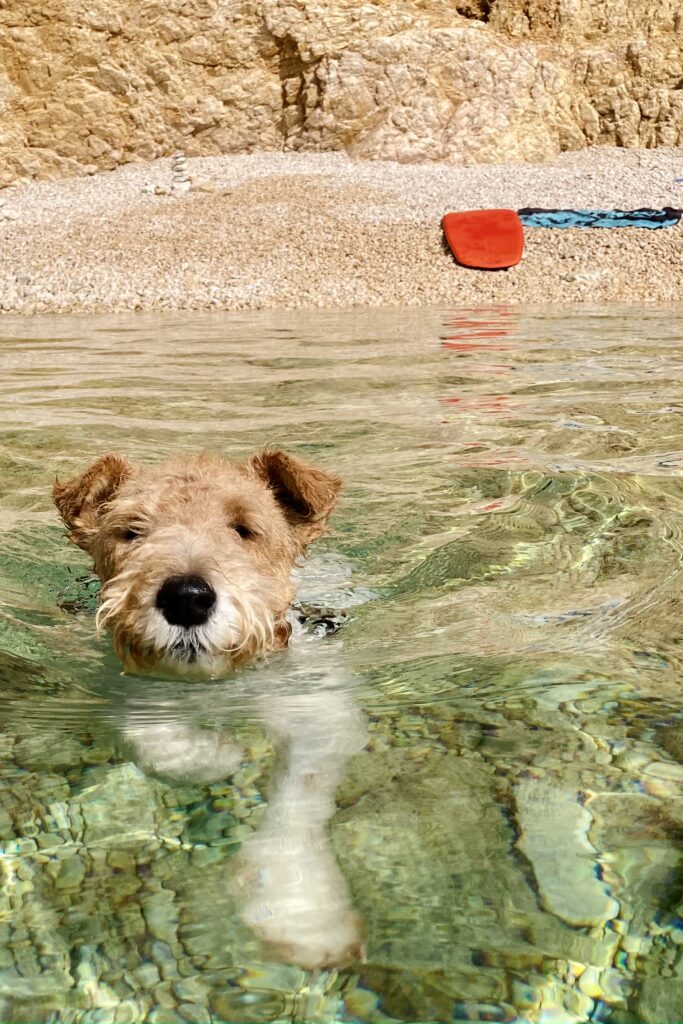
Always check beach rules locally. Croatia doesn’t have a nationwide standard—each municipality sets its own restrictions.
Krk
Krk is among the most dog-friendly areas we’ve experienced. You’ll find official dog beaches and plenty of small coves that, outside peak season, are very pleasant and quiet.
Dugi Otok
Dugi Otok is one of the quietest and least populated islands in the country. Beyond the main villages there are lots of natural entry points to the sea where being with a dog is no problem. Official signage is often missing, but in practice there’s rarely any conflict.
The island is also home to the Telašćica Nature Park. Even in this protected area we moved around with our dog without issues—always with respect for the environment.
Makarska Riviera
Here things are stricter. Town beaches ban dogs. Your best bet is the fringes, early mornings or evenings, and the less frequented stretches.
In our experience, Croatians are friendly and tolerant if you behave considerately and respect local signs.
Ferries and islands with a dog
Taking a ferry can look complicated at first, especially if you’re travelling with a dog. But the islands, in our view, offer the best of Croatia—more peace, fewer people and lovelier natural scenery.
In our experience, ferry crossings are easy to manage even with a dog:
- use navigation to time your arrival at the port so you don’t wait unnecessarily
- dogs usually travel free on Croatian ferries
- your dog can stay in the car (not recommended in the heat) or be with you on deck; access to indoor restaurant areas is usually not allowed
If you want more detail on taking dogs on ferries, we’ve covered it in a separate article: Taking a ferry with a dog.
Hiking with a dog
Croatia is not just beaches and sea. It also offers interesting mountain ranges for dog-friendly hiking.
One example is Biokovo, which rises dramatically above the Makarska Riviera and offers stunning views of the coast and islands. Another fascinating area is the Dinara range with the highest peak in Croatia—Sinjal (1,831 m a.s.l.). It’s part of the Dinaric Alps, with a rougher, less touristy character.
When planning hikes, be mindful of summer heat and scarce water. Many routes are completely dry and springs are seasonal. We recommend early starts, plenty of water and a realistic assessment of your dog’s (and your own) fitness.
Accommodation
We almost always booked accommodation online in advance and confirmed before arrival that it was genuinely dog-friendly.
We’ve never come across a place that didn’t accept our dog, or that banned him from parts of the accommodation—or, for example, the sofa or specific parts of the room. Compared with some other Balkan countries, Croatia is distinctly dog-friendly in this respect.
When choosing accommodation, we pay particular attention to:
- weight limits for dogs
- any daily pet fee
- shaded outdoor space
- suitable places to walk the dog nearby
Keep in mind that ‘pet friendly’ can mean mere tolerance of dogs, not true comfort.
Croatia outside peak season
We tend to visit Krk just before the main summer season begins. That means fewer traffic jams, cheaper accommodation, fewer people on the beaches and an overall calmer atmosphere.
You can already feel the warmth, but it’s not as extreme as in peak season—a big plus for dogs. The sea may be cooler, but for most dogs that’s not a problem.
If we had to pick the ideal time for a first holiday in Croatia with a dog, we’d choose the shoulder season.
Conclusion
From our perspective, Croatia is an excellent country for a holiday with a dog. It combines sea, mountains, quality infrastructure and relatively straightforward rules.
For us it’s always been friendly people, a laid-back atmosphere and places suited to both relaxing and active days.
The biggest risks aren’t the rules but the heat and underestimating logistics. Prepare well, avoid crowded spots and make sure your dog has shade and water, and Croatia can be an ideal first foreign destination—just as it once was for Ibo.
FAQ – frequently asked questions
Can dogs go on beaches in Croatia? Where can we find dog beaches?
Yes, but it always depends on the municipality. Some town beaches ban dogs; elsewhere there are official dog beaches in Croatia, marked with signs. Outside major tourist centres the situation is looser. Watch local signage and aim for early mornings or evenings.
Do dogs have to be on a leash in Croatia?
In public areas—towns and ports—a leash is usually required. Away from busy zones the approach is more relaxed, but your dog should always be under control and not bother others.
Are Croatian ferries complicated with a dog?
In our experience, no. Island crossings are logistically simple and well organised. Your dog can be with you on deck (usually not inside restaurant spaces) or stay in the car, which we don’t recommend in hot weather.
Is Croatia suitable for a large dog?
Yes. Size isn’t the main issue. More important are fitness and the ability to handle heat. In summer, shade, water and sensible day planning are crucial.
Is Croatia a good first trip abroad with a dog?
We think so. Easy car access, good roads, simple rules and a relatively small language barrier make Croatia a very suitable first experience abroad.
Is it easy to find dog‑friendly accommodation in Croatia?
In most tourist areas, yes. Filter for pet-friendly options in advance and confirm the specific conditions before you arrive. We haven’t faced a refusal or any unexpected restrictions.
When is the best time to go to Croatia with a dog?
In our view, the shoulder season—late spring or early autumn—is ideal. Fewer people, fewer traffic jams, more pleasant temperatures and a calmer atmosphere make it a great choice for both dog and owner.