
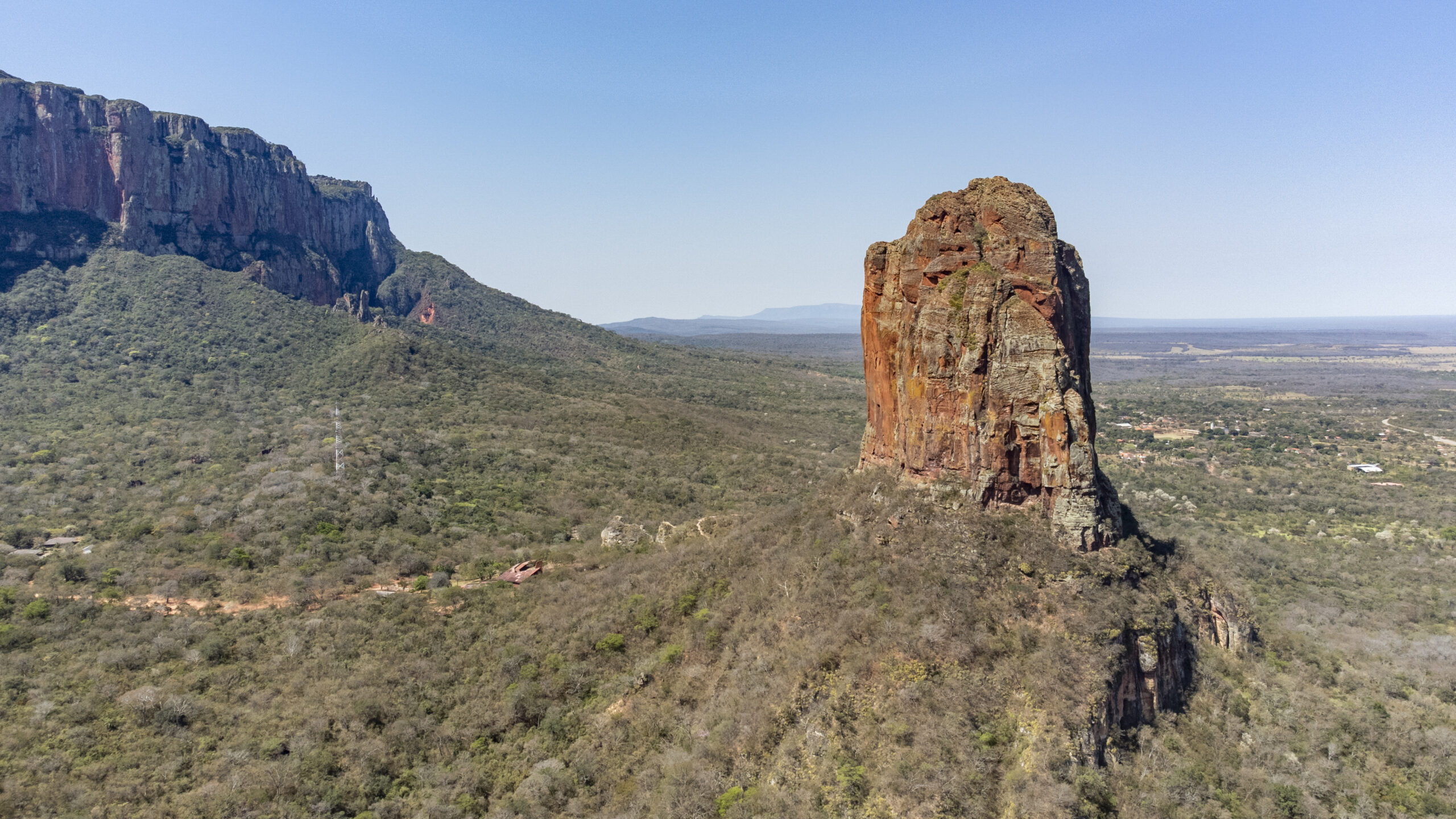


Eastern Bolivia is often overlooked. Most travelers head for the Andes, the Salar de Uyuni or the Amazon. Yet the lowlands around Santa Cruz hide places that feel completely different—quieter, more authentic, and refreshingly free of crowds.
This multi-day road trip leads from Santa Cruz de la Sierra through historic mission towns to the Roboré area, where the landscape shifts into a mix of jungle, red rock, and waterfalls.
It’s a route you can do by car without complicated logistics—yet it delivers a surprisingly powerful experience.
This itinerary is based on our real trip—we visited eastern Bolivia in August 2025. We made almost all the stops with our dog Ibo. If you’re planning to do this route with a dog, check access rules in advance, especially for museums and religious sites.
Day 1: Drive to San José de Chiquitos
In the morning, we head east from Santa Cruz de la Sierra along the F4. It’s about a 2.5-hour drive into the Chiquitania, a region of red earth, drier landscapes, and very little tourism.
On arrival we check into an eco-resort in San José de Chiquitos, a quiet spot on the edge of town.
We spend the rest of the day unwinding—perhaps by the pool—and end with dinner right at the resort.
Day 2: San José de Chiquitos and the surrounding area
Start with breakfast at the resort, then spend the day exploring the historical and natural highlights around San José de Chiquitos.
San José de Chiquitos
Visit the historic center, home to one of the best-preserved Jesuit missions in the region.
This stop includes:
- Museo Misión Jesuítica – learn how the Jesuit missions worked and what they meant for the region
- Misión de San José – a unique red-stone mission, one of the area’s most striking buildings
Sitio Arqueológico Santa Cruz la Vieja
Next we head to the original site of Santa Cruz, just outside San José de Chiquitos.
This is where Santa Cruz de la Sierra was founded in 1561 by the Spanish conquistador Ñuflo de Chávez. The site, now known as Santa Cruz la Vieja, marks the city’s first location, later moved closer to where it stands today.
It’s a historically important stop that helps make sense of how the region was colonized, how the first settlements functioned, and why the city was gradually relocated.
Valle de la Luna
Continue to the Valle de la Luna, known for its unusual rock formations.
The landscape here feels lunar—eroded red rock, odd shapes, and a character unlike the rest of the region.
Mirador de Ñuflo
Finish the day at Mirador de Ñuflo, timing it for sunset.
The lookout opens onto sweeping views of the Chiquitania. At sunset it has a special atmosphere and is often a highlight of the day.
Interested in this destination? Would you like to visit it with your dog? Check the entry requirements directly in BorderCooler®.
Day 3: Hike to Cerro Turubó
We devote day three to hiking up Cerro Turubó, one of the area’s standout natural landmarks.
The trail crosses the dry country typical of this region and gradually climbs to the summit. Expect broad views, almost no crowds, and an authentic feel for the local landscape.
Afterwards, relax back at the resort.
Day 4: Drive to Roboré
After breakfast we continue east toward the town of Roboré.
Chochís and Torre de David
En route we stop in the village of Chochís for a short hike to the striking rock formation Torre de David, and visit the nearby Santuario Mariano de la Torre—a notable spiritual site with bold architecture set in the rural landscape.
Cascada El Velo de Novia
Then we continue to the Cascada El Velo de Novia waterfall.
A short hike leads to the falls, which drop into a natural pool—perfect for cooling off on a hot day.
Arrival in Roboré
By late afternoon we reach Roboré, check in, and spend the evening in a town that feels calm and genuine, with hardly any tourism.
Day 5: Around Roboré
We devote this day to the natural attractions around Roboré—a relaxed day with plenty of swimming and downtime.
Chorro de San Luis
Visit the Chorro de San Luis waterfall. The trail through the local jungle takes about 30 minutes.
The falls plunge into a natural pool framed by greenery and are among the most beautiful spots in the area.
Aguas Calientes
We also head to the Aguas Calientes area.
Here you’ll find natural hot springs—an ideal way to unwind after the road trip.
Optional extension: San Ignacio de Velasco
If you’re keen, add a day and continue to San Ignacio de Velasco, one of the most important Jesuit missions in the Chiquitania.
From Roboré, drive northeast for around 2–3 hours. On arrival, spend the afternoon exploring the town and its surroundings.
San Ignacio de Velasco
The town is one of the main centers of Jesuit missions in Bolivia and has retained a notably authentic feel.
- Misión Jesuítica de San Ignacio de Velasco – a monumental 18th-century church (founded in 1748), known for its wooden architecture and richly decorated interior
- Central square (Plaza Principal) – the town’s natural heart, with a colonial atmosphere and everyday local life
- Museum of the Missions – offers a deeper look at the history of the Jesuit reductions and how they operated in the region
The afternoon is ideal for a slow wander through town and soaking up the atmosphere of this less-visited corner of Bolivia.
After an overnight stay, start the drive back toward Santa Cruz the next day.
Day 6: Return to Santa Cruz
The final drive back to Santa Cruz de la Sierra depends on which version of the itinerary you choose.
- Base itinerary (5 days): return directly from Roboré; leave early and allow about half a day on the road
- Extended itinerary (6 days): return from San Ignacio de Velasco; it’s a longer drive, so set off as early as possible
Conclusion
This is one of those understated yet powerful experiences of Bolivia.
It doesn’t serve up headline must-sees like Uyuni; instead, it reveals a more authentic side of the country—no crowds, just real contact with the place and its people.
If you want to experience a Bolivia most travelers never see, this is the way to go.
The purpose of this article is to show the kinds of itineraries we can design and what a trip like this looks like in practice. We tailor route details, logistics, and recommendations to each brief—exactly to how you want to travel.
Practical info and route overview
- Duration: 5 days (or 6 with the San Ignacio de Velasco extension)
- Route: Santa Cruz de la Sierra – San José de Chiquitos – Roboré – Santa Cruz
- Highlights: Jesuit missions, Valle de la Luna, viewpoints, waterfalls, hot springs
- Trip type: self-drive road trip (paved roads plus short local dirt turnoffs)
- Difficulty: easy to moderate
- Ideal for: travelers who want Bolivia beyond the main routes
- Best time: the dry season (roughly May to October) brings less rain, better road conditions, and pleasant temperatures for driving and hiking