
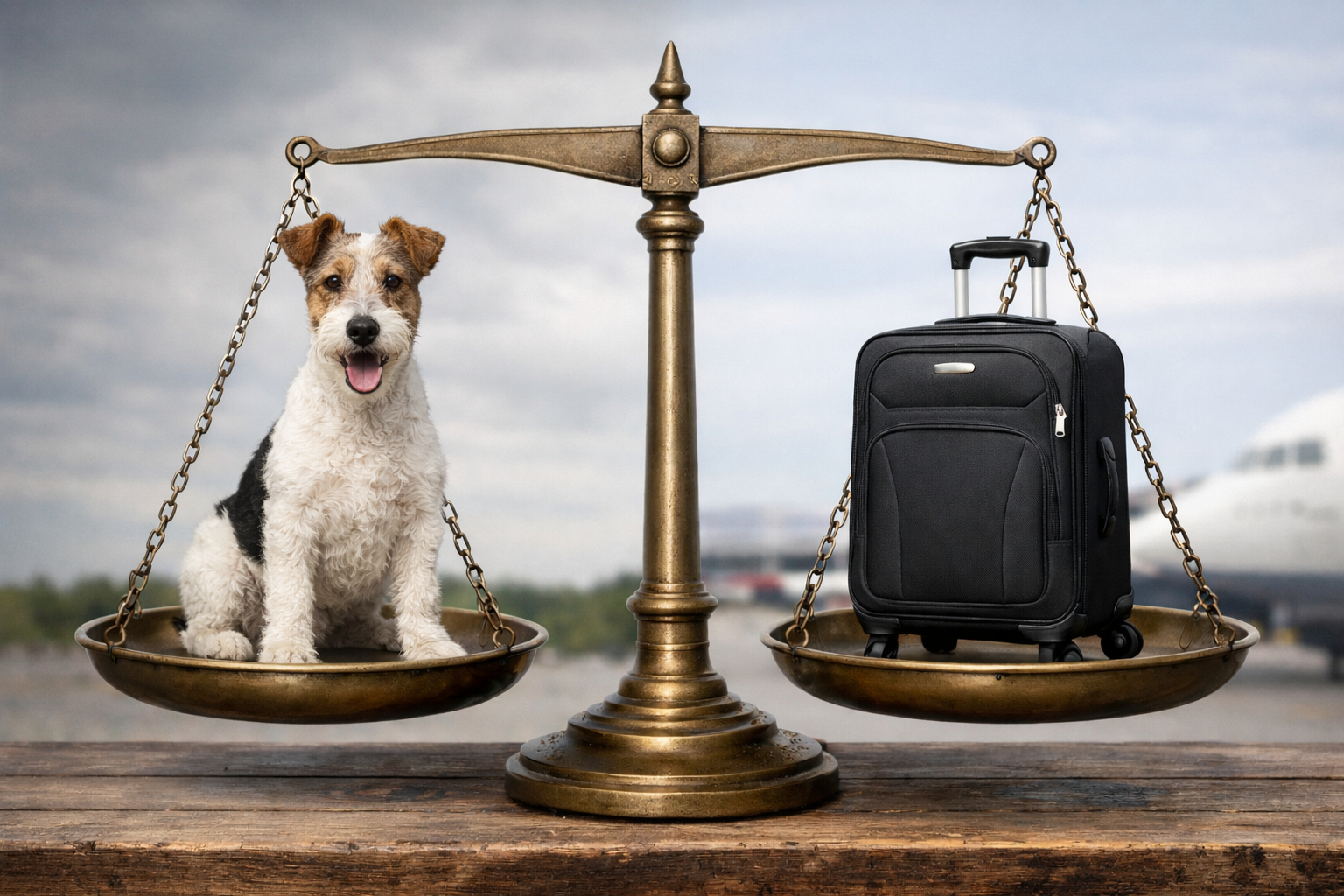
Traveling with a dog is for many a natural part of life, for others something unimaginable or — in the best case — a major complication that can significantly change the nature of a holiday or trip. The truth is that a dog is neither purely a “bonus” nor exclusively a “problem” — it is a factor that changes the way you travel. Let’s look at it systematically: negatives, positives and the neutral dimension of traveling with a dog.
Disadvantages of traveling with a dog
Financial aspect
Traveling with a dog is generally more expensive.
Accommodation labeled as pet friendly is often more expensive or charges a one-time or daily fee for the dog. In transport — whether train, bus or plane — a separate ticket or surcharge is usually required. When flying, these amounts are often not negligible. Added to that are costs for equipment and preparation: a carrier, a safety tray for the car, travel bowls, pads or a veterinary check-up before the trip.
Individually these are not dramatic amounts, but ultimately they can significantly increase the budget of the entire trip.
Restrictions on where and when you can go with a dog
A dog is not welcome everywhere and a destination is not always suitable for staying with a dog.
Many national parks, protected areas, museums, castles or historic monuments have a ban on dogs or very strict rules. Many beaches, swimming areas and urban attractions become inaccessible to you because dogs are prohibited. Although the situation in gastronomy is gradually improving, entry with a dog into restaurants and cafés is still not a given. Traveling with a dog naturally also brings a narrower selection of accommodation options.
If you like extreme weather, that doesn’t mean your four-legged friend will enjoy it too. It’s hard to spend a pleasant beach holiday with a dog at 40 °C temperatures or in frigid Greenland.
That means more planning, checking rules and sometimes having to give up certain places or experiences.
Logistics and responsibility
A dog brings additional responsibility to traveling.
You can’t make long transfers or undertake strenuous activities regardless of its needs. The schedule must be adapted to the weather, the dog’s fatigue, the need for water, shade and rest. If a health problem appears, priorities change immediately and the whole itinerary can fall apart.
Positives of traveling with a dog
A calmer style of travel
A dog naturally adjusts the itinerary of a trip.
The pace slows down, the schedule is less packed and extremes gradually disappear. Long days full of transfers, rushing between sights or physically extreme activities occur less often. Instead, there is more room for nature, walks, short trips and spontaneous stops.
For many people, it’s a return to simpler, calmer travel.
Mental well-being and companionship
Traveling with a dog means you are never completely alone.
A dog can reduce stress, help handle unexpected situations and bring a feeling of home even in a foreign environment. At the same time it often serves as a natural way to make contact — people speak to you, ask questions and communication arises spontaneously.
Stronger bond and ethical dimension
For many owners it is natural to take the dog with them.
The stress of finding a sitter or temporary care disappears. Shared experiences strengthen the bond between human and dog and create memories that would not arise when traveling without a dog.
Neutral dimension of traveling with a dog
The dog as a variable, not a problem
The dog itself is neither an advantage nor a disadvantage.
It is a factor that changes the character of the journey. It influences the choice of places, the pace and the daily routine. It forces you to plan more realistically, with less emphasis on performance and more emphasis on comfort.
Difference between an individual and a group
A fundamental difference is whether an individual travels with a dog or several people do.
If an individual travels, the whole schedule must adapt to the dog. In a group the situation is more flexible — the program can be split. Part of the group will undertake more demanding or dog-unsuitable activities, while the rest stays with the dog on a calmer itinerary.
The dog thus naturally belongs to the calmer branch of the itinerary without significantly restricting anyone.
Change of priorities
Traveling with a dog often changes the view of what is important on a trip.
Fewer places, more time. Fewer extremes, more balance. Less performance, more presence.
Conclusion
Traveling with a dog is not suitable for everyone or for every type of trip. It brings higher costs, restrictions and responsibility. At the same time, however, it offers a calmer rhythm, a stronger experience of the moment, a unique feeling of companionship and often opens the way to greater socialization with locals.
A dog isn’t an item you pack with your luggage. It’s another member of the trip and, like any human member, can affect the overall experience both positively and negatively. That said, the better behaved the dog, the fewer the negatives.
If a person accepts that a dog naturally adjusts the itinerary and eliminates extremes in the program, traveling with a dog can become a full-fledged and enriching way to explore the world.