

An early-summer climb of Cima di Terrarossa (2,420 m) was one of those days that remind you why you love the mountains. The quiet of first light, a hint of winter still hanging on in late June, and the company of a dog turned the hike into something hard to sum up in a single line.
Getting to Sella Nevea
We set off by car from the village of Log pod Mangartom, crossed the border, and continued to the Italian mountain village of Sella Nevea. From there, a steep paved road leads to the parking area below Rifugio Giacomo di Brazzà, at roughly 1,500 m.
Even at the car, it was clear we had a proper mountain day ahead: more than 900 metres of vertical and a fairly steep climb.
When your dog says “no”
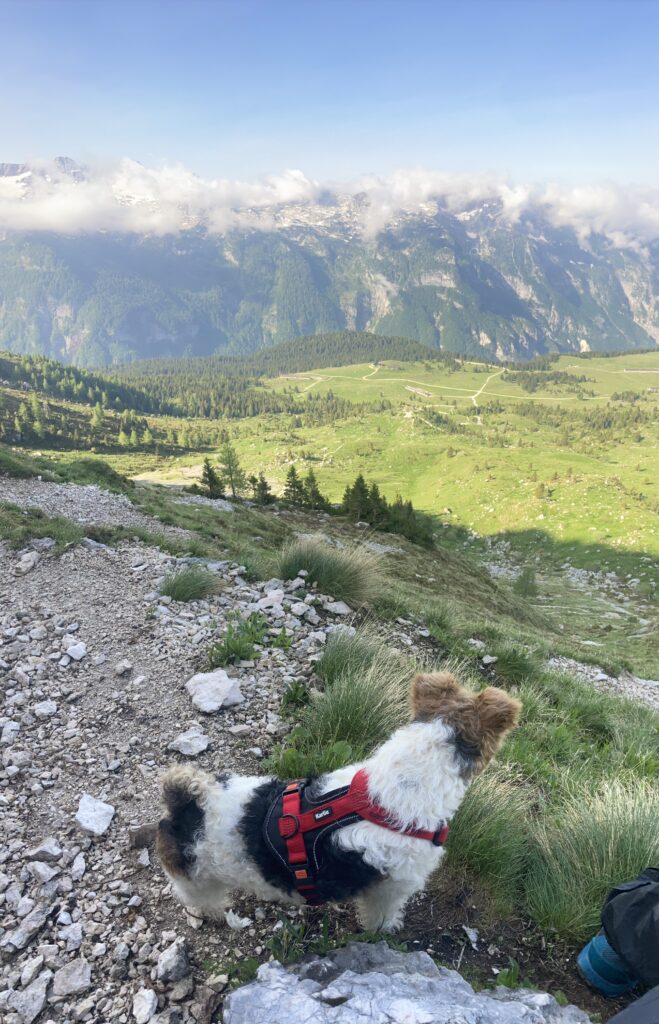
Ibo didn’t look thrilled that morning. By stubbornly ignoring commands and circling back to the car, he made it clear he wasn’t in the mood for adventure. The first stretch played out with a bit of tension, and we wondered if we’d chosen our goal a touch too optimistically.
Everything changed about thirty minutes in, when we reached Rifugio Giacomo di Brazzà. From there, the path tilted up in earnest, and that, it seemed, finally woke Ibo up.
Interested in this destination? Would you like to visit it with your dog? Check the entry requirements directly in BorderCooler®.
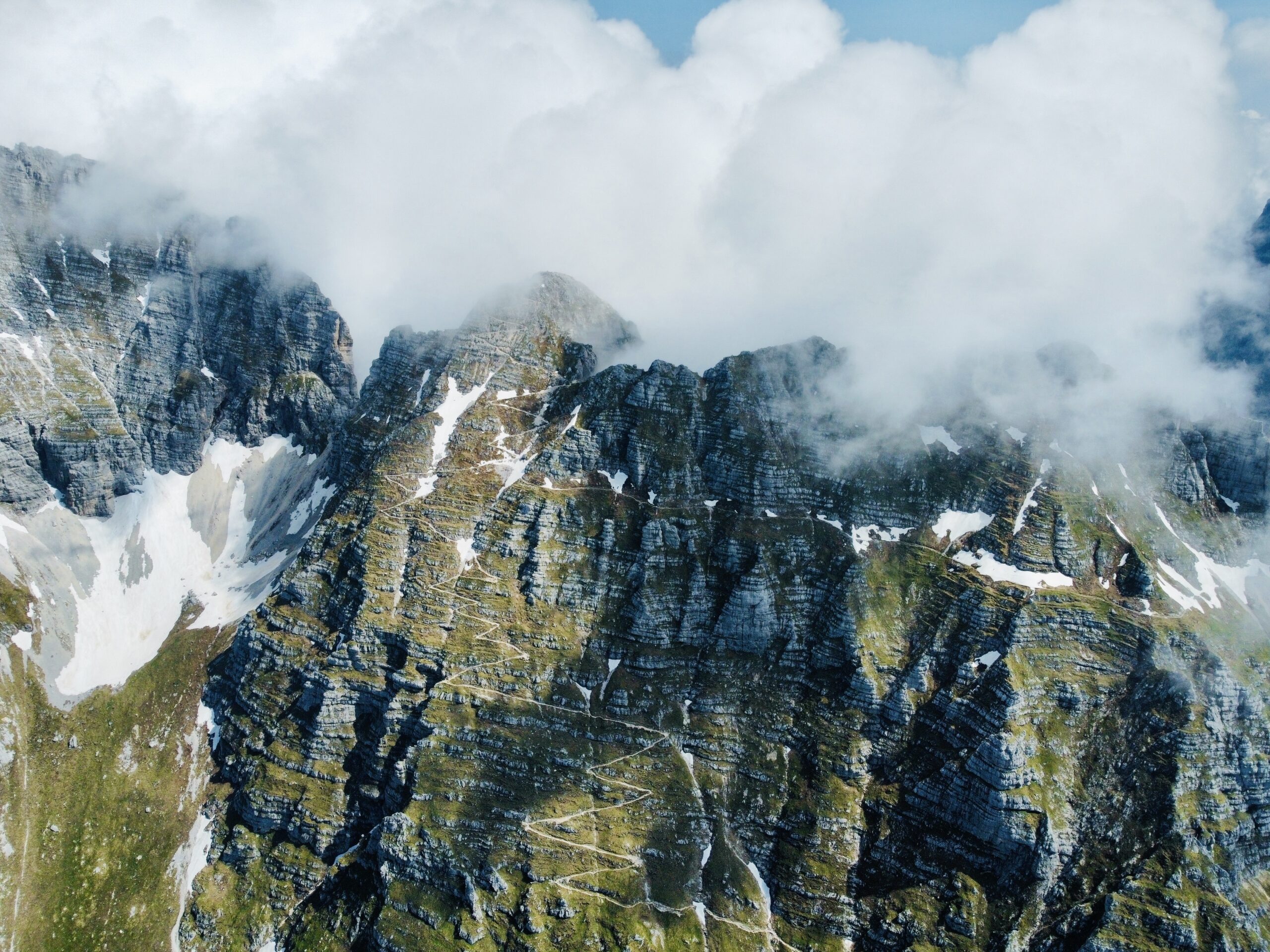
Endless switchbacks
After another twenty minutes or so, the trail pitched into tight switchbacks across a steep slope. From below it was often hard to see where it went next, but each bend revealed the logic of the route.
And there were plenty. We’d started early, so we had the place to ourselves—just us, a few chamois, and the occasional whistle from a marmot.
Forca di Terra Rossa saddle
We gradually approached the Forca di Terra Rossa (2,349 m). On the last stretch below the pass, the first patches of last winter’s snow appeared. There wasn’t much, and it was easy to skirt around.
The pass itself is fairly inconspicuous, and views are still limited. This is where the first hiker of the day caught up to us—an older Italian gentleman. With a bit of gesturing, we quickly worked out we were headed for the same summit. He moved a little faster, so we let him go ahead.
Final push and the summit
As we gained height, snow patches multiplied and a few stretches were completely covered. Fortunately, the angle stayed gentle and progress felt secure.
The top of Cima di Terrarossa came into view and the panorama began to open up. The first clouds rolled in—just as forecast—but it was clear we’d beat them. And we did.
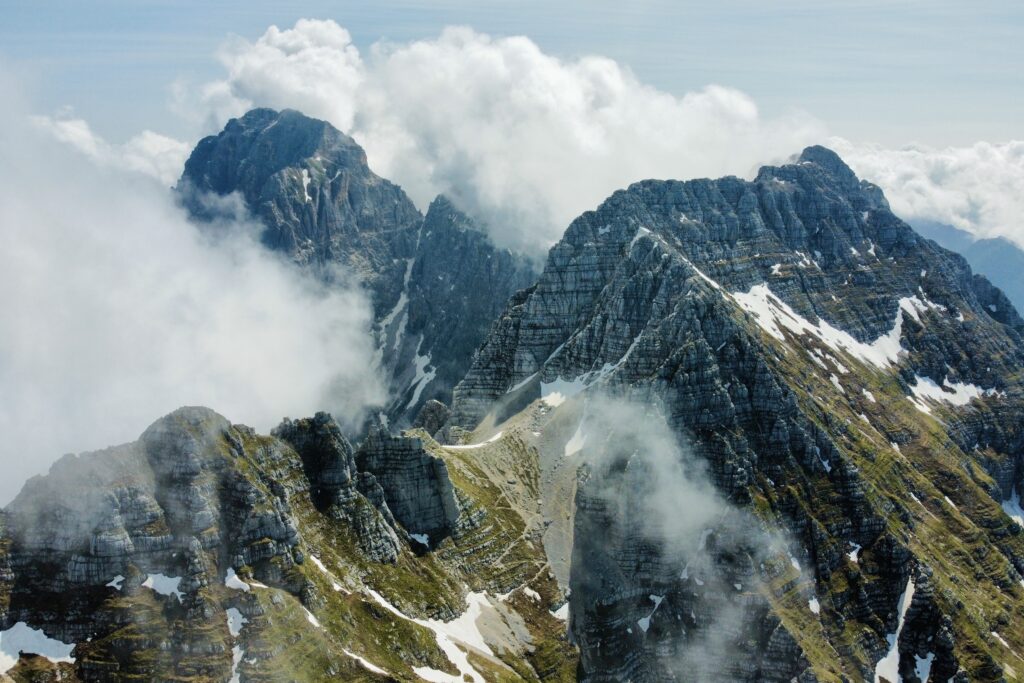
On the summit I take in the views from this new-to-me peak. Ibo flops into the grass and rests. I pull out the drone and grab a few shots from above. We spend just under half an hour up there.
Heading back
We pack up and retrace our steps. As much as the ascent made us work, the descent goes much easier. Before long we’re back at the car, settling in with that good, tired feeling and heading back to our lodging.
Practical notes for the hike
The route up Cima di Terrarossa is technically straightforward and well suited to a medium or large dog. Aside from the final stretches near the Forca di Terra Rossa and the summit itself, there are no exposed sections. Bring a hiking leash and, of course, a proper harness for your dog.
The only factor likely to complicate the climb is snow or ice, especially in early summer. It’s worth checking current conditions before you go.
Cima di Terrarossa is a great objective if you want an honest mountain climb and well-earned views—on a route a dog can manage.
Hike facts
- Summit: Cima di Terrarossa (2,420 m)
- Range: Julian Alps
- Elevation gain: approx. 900–950 m
- Ascent and descent time: around 6 hours (round trip)
- Start: parking area below Rifugio Giacomo di Brazzà (approx. 1,500 m)