


What does a road trip that, in just under two weeks, takes you across a slice of the American West — from Arizona’s desert canyons to Yellowstone’s geothermal wonders — look like?
The route starts in Las Vegas and ends in Salt Lake City. It runs through northern Arizona and the Navajo Nation, past Utah’s national parks, then continues north across Wyoming to the Grand Teton and Yellowstone region.
This suggested plan draws on my 2017 trip, when I followed an almost identical route while visiting the U.S. In Wyoming I witnessed a total solar eclipse — a moment that became a defining memory of the trip.
The road trip links icons like the Grand Canyon, Monument Valley and Antelope Canyon with lesser‑visited corners of Utah and Wyoming. After the dramatic desertscapes, the route leads into the quieter reaches around Capitol Reef, the Wind River Range, and finally the geothermal realm of the world’s first national park — Yellowstone.
Day 1 – Arrival in Las Vegas
We land in Las Vegas. After checking in, we walk a stretch of the Las Vegas Strip and stop at a few of the city’s classic sights.
We make a quick stop by the Bellagio, famous for its fountains. In the evening, those who want can visit one of the casinos. We spend the night in Las Vegas.
Day 2 – Grand Canyon North Rim and drive to Page
In the morning we leave Las Vegas, heading east for the North Rim of the Grand Canyon.
The canyon’s sheer scale and depth hit you immediately. Point Imperial is one of the finest viewpoints.
In the afternoon we continue toward the town of Page. Along the way we meet the Colorado River for the first time at Marble Canyon and stop at the historic Navajo Bridge.
We arrive in Page in the evening and stay the night.
Day 3 – Page and Antelope Canyon
We spend the third day in Page, a handy base for several well‑known natural attractions.
In the morning we visit Horseshoe Bend — the iconic meander of the Colorado River. Later we head to Lake Powell, where you can rent a kayak or take a swim.
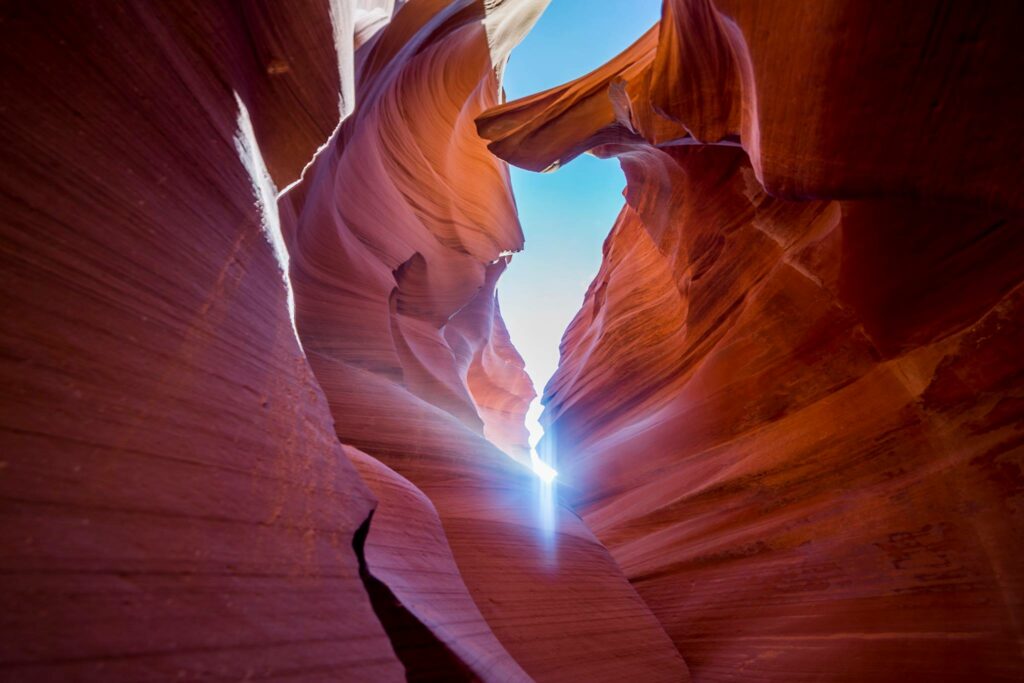
One of the area’s headline sights is Lower Antelope Canyon. While we wait to enter, local Navajo musicians set the mood with live music.
The canyon itself often exceeds high expectations. Narrow sandstone walls and light filtering from above create shapes and colors that are hard to forget.
Day 4 – Monument Valley, Moki Dugway and the Lake Powell region
In the morning we set out from Page toward Monument Valley.
On the way we stop at a few famous spots — such as the Mexican Hat rock formation and the viewpoint known as Forrest Gump Point.
We also pull over at Goosenecks and continue along the storied Moki Dugway. From there we detour to Muley Point for broad views over a landscape shaped by the Colorado River.
We make a stop at Hite Crossing Bridge. The bridge spans the northern reach of Lake Powell at the site of the former settlement of Hite, once an important crossing of the Colorado before Glen Canyon Dam was built.
If time allows, consider the lesser‑known Leprechaun Canyon — a tight slot canyon with smooth sandstone walls and Antelope‑like hues, but far fewer visitors.
Overnight in Hanksville.
Day 5 – Capitol Reef and a drive across Utah
We leave Hanksville in the morning. After about an hour we reach Capitol Reef National Park.
Here we take a short hike to Hickman Natural Bridge — a graceful sandstone arch high above the canyon and one of the park’s most photogenic landmarks.
If time permits, you can also visit the Upper Cathedral Valley Overlook — a viewpoint above the broad Cathedral Valley with sweeping views of classic sandstone monoliths and Capitol Reef’s desert scenery.
We arrive in the small town of Salina in the evening and stay overnight.
Day 6 – Stewart Falls and onward to Wyoming
Breakfast at the hotel in Salina, then a drive to the trailhead for Stewart Falls — a welcome leg‑stretcher after longer days behind the wheel.
If the weather is good and you have enough time, you can add a hike up Mount Timpanogos — one of the highest peaks in the Wasatch Range (3,581 m). It’s among Utah’s favorite hikes, but it’s a full‑day route, typically 8 to 10 hours, with beautiful views over Utah Valley. If you choose this hike, plan a dedicated day in the itinerary.
In the afternoon we continue north into Wyoming. The goal is to reach the area near the Wind River Reservation for the night and get ready to explore this lesser‑visited part of the state.
Day 7 – Wind River Reservation
We start the day in the Wind River Reservation, homeland of the Eastern Shoshone and Northern Arapaho. It’s a vast landscape of open country, mountain horizons, and a strong presence of Native American culture.
During the day you can stop at various places around the Wind River Range — including viewpoints over high alpine massifs and smaller mountain lakes — lesser‑known yet deeply impressive corners of Wyoming.
The wider region is known as a gateway to the wild Wind River Range, one of the most rugged and least populated mountain areas of the American West.
Toward evening we make a longer push west to the Grand Teton area and Yellowstone’s South Entrance.
Day 8 – Grand Teton, Signal Mountain and into Yellowstone
We wake near Signal Mountain Summit in Grand Teton National Park. In the morning we soak up views over Jackson Hole and the dramatic Teton skyline — among the most iconic mountain scenes in the American West.
We then continue north through the South Entrance into Yellowstone National Park, established in 1872 and widely considered the world’s first national park.
The park is famed for its geothermal activity, with more than ten thousand features — geysers, hot springs, mud pots and fumaroles.
One of the first stops is Mud Volcano — an area of active mud pots and a strong sulfur smell.
We also visit Lewis Falls — a roughly 9‑meter waterfall on the Lewis River that’s easy to see right from the main road.
While driving the park roads it’s fairly common to encounter American bison, one of Yellowstone’s enduring symbols.
Day 9 – Grand Canyon of the Yellowstone and geysers
The next day we continue exploring Yellowstone.
One of the park’s most impressive places is the Grand Canyon of the Yellowstone, home to Lower Falls — one of its most famous waterfalls.
Later we head to one of the world’s best‑known geysers — Old Faithful. It erupts roughly every 30 to 120 minutes, so you may need to wait or time your visit.
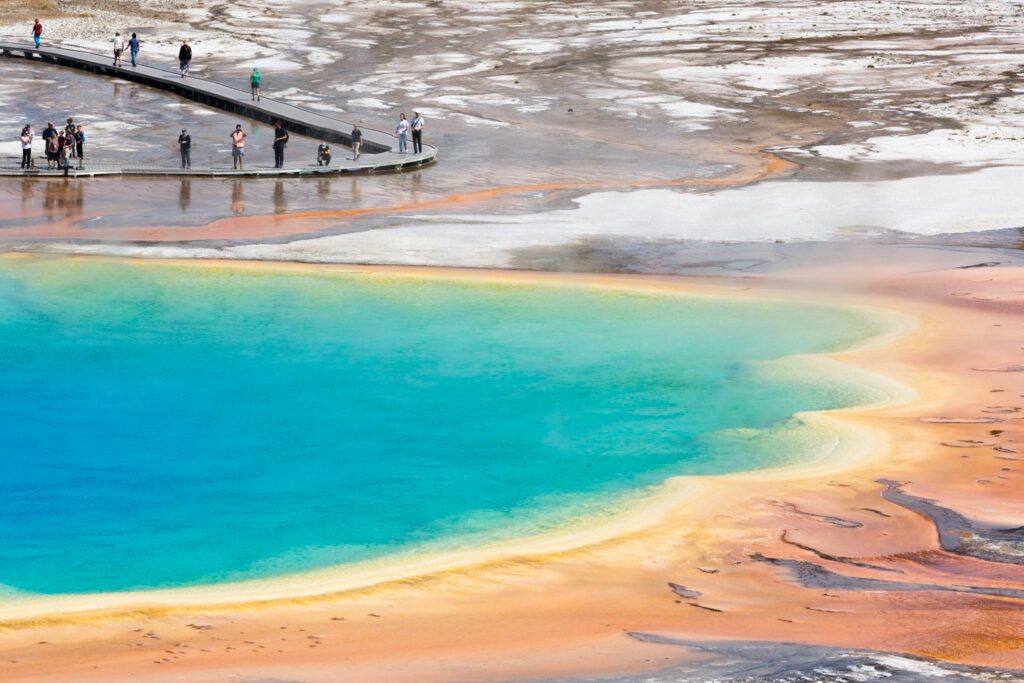
Another signature attraction is Grand Prismatic Spring in the Midway Geyser Basin — one of Yellowstone’s largest and most vividly colored hot springs.
Day 10 – Montana and Idaho Falls
We leave Yellowstone and briefly cross into Montana — the northernmost point of our route.
Later we continue to the city of Idaho Falls. Set on the Snake River, it’s a pleasant place to unwind after a long drive.
We visit the local falls on the Snake River and take a short side trip into Swan Valley to see Creek Falls.
Day 11 – Salt Lake City
The final leg takes us to Salt Lake City.
We stop at the Utah State Capitol Building and take in the city panorama. Salt Lake City surprises with its calm atmosphere, abundant greenery and relatively modest skyline.
Day 12 – Departure
Departure from Salt Lake City.
Road trip overview
- Duration: about 12 to 13 days
- Start: Las Vegas
- Finish: Salt Lake City
- Trip type: road trip across the American West
- Main stops: Grand Canyon (North Rim), Page, Horseshoe Bend, Antelope Canyon, Monument Valley, Capitol Reef, Wind River Reservation, Grand Teton, Yellowstone, Idaho Falls
- Daily driving (approx.):
- minimum: around 30 km
- average: around 240 km
- maximum: around 510 km