
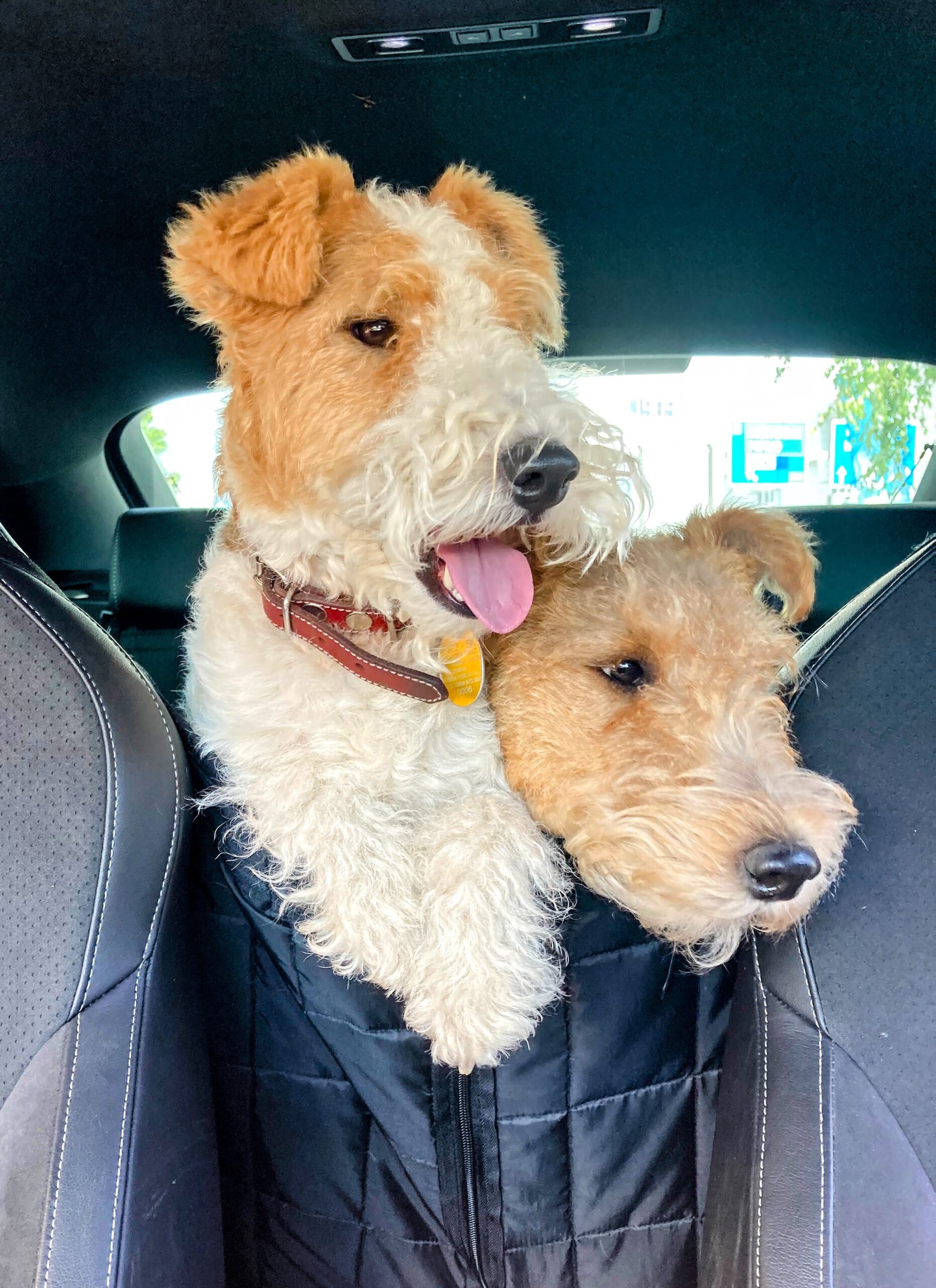
Traveling by car with a dog is completely natural for us today. It wasn’t that way at the beginning. As with most things with a dog, it turned out that the most important things are patience, gradual getting used to it, and the ability to adapt to the specific dog. Our Ibo now handles long journeys without problems, but the path to that involved many shorter rides, trials and errors, and a gradual search for what works best for him — and for us.
Gradual acclimation to the car
It was the same for us: the beginnings were cautious. Short rides around town, trips to a nearby forest or to a place where a walk awaited him were ideal ways for Ibo to start associating the car with something positive. We gradually extended the rides, and today even several-hour transfers are no problem for him.
It was important not to rush. First just getting into the car and sitting, later a short ride, and only then longer routes. Thanks to that, today he doesn’t perceive car travel as stress, but as a natural part of our shared routine.
How we ensure safety during rides
The safety of the dog in the car is a topic that cannot be ignored. Although we admit that sometimes we slip up and on very short transfers within the city we transport the dog without any safety devices, we never feel good about it. That feeling is a clear signal to us that it’s not a sensible solution.
On longer journeys, securing the dog is an absolute must for us.
Fabric car tray
We most often use the fabric tray on the rear seats. It’s practical, protects the car interior and at the same time creates a clearly defined space for Ibo in which he feels comfortable. The tray is attached to the seats and complemented by the option to attach the dog to a harness.
This solution has proven itself especially on road trips and longer transfers, where Ibo lies calmly most of the time or watches what’s happening around him.
We consider the main advantages of this solution to be the low weight and compactness of the tray. Its maintenance is also very simple — from time to time it is enough to take it out of the car and wash it in a regular washing machine. What we probably like most about this solution is the ability to maintain contact with the dog even during the ride. We always have Ibo under control as a co-passenger and can react quickly in case of any problems.
There are also similar solutions designed for placement in the trunk of station wagons. Many models of trays are modular and can be adjusted in various ways — for example, reduced to a half profile or divided by a partition into two parts, which allows transporting two dogs without them having to fight over their space.
Transport crate
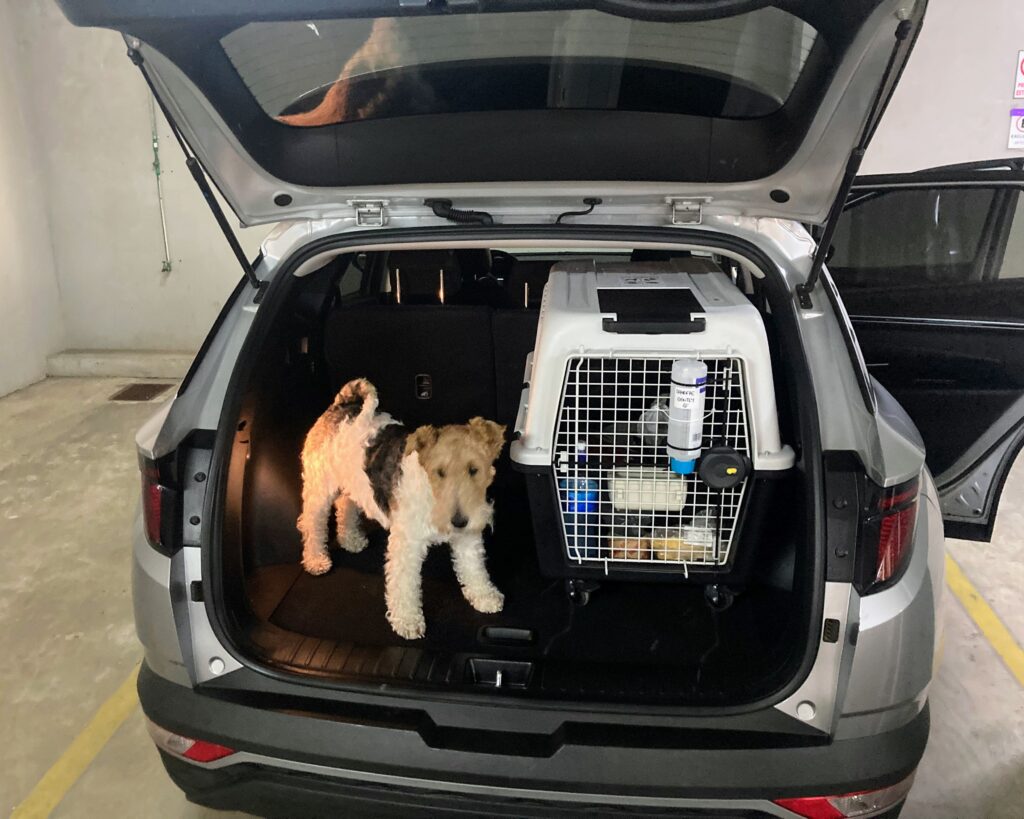
We used the transport crate intensively especially during the period when we were getting Ibo used to the crate. The reason was not only car travel, but also preparation for flying, where a crate is a necessity in Ibo’s case.
Thanks to that, today he doesn’t perceive the crate negatively and takes it as his safe space. Although we use it less in the car today, in certain situations — for example during very long transfers — it still has its place.
An undeniable advantage of the crate is its safety. A dog traveling in the car thus has its own “fortress”, which is invaluable in the event of an accident. At the same time, however, this is also its disadvantage — the crate is large and heavy and on longer transfers it was often more of a burden for us. You have to account for it during the entire vacation.
Gear we bring with us
For longer trips we always have a basic set of gear prepared for Ibo, without which we wouldn’t set out on the journey.
Essentials include:
- enough water and his travel bowl,
- food or treats,
- collar, harness and leash for walking during breaks,
- a light-up collar,
- a mat (ideally with absorbent properties) or a blanket,
- poop bags, or wet wipes.
So he doesn’t get bored during the ride, we also put his favorite toy in the tray. Even such a detail can make a long journey calmer.
Motion sickness during rides
We too went through a period when Ibo didn’t handle car rides perfectly. Nausea, drooling or restlessness are not uncommon in dogs, especially at a younger age.
A few simple rules worked for us: don’t feed the dog just before the ride, drive smoothly and take regular breaks. With increasing experience the problems gradually disappeared and today we hardly ever have to deal with motion sickness.
If the problems persist, it certainly makes sense to consult a veterinarian.
Dog left unattended in the car – a common and dangerous mistake
At this point we consider it important to point out a fairly common mistake that we encounter not only on the road but also in parking lots. It is leaving the dog unattended in the car.
Even if it may seem like just a short stop, there are several risks. The dog may be nervous and stressed without the owner’s presence, which can show as whining, trying to get out of the tray, or unpredictable behavior.
An uncontrolled change in temperature in the car is also a major risk. In summer heat, but also on cold days in direct sun, the temperature inside the car can change very quickly. In extremes — both high and low — such a situation can be literally fatal for the dog.
Lastly, you should also consider that an unattended dog can get out of the tray into other parts of the car interior, where there is a risk of injury to the dog or damage to the vehicle’s equipment.
If it is even slightly possible, we do not leave the dog unattended in the car. And if such a situation does occur, it should be an absolutely exceptional and very short period of time.
Conclusion
Traveling with a dog in the car is a natural part of life for us today. It’s not always perfect and sometimes we make compromises, but long-term experience has taught us that the dog’s safety and comfort should always come first.
If the dog gets used to the car gradually, has his own space and feels comfortable, traveling changes from stress into shared time that you can both enjoy.