
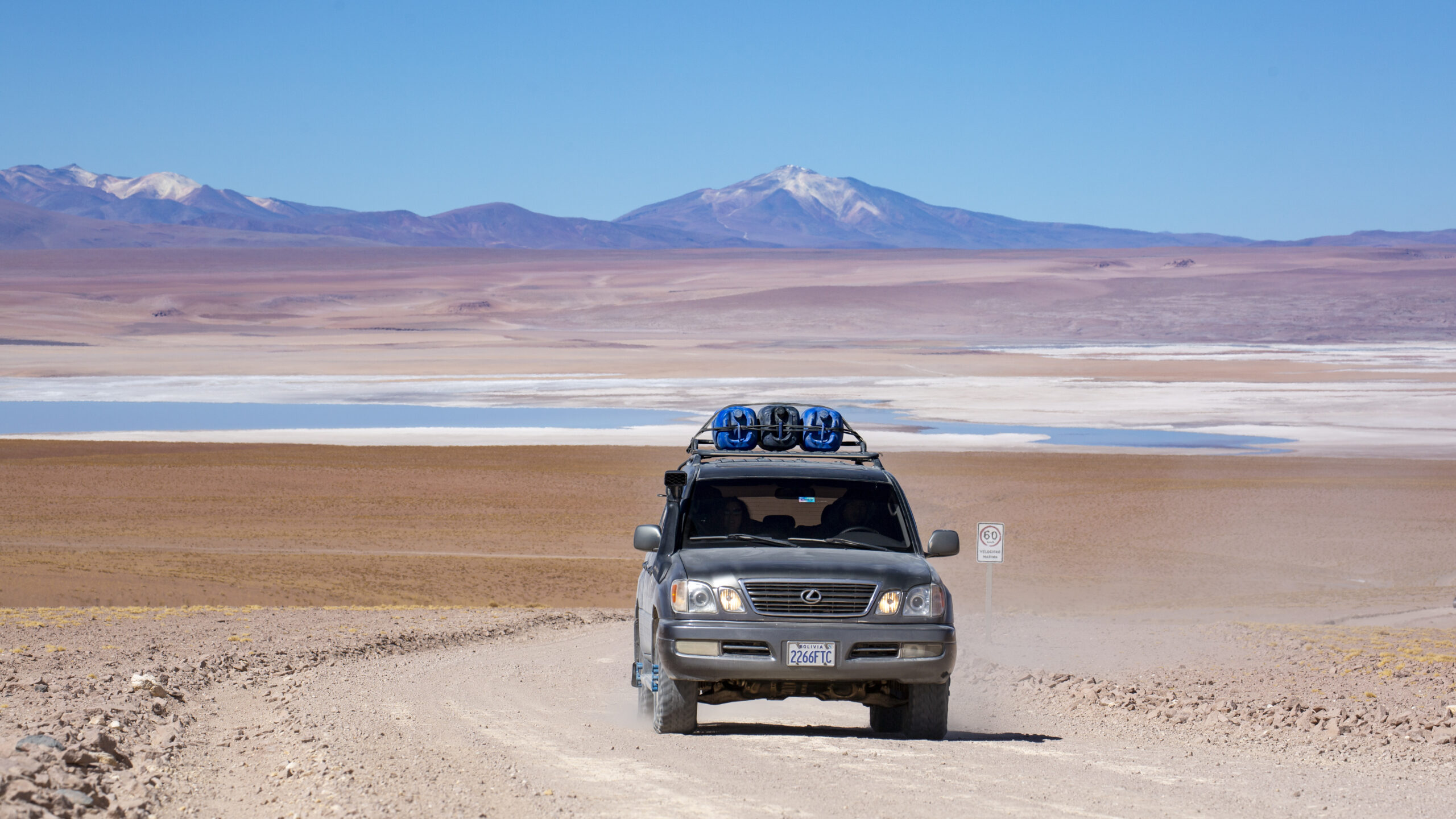
The Altiplano is an extensive high plateau in South America, located at an altitude of approximately 3 500 to 4 800 meters. It stretches mainly across Bolivia, the northern areas of Peru, northern Chile and, to a lesser extent, northwestern Argentina. It is one of the highest inhabited regions in the world, where thin air, intense sun, freezing nights and vast distances combine into an environment that is as fascinating as it is unforgiving. The landscape is open, raw and in places completely empty; infrastructure is limited and help is often very far away. That is why choosing the right vehicle for the Altiplano is crucial — it is not just about comfort, but about the ability to move safely and independently in terrain that quickly punishes mistakes.
Character of the Altiplano landscape and regional differences
Southern Bolivian Altiplano — salt, sand and isolation
The southern part of the Bolivian Altiplano is among the most iconic but also the most demanding areas of the region. It is dominated by vast salt flats, sandy and gravel stretches and large open spaces without clearly defined tracks. Roads often disappear into the terrain and navigation relies more on the landscape than on maps or signage. Infrastructure is minimal and distances between settlements are large, making this area one where the importance of a reliable four-wheel-drive vehicle becomes fully apparent.
Northern Altiplano (Peru and Bolivia) — more life and a gentler character
The northern part of the Altiplano, especially areas around Lake Titicaca, has a milder and more populated character. The land is used for agriculture, there are more villages and significantly more paved roads. Driving is technically simpler compared to the south and more accessible even for less experienced drivers. However, the altitude is still high, which manifests as loss of engine power and increased demands on both the vehicle and the driver.
Chilean Altiplano — dryness, volcanoes and harsh conditions
The Chilean portion of the Altiplano is extremely dry and highly volcanic. Road surfaces are often hard and sharp, placing high demands on tires and suspension. The area is sparsely populated, exposed to strong winds and large temperature swings between day and night. Although some roads may seem of better quality than in Bolivia, the technical difficulty of the terrain makes this part of the Altiplano an environment where vehicle reliability is tested very quickly.
What makes the Altiplano challenging for vehicles
Driving on the Altiplano means a combination of high altitude, thin air and noticeable engine power loss, long stretches without fuel stations or service, and a high proportion of unpaved roads. In a single day you can encounter intense sun, strong winds, sand, fords and freezing nights. The vehicle is not just a means of transport here — it is your assurance, shelter and often the only way to get back in case of trouble.
Ideal choice: a classic 4×4 with low-range gearing
If you want to explore the Altiplano freely and without major restrictions, a full-fledged off-road vehicle with four-wheel drive and low-range gearing is the best option. It provides better traction on sand and gravel, higher ground clearance, greater chassis durability and the ability to cope with fords and broken sections.
A major advantage is older, mechanically simple vehicles without unnecessary electronics. In the remote parts of the Altiplano, availability of service is very limited and modern systems dependent on diagnostics or specialized parts can become a serious problem in case of failure. Simpler mechanics significantly increase the chance of an improvised repair directly in the field or in a small local workshop, which is often decisive under these conditions.
Practical comparison: Toyota Hilux vs. Toyota Land Cruiser on the Altiplano
During our last trip across the Altiplano we had the opportunity to try two iconic off-road models — the Toyota Hilux and the Toyota Land Cruiser — under different circumstances.
The Toyota Hilux accompanied us for almost the entire journey through Bolivia. Besides common roads, we repeatedly used it on extreme climbs to the foothills of several volcanoes, including the climb to Uturuncu, where we reached about 5 580 meters above sea level. The pickup offered a reasonable degree of comfort for three people and a dog. Carry-on luggage was stored on the rear seats and behind the front seats, while larger luggage was in the cargo area.
A drawback of this type of vehicle is that the cargo area is completely separated from the cabin, which makes easy access to luggage during the drive impossible. Despite a lockable cargo area, dust still managed to get practically everywhere. Combined with constant road roughness, the dust acted like fine sandpaper and in some cases caused minor damage to luggage in the form of scratches or scuffs.
On the other hand, we experienced the Toyota Land Cruiser as passengers during an excursion across the Salar de Uyuni. It is an exceptionally comfortable vehicle with the luggage area inside the cabin. This eliminates the dust problem and restricted access to luggage. Although we did not attempt the same extreme climbs in Bolivia with it as with the Hilux, from previous experience on Socotra we know it is an extremely durable and reliable vehicle that will not give up easily.
An SUV without 4×4? Only with big compromises
Common SUVs with two-wheel drive can handle main paved routes and transfers between larger towns, but their limits quickly show off the main tracks. Low ground clearance, lack of low-range gearing and reduced performance at altitude greatly increase the risk of problems. If you only travel between cities like La Paz and the outskirts of the Salar de Uyuni along the main road, it is manageable. But if you plan to deviate even slightly from the route, compromises will very quickly turn into stress.
Manual or automatic at altitude
High altitude generally favors a manual gearbox. It allows better control of power, more precise engine management on climbs and is mechanically less prone to failure. Automatic transmissions work, but combined with a weaker engine they can feel slow and less predictable, especially off-road.
What to watch for when renting a car
When renting a car for the Altiplano, pay attention to the details. A full-size spare, good tire condition, functional four-wheel drive, a jack and basic tools should be a given. It is equally important to verify whether the contract allows driving off paved roads. The cheapest option rarely turns out to be the best choice under these conditions.
Beware of salt flats
Driving on salt flats is undeniably a powerful experience, but you must also consider the risks. Not all flats are passable and their traversability largely depends on current weather. During the rainy season many routes become completely impassable and places that are safe when dry can quickly turn into traps.
Salt flats often offer tempting shortcuts between points on their edges, but the shores are among the most treacherous sections. The edges of the flats tend to be soft and unstable, with a risk of the vehicle sinking or the salt layer breaking through. The same risk applies to the shores of so-called islands in the middle of the flats, which may appear safe at first glance.
Special attention should also be paid to the salt itself. After extended driving it gets into all parts of the undercarriage, significantly accelerating corrosion of metal components. For this reason it is advisable to thoroughly treat and wash the vehicle’s undercarriage before and especially after driving on a salt flat. In more populated areas this is usually not a problem, but in isolated parts of the Altiplano such maintenance can be much more complicated. For this reason many rental companies explicitly prohibit driving their vehicles on salt flats.
Summary: which vehicle to choose for the Altiplano
The Altiplano is not a place to take technical risks. A full 4×4 will give you freedom, safety and the ability to reach places where ordinary roads end. Both the Toyota Hilux and the Toyota Land Cruiser are excellent choices in this environment, each with its own advantages and compromises. The right vehicle will allow you to focus on what matters — the space, the silence, the raw landscape and the experience, which is among the most powerful in South America.