
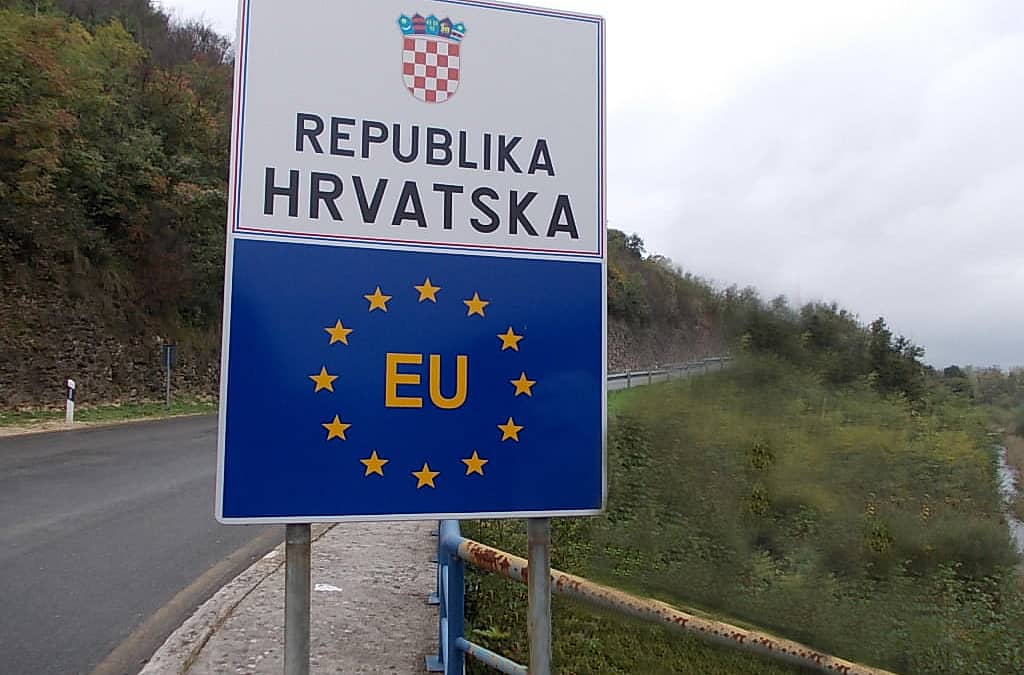


Croatia is one of the most popular destinations for travelling with a dog—whether you’re heading for the sea, a coastal road trip or the Biokovo mountains. Entry rules for dogs, however, depend on the country you’re coming from.
In this guide we break the requirements down into two basic scenarios:
- entering Croatia from another EU country
- entering Croatia from a non-EU country
Alongside the official requirements, we also share our real border-crossing experience.
Croatia is in the EU: what that means for your dog
Croatia is an EU member state, so the same pet travel rules apply when you take your dog from one EU country to another.
If you’re travelling with a dog from another EU country (for example, Slovakia, Slovenia or Hungary), your dog must have:
- a microchip (ISO standard)
- a valid rabies vaccination
- a European pet passport
The rabies vaccination must be administered after the microchip is implanted and be valid at the time of entry.
No additional health declaration or veterinary certificate is required for non-commercial travel (that is, travelling with your own dog, not for sale or transfer of ownership).
Protecting your dog from leishmaniasis in southern Croatia
If you’re travelling with a dog to the southern parts of Croatia—roughly from the Zadar area southwards—it’s sensible to consider protection against leishmaniasis.
In southern regions of Croatia, the disease cannot be ruled out entirely. Leishmaniasis is spread by tiny biting sand flies (phlebotomines), found mainly in warmer coastal areas.
There are essentially two options for protection:
- vaccinating your dog against leishmaniasis
- preventive protection in the form of an anti-parasite collar or insect-repellent products
It’s wise to discuss the right form of prevention with your vet before the trip—especially if you’re planning a longer stay in southern Dalmatia.
Interested in this destination? Would you like to visit it with your dog? Check the entry requirements directly in BorderCooler®.
Our experience: entering Croatia from an EU country
We’ve entered Croatia by car with our dog multiple times, both from Slovenia and from Hungary.
As these are internal EU borders and Croatia is part of the Schengen area, there was no standard border control. In practice, we didn’t have to stop; no one asked for documents and no one checked the dog.
We obviously had the documents ready (in this case the European pet passport), but we never had to show them.
That doesn’t mean you shouldn’t have them. The requirements apply even if no physical check takes place.
Entering Croatia with a dog from a non-EU country
It’s a different situation if you’re coming to Croatia from a non-EU country—for example, Bosnia and Herzegovina, Serbia or Montenegro.
In that case you’re crossing the EU’s external border and the dog must meet the EU entry conditions.
The basic requirements are:
- a microchip
- a valid rabies vaccination
- a European pet passport (if the dog is EU-origin) or a veterinary certificate
If the dog is EU-origin and travels with a valid European pet passport, the paperwork is simpler. The key is that the rabies vaccination remains valid.
For some non-EU countries a rabies antibody blood test (the titre test) may be required, especially when returning from a so-called “non-listed” country. This doesn’t apply to all Balkan states—the requirements vary according to the EU category of the country.
Our experience: entering from Bosnia and Herzegovina
We entered Croatia by car from Bosnia and Herzegovina with our EU-origin dog, who has a European pet passport.
We had all the required documents ready—the passport with a valid rabies shot and the microchip.
The reality at the border was simpler: neither we nor the dog were checked. No documents were requested and we passed without any veterinary control.
Even here, the same applies as at an internal EU border—the fact there was no check doesn’t mean the obligations don’t exist.
During a random or targeted inspection, you must be able to present all documents immediately.
What to watch for when returning to the EU
If you travel with a dog from the EU to a non-EU country (for example, Bosnia and Herzegovina) and then return via Croatia, pay attention to:
- the validity of the rabies vaccination
- the category of the country you are returning from
- any requirement for an antibody blood test (titre)
For most typical Balkan trips with an EU-origin dog and a valid passport, it’s administratively straightforward. The important thing is to have the paperwork in order before you set off.
Practical tips at a glance
- Check the rabies vaccination date before you travel.
- Make sure the microchip is readable and recorded in the passport.
- Keep your dog’s passport on you, not just in your luggage.
- If travelling outside the EU, check in advance whether the country is EU-listed under the pet travel rules.
From an administrative point of view, Croatia is an easy country for travelling with a dog—especially if you’re coming from the EU. Still, it’s worth knowing exactly what’s required so nothing at the border catches you out.