


Picture an almost three‑kilometer wall of water plunging in hundreds of streams into a deep canyon. You can hear the roar hundreds of meters away and a fine mist hangs in the air. That’s the first impression of Iguazu Falls—one of the largest waterfall systems on Earth.
Iguazu Falls rank among South America’s best‑known natural sights. Straddling the border of Brazil and Argentina, they form one of the biggest waterfall systems in the world.
On our journey through South America we decided to visit the Brazilian side of Iguaçu National Park. While most of the individual falls are on the Argentine side, Brazil offers some of the finest panoramic views of the whole system.
Where are Iguazu Falls?
Iguazu Falls lie on the Iguazu River along the border between Brazil and Argentina. The Brazilian side is in the state of Paraná near the city of Foz do Iguaçu, which also sits right by the Brazil–Paraguay border. That’s why many visitors come from Paraguay.
The entire system comprises roughly 275 individual waterfalls spread over nearly 3 kilometers. Its largest and most famous feature is the vast chasm called Garganta del Diablo—the Devil’s Throat.
Iguaçu National Park in Brazil
The Brazilian side belongs to Iguaçu National Park (Parque Nacional do Iguaçu), established in 1939. The park is also a UNESCO World Heritage Site.
Compared with the Argentine side, Brazil’s section is more compact. Most visitors follow a single main viewpoint trail that runs along the rim of the Iguazu River canyon.
Getting to the falls from Paraguay
Our visit began in the morning in Ciudad del Este, Paraguay. We had a rental car from a local agency. Normally you can’t take a Paraguayan rental car across borders, but trips to Iguazu Falls are a common exception in this region. Just inform the rental company in advance so they can adjust the insurance for driving in Brazil.

The trickiest part wasn’t border control—it was traffic on the Friendship Bridge. At the time, it was the only way to drive from Paraguay into Brazil, and long jams were frequent.
There’s now a newer bridge as well, the Puente de la Integración, farther south over the Paraná River. Check current traffic before you go and pick whichever route is fastest at the time.
Once across the border we moved fairly quickly through central Foz do Iguaçu on the Brazilian side and continued along BR‑469 straight toward the national park. It’s about a 20‑minute drive from the city center.
Arriving at Iguaçu National Park
The road brings you to the parking area by the Visitor Center – Parque Nacional do Iguaçu. You’ll need to leave your car here. If possible, look for a spot in the shade—the heat builds quickly during the day.
We were immediately impressed by the smooth organization. A park staff member at the lot directed us toward the visitor center.
Inside, we bought tickets at a self‑service kiosk and paid by card. After purchasing, staff explained the next steps: visitors continue by shuttle bus. Park buses run between the visitor center and several stops by the falls. Everything was well run—buses were frequent and it was easy to find a seat.
For slightly better views during the ride, sit on the right‑hand side of the bus. You won’t see much of the falls from the bus, though, as the route runs mostly through dense forest.
The bus makes several stops. We recommend getting off one stop before the terminus—Estação Trilha das Cataratas—and continuing on foot along the riverside trail.
The viewpoint trail to the falls

From the Estação Trilha das Cataratas stop, a paved path leads through subtropical forest straight to the falls. It’s an easy, well‑maintained walk that even less experienced visitors can handle comfortably.
You may meet a few of the park’s regular inhabitants along the way. Most commonly you’ll spot birds, butterflies and small mammals. South American coatis are frequent here and used to people. Watch the treetops for toucans and parrots, and look for clouds of colorful butterflies beside the path.
The trail follows the rim of the Iguazu River canyon, gradually opening views onto dozens of waterfalls on the Argentine side.
One of the Brazilian side’s strengths is the panoramic sweep of the entire system. From many points you can see the broad arc of falls, a perspective that’s harder to get from Argentina.
Devil’s Throat from the Brazilian side
The standout moment is the walkway that leads right out toward the falls at Devil’s Throat. Here the river plunges into a deep chasm with tremendous force, creating a thick mist visible from far away.
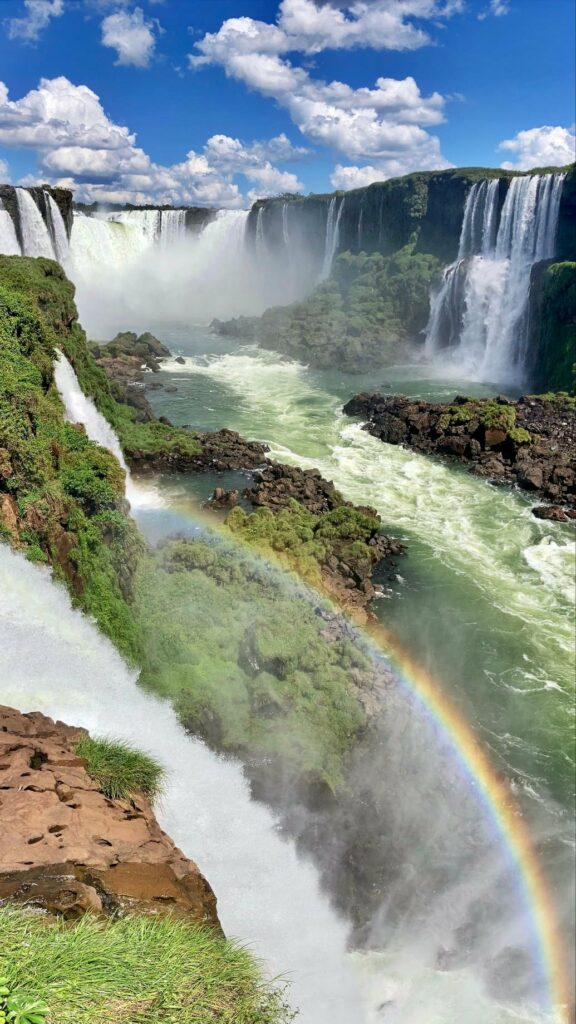
When the flow is strong it’s almost impossible to stay dry. Spray often reaches the viewing platform at the end of the walkway. During our visit a vivid rainbow formed in the fine mist, heightening the scene and turning the views into one of the day’s most memorable moments. We were there outside the main rainy season; even so, the power of the water was incredible, and we could only imagine what it looks like after heavy rains.
No drones allowed
Across the park we noticed multiple signs prohibiting drones. We followed the rule, so we don’t have any drone footage from here—though we’re sure the aerial views would be worth it.
Facilities at the end of the trail
At the end of the viewpoint trail, you’ll find several restaurants and small stands selling food and drinks. Souvenir shops are there too.
If you don’t want to buy souvenirs here, you can still do so back at the visitor center by the parking area. The shuttle bus will take you there from the end of the trail.
Brazil or Argentina?
Many travelers ask which side of Iguazu Falls to visit. Ideally, see both.
The Argentine side offers more walkways and the chance to stand right above some of the falls. The Brazilian side is shorter but gives a better overall panorama.
If you only have time for one, choose based on whether you prefer sweeping views or a closer, more immersive encounter with the falls.
Conclusion
Iguazu Falls are the kind of place that impress even seasoned travelers. The scale, the force of the water and the tropical surroundings combine into something hard to compare with other waterfalls worldwide.
Brazil’s side of the national park is an excellent first introduction to this natural wonder. Thanks to the park’s good organization and regular shuttle buses, you can see it all at a relaxed pace in a single afternoon—and still have ample time to return to Paraguay. We wholeheartedly recommend a visit to anyone traveling through this corner of South America.