
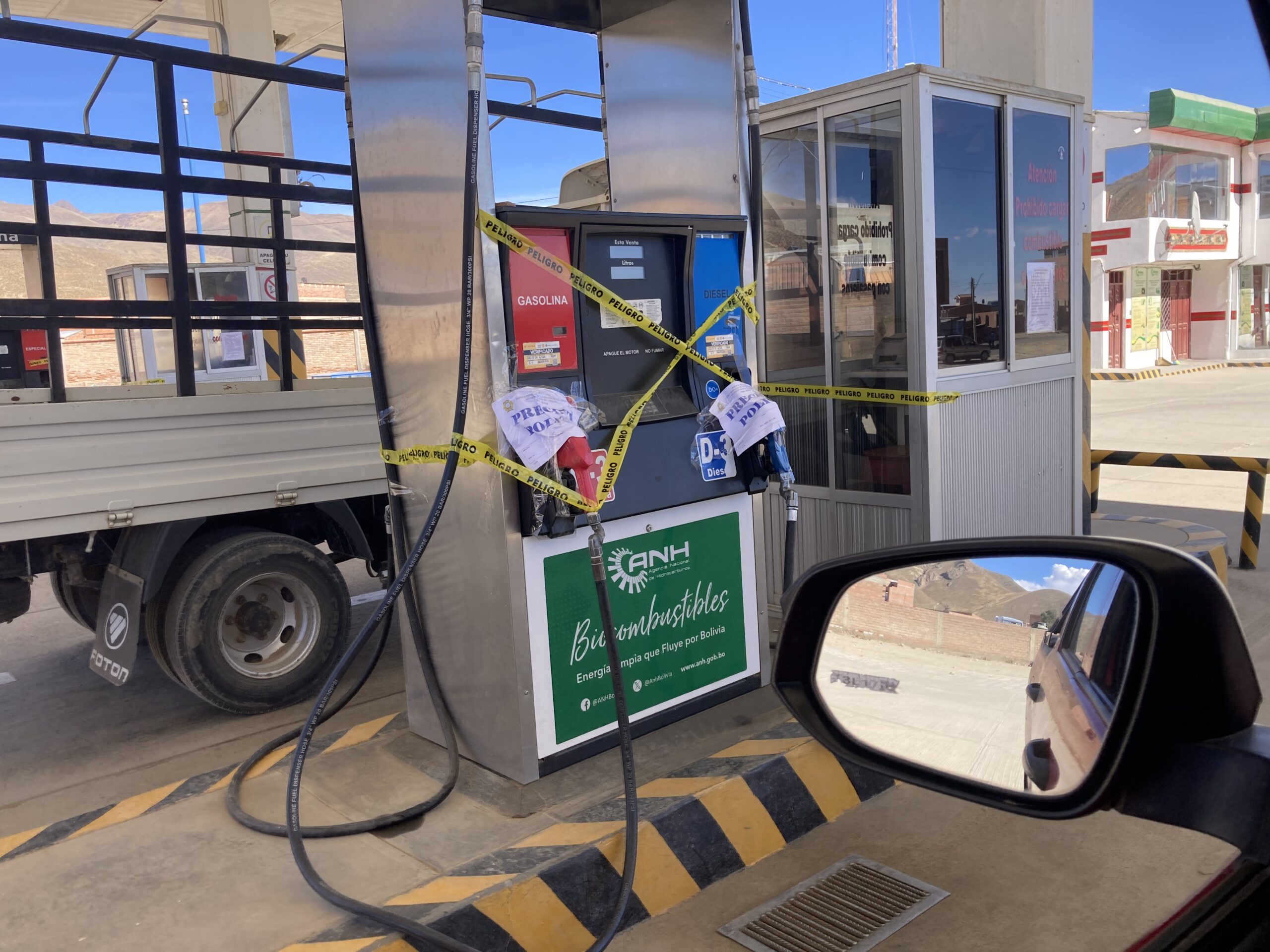
During our trip through Bolivia in the summer of 2025 we quickly realized that fuel (both gasoline and diesel) is a real problem there. Reports of shortages reached us even before departure. That it wasn’t just a rumor was confirmed shortly after our arrival by the manager of the Hertz rental agency where we rented the car for our trip.
However, the fuel shortage was only one side of the coin. Bolivia is an extremely vast country, and it is not unusual to drive hundreds of kilometers without encountering a single gas station. The combination of these two factors – limited supply and large distances – naturally made us worry about how we would manage to travel around the country by car.
Table of Contents
When the state sets prices, it doesn’t end well
The fuel shortages at gas stations were related to a system in which the Bolivian government long set fuel prices significantly below market levels through subsidies. For locals this appears to be an advantage at first glance – fuel is cheap.
The problem arises when a price is administratively set lower than the actual costs of import and distribution. If the state keeps fuel prices artificially low while import and production cost more, someone ultimately has to cover the difference. Either the national budget covers it, or the quantity of imported fuel starts to be cut back.
A price set this way naturally creates high demand that the distribution reality cannot cover in the long term. In 2025 there was also pressure on the country’s foreign exchange reserves and dependence on imports. If there aren’t enough dollars to buy fuel abroad or if deliveries are delayed, there is simply less fuel – and the result is endless queues at gas stations.
Refueling at the subsidized price
The subsidy system was set up for domestic vehicles and local residents. When refueling the license plate was entered and the price was determined accordingly. Although we had a car with a Bolivian license plate, normally a tourist driving a rental car is not entitled to the subsidy.

However, when we picked up the car the rental manager offered us a solution. He issued a certificate stating that we were employees of a local Bolivian company. The document existed solely so that we could refuel at the local price. In reality, of course, we were not employed there.
That certificate helped us several times when refueling. Its purpose was to dispel the assumption that we were foreign tourists.
This small and essentially harmless ‘travel hack’ saved us a considerable amount of money while traveling through Bolivia and worked reliably at all official gas stations. However, its usefulness quickly disappeared when our wanderings took us to more remote parts of the country.
Cheap but unavailable
While refueling in larger cities was without major complications, problems arose as soon as we encountered the more remote and less accessible parts of the Altiplano. We began to encounter closed gas stations, limited selling hours and queues of several hours. Fuel simply wasn’t available, and it didn’t matter whether you were local or a tourist.
And as is often the case, where the state fails, the free market steps in – often unpleasantly labeled as the black market.
The black market
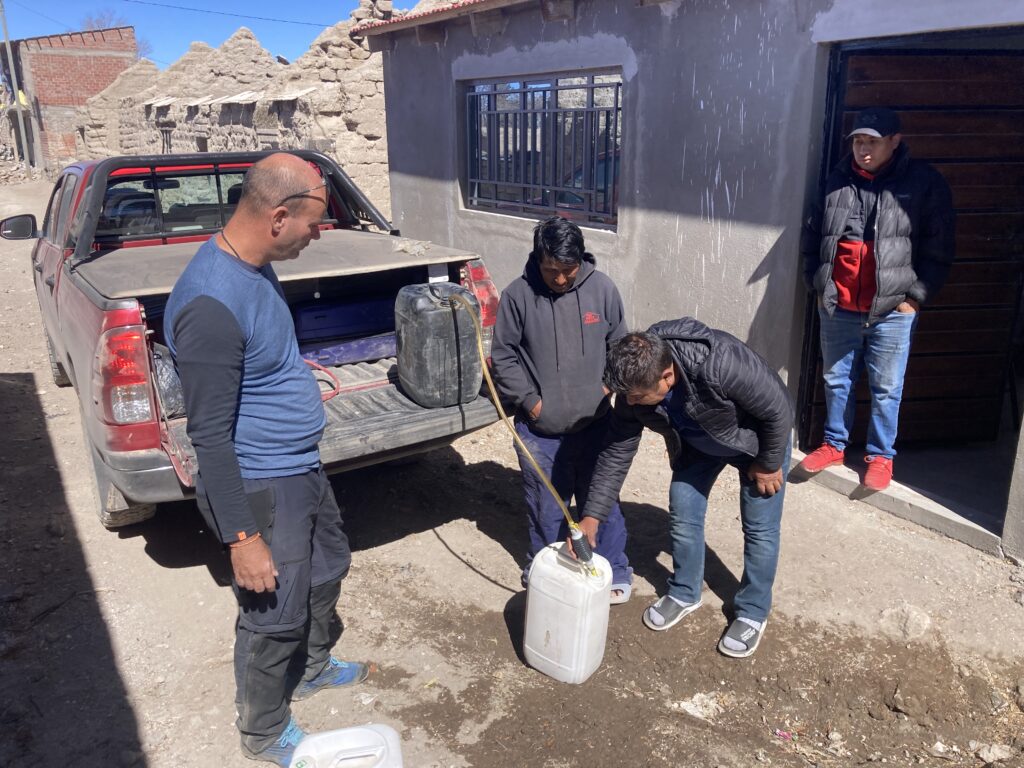
In villages and small towns where fuel was not available, it could sometimes be bought from locals. That meant asking around, waiting, and accepting a price that was roughly ten times the subsidized price, which approximately corresponded to the price of unsubsidized fuel.
Of course, such a purchase was often very uncertain. There were villages where we managed to obtain fuel. And there were others where it simply wasn’t possible.
Jerrycans
To be able to function effectively in this environment and reach truly remote parts of the country, we had to have the right equipment. The key to success was having sufficient fuel reserves in the car. That meant not relying only on the car’s tank, but carrying with us – in our case – three 20-liter jerrycans. By arrangement we got them for a small fee directly from the rental agency along with the car.
It should be noted right away, however, that it was not possible to fill jerrycans directly at regular gas stations. We tried, but the staff repeatedly refused. If we wanted to replenish the supply in the jerrycans, we had only two options:
- to refuel outside gas stations on the black market,
- to pump our own fuel from the car’s tank into the jerrycans and repeatedly visit gas stations.
Fortunately, we ultimately did not have to resort to the second method during our journey, which we appreciated. It would have been a relatively time-consuming process.
Overall, the jerrycans in the car brought us enormous comfort. Without them our journey would essentially not have been possible. The fact that we traveled with a dog required even more careful preparation. Waiting in endless queues in the heat and direct sun with a dog in the car was an unacceptable scenario. Equally unacceptable would have been getting stuck without fuel somewhere in the middle of the Altiplano.
For completeness we add that besides the jerrycans we also had small items in the car, such as a transfer hose, a supply of empty plastic bottles from which we made improvised funnels, and a small cloth for filtering impurities from the fuel.
And one more tip: always plan handling of fuels in advance, do not perform it in the dark and avoid extreme temperatures (both cold and heat). Pay attention to safety.
Where we refueled
Below we list places where during our journey we refueled at regular gas stations, on the black market, and also places where we were unable to refuel at all. The list is purely informative and conditions are subject to change. It is meant to give an idea of the scale of the problem.
Refueling in cities
Refueling in cities like Santa Cruz de la Sierra, Tupiza, Tarija, Roboré, San Cristóbal and similar was always trouble-free. Fuel was available and wait times at gas stations ranged from a few minutes to at most half an hour.
Refueling on the black market
We used black market services fairly often, roughly as often as refueling at official gas stations. Below is a list of places where this occurred:
- Jirira – a village on the northern shore of the Uyuni salt flat. Finding a seller was a bit time-consuming, but ultimately successful.
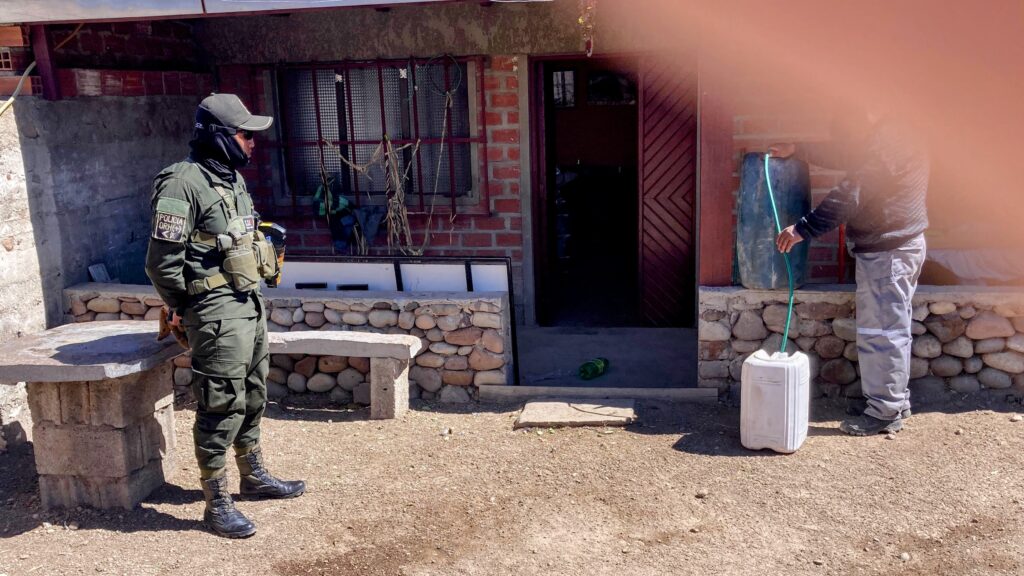
- Tahua – the capital of the Tahua canton on the northern shore of the Uyuni salt flat. Here a local policeman even assisted us with ‘refueling.’
- Llica – a forgotten little town in the northwest of the Uyuni salt flat. We were lucky and came across a seller right at the entrance to the town.
- San Pedro de Quemes – a town where we sorted everything out: car wash, currency exchange and refueling.
- Villa Mar – a small town in the southern part of Bolivia. Here the fuel shortage was already evident even on the black market. We managed to find some, but only a few liters.
Where we failed
Despite all efforts we also encountered places where we could not obtain fuel. These were mainly the southern parts of the Altiplano, for example the area around Laguna Colorada, the area near the Aguas Termales Chalviri baths, or the village of Quetena Chico beneath the volcano Uturuncu.
Conclusion: Fortune favors the prepared
Traveling by car in Bolivia during a fuel shortage meant thinking ahead. Having only a route plan was not enough. It was necessary to account for distances, check the availability of gas stations, have a reserve and be prepared to improvise.
The key points were:
- to have sufficient fuel reserves in the tank and in jerrycans,
- to top up supplies whenever there was an opportunity,
- not to rely on a single specific gas station,
- to have basic equipment for handling fuel,
- to plan transfers with regard to the temperature and the comfort of the dog.
It was logistically more demanding than we are used to in Europe. Still, we didn’t get stranded anywhere because of fuel shortages. Nowhere did we ‘get stuck’ without a way to continue.
In the end the simple rule was confirmed again: fortune favors the prepared. In Bolivia this holds doubly true.