The Salar de Uyuni salt plain is one of Bolivia’s most iconic places and for many the main reason they visit this part of the world. We didn’t want to miss this travel hotspot either, even though this time our travel partner is Ibo. As it turned out, a trip to the Uyuni salt flat with a dog is completely possible — you just need to expect a few compromises.
Coquesa – the peaceful gateway to the northern plain
The night before the trip we spent in the village of Coquesa, right on the edge of the salt plain. In the morning we woke up to a view of the majestic Tunupa volcano dominating the entire northern rim of the Uyuni plain. The northern part is less known to tourists, which is a big plus for us — we like discovering places that aren’t yet saturated with tourism. At the same time, everything needs to be handled a bit in a “Bolivian” way and more proactively — you won’t find tourist offices on every corner here like in the town of Uyuni.
Because driving our rented car on the salt flats is not allowed (risk of getting stuck and damage to the car from the salt), a day before, with the help of our hotel staff, we searched for a guide with a suitable vehicle that would also take the dog. And we managed — via WhatsApp, literally at the last minute. For about 110 USD per person we arranged a guide, a car, all entrances and lunch. And Ibo? He supposedly wasn’t a problem, he could come with us… and of course for free. Awesome! In the morning, after breakfast at the hotel, our guide was already waiting for us in the parking lot with a polished Toyota Land Cruiser.
Caves and museum – an intro to local culture and history
Our first stop was at the Cueva de las Momias cave, just a few kilometers from our accommodation, in the slopes of Tunupa itself. Naturally mummified remains of the original inhabitants have been preserved in the cave. The site is modest but very impressive and already offers nice views of the plain.
Since it is a spiritually significant place, we decided this time to leave Iba in the car. It was pleasantly cool outside in the morning, so it wasn’t a problem. The whole visit including a short trek took us about 45 minutes.
The program continued in a small village museum where our guide explained local traditions and ways of life in Spanish. Even though we didn’t understand everything, the exhibits helped complete the picture of life in this remote area. Ibo skipped this part too — he simply doesn’t like museums. 😄
Entry to the plain – endless white horizons
When we drove onto the plain, our feelings were indescribable. An endless white expanse in every direction, no turns or landmarks — just pure emptiness. During the dry season the surface is hard as concrete, but in the rainy season it’s covered by a few centimeters of water, creating the world’s largest natural mirror.
Lunch in the middle of nowhere
After a few kilometers of driving the guide stopped in the middle of nowhere, set up a table, chairs, wine and beer, and served a hot lunch. Strong sun, complete silence and no wind — a surreal experience you don’t get every day.
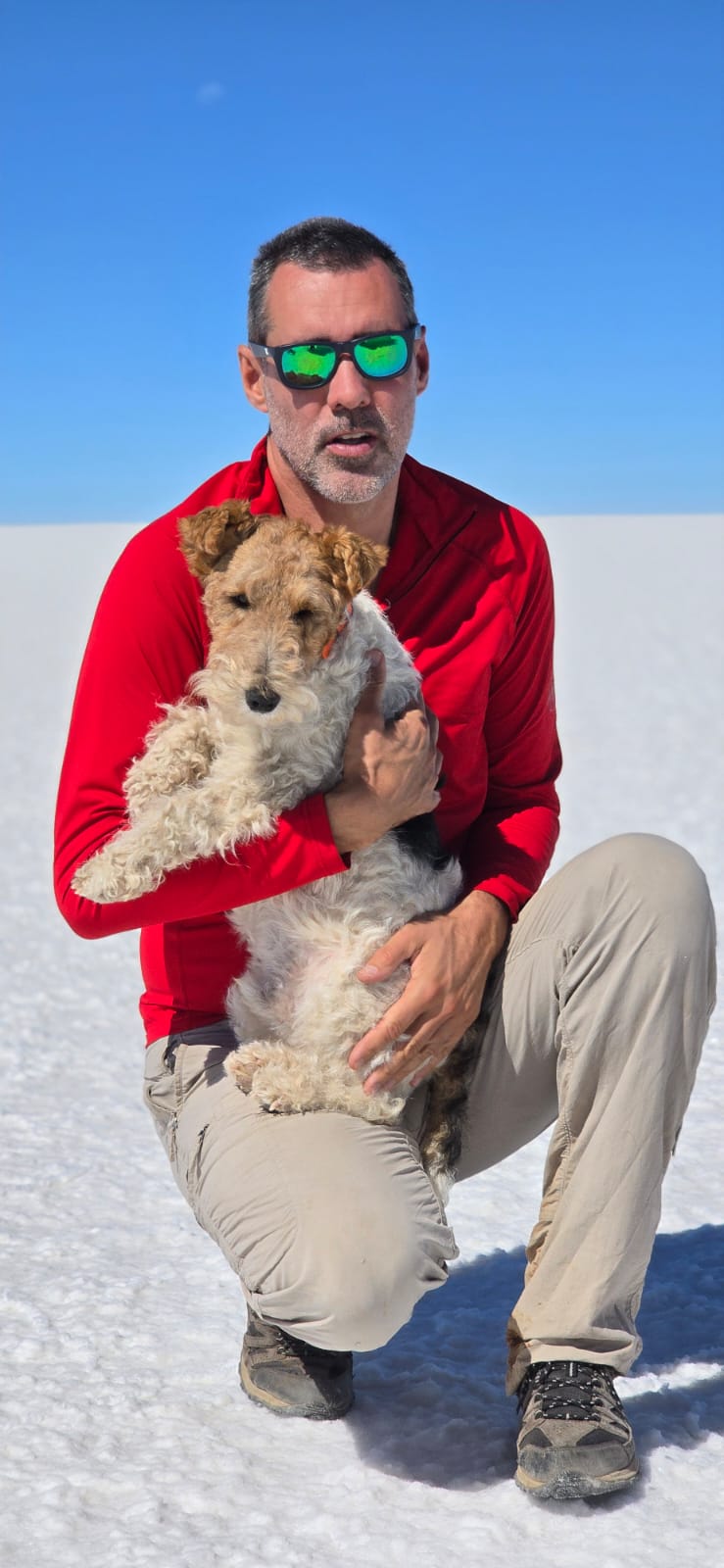
We only walked Iba for a short while. The surface is pure salt, which isn’t ideal for his paws. To anyone coming here with a dog, we recommend packing protective boots — your pup will certainly thank you and they’ll allow him to enjoy the place without restrictions.
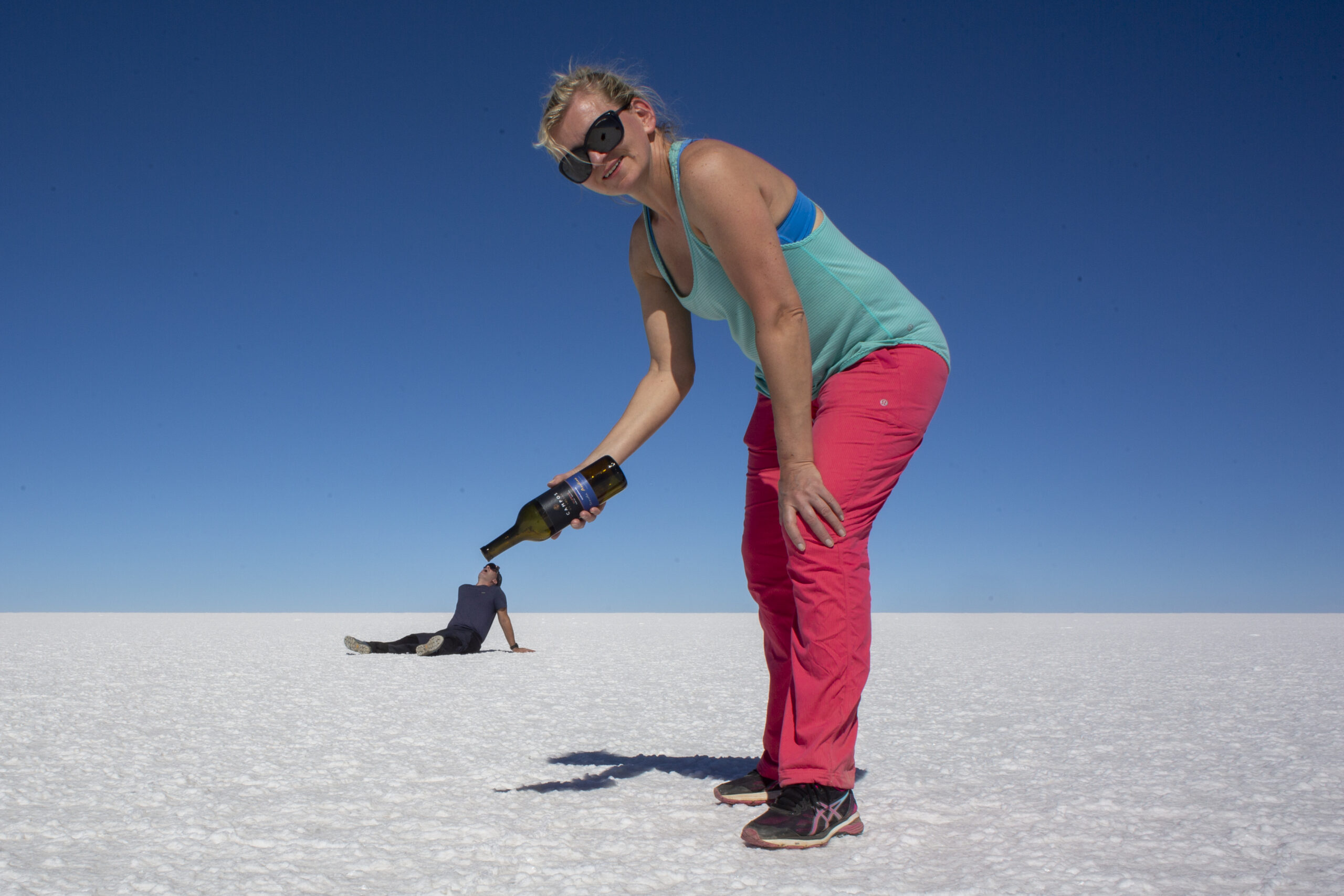
After a delicious lunch we took a few avant-garde photos. The endless white horizon allows you to experiment with perspective — and a glass of wine or beer certainly helps creativity. 😄
Isla Incahuasi – island of millennial cacti
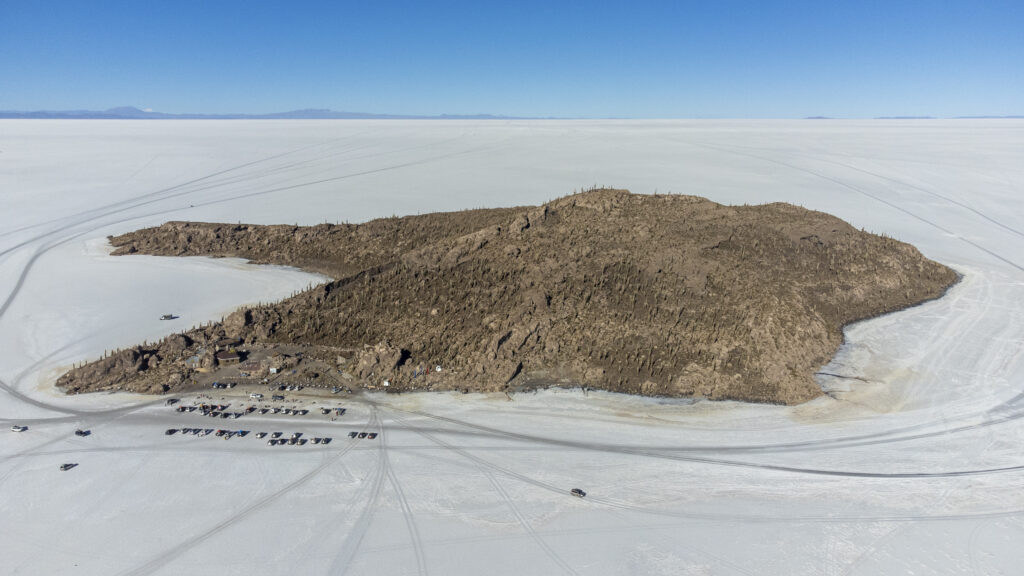
But our day was far from over. Our wheels — and especially our guide — brought us to Isla Incahuasi, a coral island in the middle of the salt sea, dotted with millennial cacti. This place is a complete contrast to where we came from. While the northern shore is quiet and still almost undiscovered, Isla Incahuasi is probably the most visited spot on the whole plain (excluding the town of Uyuni).
Jeeps full of tourists arrive from all directions and we suddenly find ourselves in a busy spot full of cars and people instead of silence and emptiness. The island, however, has its own strong charm — and it’s big enough that the hustle doesn’t feel overwhelming.
We hiked to the highest point of the island of the same name, Incahuasi, at about 3 700 m a.s.l. It’s an easy route and we were at the top in roughly 20 minutes. Ibo handled it easily too, having spent most of the day comfortably in the car until then. At the top we met tourists from various countries and Ibo immediately became the main attraction — we didn’t see another dog. In the end we watched a little scene where an Italian tourist photographed a Japanese tourist with our Slovak dog.
After a short rest and a cold beer enjoyed at this breathtaking spot, we returned to the car. Before heading back to the “mainland” we had one smaller stop left.
Cueva del Diablo – legends on the edge of the plain
The end of the day belonged to a cave with the dramatic name Cueva del Diablo on the island Isla Phia Phia. It’s just a few minutes’ drive across the plain from Isla Incahuasi, but suddenly everything is back to normal. No tourists, no cars — just us and a mysterious place at the end of the world.
According to legends the cave was a site of rituals and a hiding place for spirits; today it’s more of an unobtrusive but very impressive photo spot with a beautiful view at sunset. Final shots, return to the car and a few dozen minutes later we’re back at the hotel — a llama steak is served as a tasty full stop to our day.
Uyuni Plain with a dog? Why not?!
Salar de Uyuni showed us the contrasts a single place can hold: the silence of the north and the bustle of the tourist center, a private lunch in the middle of nowhere and, a few kilometers away, dozens of jeeps parked side by side. We confirmed that traveling around Bolivia with a dog is not only possible but also immensely rewarding. It does require a bit more planning and care, but that feeling when you stand together in the middle of the world’s largest salt flat is worth it all.
Interesting facts about Salar de Uyuni
• Area: approx. 10 582 km² — larger than the entire Banskobystrický Region
• Elevation of the plain: approximately 3 650 m a.s.l.
• Thickness of the salt layer: from 2 to 10 meters
• Annual visitors: around 300 000 tourists per year, mainly from Europe and Asia
• Best time to visit:
— dry season (June – October): geometric “salt tiles” and driving on the plain
— rainy season (December – April): the “world mirror” effect