
Ibo Island in the Quirimbas archipelago
Ibo Island in the Quirimbas archipelago off northern Mozambique is one of those places that still lies outside the main tourist trail. Getting here, however, is not always easy—especially if you opt for the more adventurous jungle transfer from the town of Pemba.

I first learned about the Quirimbas archipelago on the east coast of Africa during my visit to Mafia Island in Tanzania. Even Mafia Island itself is unknown to most people, whose attention is more often drawn to the more commercially known Zanzibar. From that perspective, the Quirimbas islands are even more exotic.
The Quirimbas islands lie off Mozambique’s northern coast and most of them are very difficult to reach for tourists. Functional infrastructure is basically non-existent, accommodation options are minimal and comfort is more the exception than the rule. Yet it is precisely this that makes the place an still-undiscovered paradise.
One of the few exceptions is Ibo Island, where you can find hints of civilization in the form of a makeshift airstrip and basic infrastructure such as an ATM, a few accommodations and local restaurants.
We set out for Ibo Island from a beach resort near the town of Pemba. We had two transport options. The first was a short flight from Pemba airport to the airstrip on Ibo Island — a comfortable solution but not cheap, about €250 per person. The second was a more adventurous roughly 250-kilometre drive, including 80 km through the local jungle north to the village of Tandanhangue and from there by local boat across the sea to Ibo Island.
The locals confirmed what Google Maps had told us. The drive should be straightforward and take around 4 to 6 hours. The decision was quick. We hired a local driver with a car, packed the basic equipment needed for such a transfer (food, water supplies, insect repellent) and went to bed early. We had no idea what adventure awaited us the next day.
Early morning start
We set off at 4:00 in the morning to give ourselves plenty of time. It was crucial to reach the port at Tandanhangue at high tide, as only then can the local boat set off.
Right away, however, we were surprised by the driver’s choice of car. We expected him to pick us up in a proper 4×4, but he arrived in a Toyota Corolla. I told myself he probably knew what he was doing. Indeed, the first part of the journey was on tarmac, along the main road, and went calmly — we even slept through most of it; after all, it was still early.
We soon realized, though, that the driver had turned off the main road into the jungle, and it was obvious for two reasons: monkeys began running across the road and our average speed quickly dropped below 20 km/h.

It had rained all night and the rain hadn’t stopped in the morning. Mud from the road quickly covered our car. The driver muttered to himself more and more often and we began to realise one detail — we definitely shouldn’t have been in a Toyota Corolla here, but rather in a more off-road vehicle. You don’t need much imagination to see that our car was not the ideal vehicle for an African jungle after a nocturnal downpour.
First complications

The car got stuck fairly quickly. The first time we were lucky — there was a village nearby. The locals helped willingly and pushed the car out. They even washed it for us. It was a kind and at the same time completely pointless gesture. After a few metres it was covered in mud again.
After another hour of driving and overcoming further flooded sections we encountered another submerged stretch of road. Unfortunately, our Corolla simply couldn’t handle this one. The water was deep, the section long, and attempting to cross it would have meant submerging the car.

We began to ask ourselves what to do next. Our food was running low and we didn’t have enough water for a possible overnight stay. The biggest problem, however, was protection against the ever-present mosquitoes. During the day it wasn’t such an issue, but it was clear that one bottle of repellent wouldn’t be enough for an overnight. It’s worth mentioning that in these areas malaria transmitted by mosquitoes is a real risk.
We decided to turn back, try to return to Pemba and reach the island another way — with a better vehicle or by air.
Almost stuck
By mutual agreement our driver skilfully turned our car on the narrow road and then skilfully stuck it in the deepest mud around. This time, however, it was not a ten‑minute problem. It took about half an hour and eleven local men.
Watching the locals try to help us, yet without the ability to organize themselves, was tragicomic. Someone pushed, someone tried to lift the car, others placed reeds under slipping wheels. In the end I realised I had to organize them at least a little. With gestures I showed them that it would be best if everyone pushed in the same direction. It worked and we could continue.

It began to dawn on us that things here could very quickly get out of control.
At the same time we realised that our driver had underestimated the situation — he had come with an unsuitable car, without basic preparations and without water or food for us or himself. If we wanted to get back safely, we had to start relying on ourselves rather than on his judgement. So I took the wheel.
Stuck
At first the return seemed like a sensible decision. I handled the muddy sections without major problems and for a moment we felt that the worst was behind us.
Then, however, a problem surprised us. The road we had traversed in the morning — albeit with difficulty — was suddenly completely submerged. Hectolitres of water from the night rain were finding their way to the sea. Rivers had burst their banks and we stood before a flooded stretch with no way around it.
We began to understand that we were cut off on all sides. If the water continued to rise, our maneuvering space could shrink even further.
A stroke of luck was that in these spots we had phone signal. We started calling our contacts in Pemba and on Ibo Island. No one could help. All access routes were flooded and no one could quickly provide a suitable vehicle. We were simply stuck.
Hope
While we were thinking what to do next and mental images of spending the night in a flooded jungle were already running through our heads, an off‑road vehicle appeared on the horizon heading towards us. Shortly after, a Nissan Navara with full 4×4 capability stopped by us. For a moment we felt a small glimmer of hope.

The problem was that the vehicle’s crew had a completely different destination. They needed to deliver goods to a nearby village and had no intention of going to Pemba or to Ibo Island. They too were stopped by the flooded road. One of the men got out and waded through the flooded section on foot. He examined the terrain, crossing the road back and forth. From their gestures it looked like they might try to cross it, which would not be an ideal scenario for us.
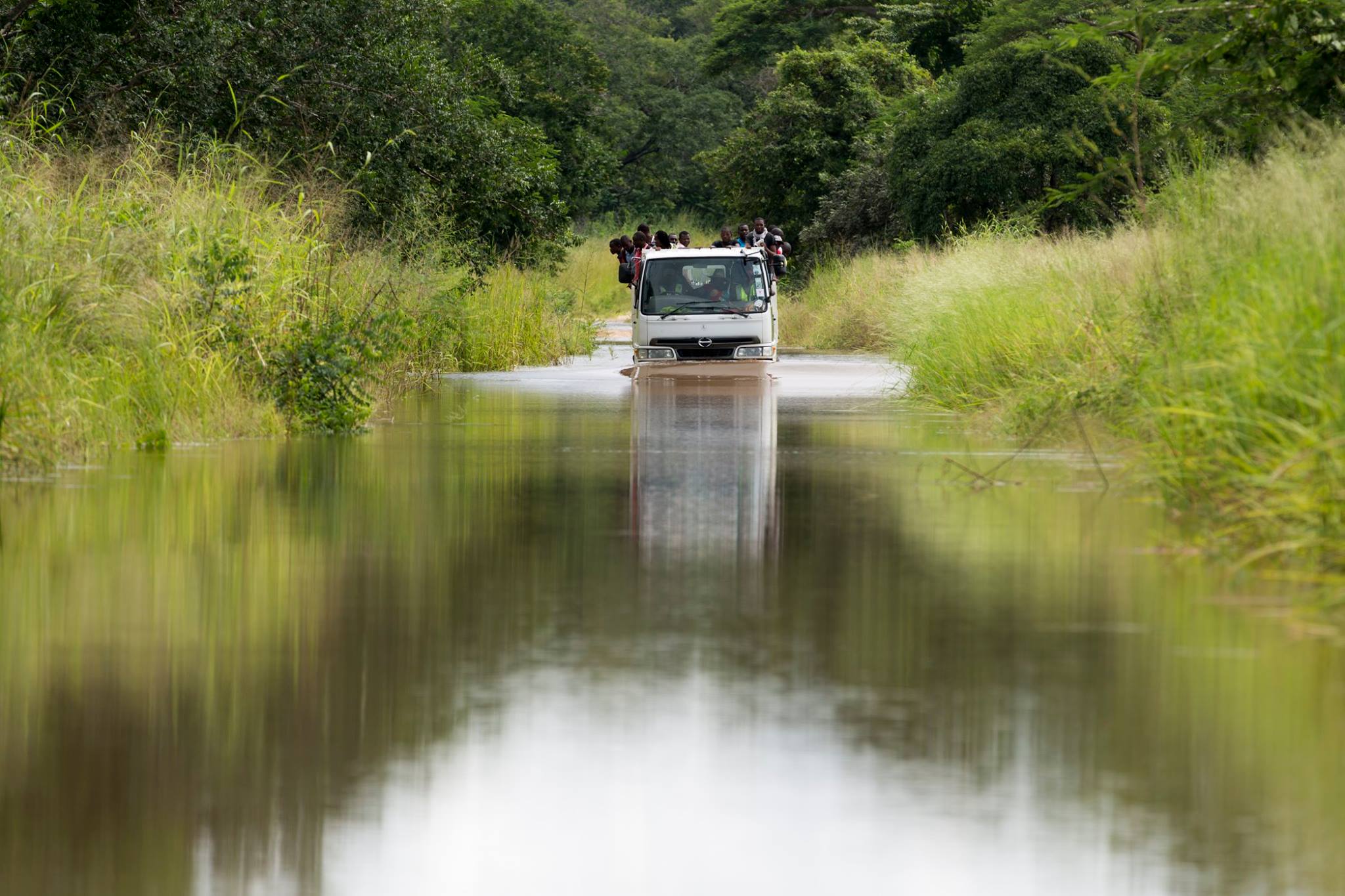
But the situation changed when a truck stopped on the opposite side of the flooded stretch. From a distance it was clear this was a completely different calibre of vehicle — high clearance, large wheels. Still, its driver hesitated for a moment. In the end he decided to take the risk.
As the truck approached, at first it seemed the water wasn’t that deep. Then came the turning point. The wheels vanished beneath the surface, and later even the headlights. The front grille pushed a large wave ahead of it and for a moment we thought it would get stuck there.

The sight of the half-submerged truck significantly changed the mood of the Nissan Navara’s crew. They realised they had no chance of safely crossing this section. The truck eventually made it through successfully and stopped by us for a moment. We tried to negotiate with its driver for a lift towards Ibo Island. We couldn’t understand each other, but his gestures were clear — he wouldn’t take us anywhere.
Our hopes turned back to the Nissan crew. After a short negotiation and weighing up the situation, they fortunately decided to change plans. They abandoned the cargo they were supposed to deliver and for a small fee were willing to take us all the way to the port at Tandanhangue. Our Toyota Corolla, by the way covered in mud, stayed in the local village and we continued.
Finally the right direction!

After agreeing with the Nissan crew, things finally swung in our favour. We had the right direction and a car that looked at home in these conditions. Nobody thought about comfort anymore. Three of us squeezed into two seats up front, our original driver from the Corolla ended up in the cargo area among the goods. At that moment it didn’t matter — the main thing was that we were moving again toward our destination.
The joy didn’t last long. The road got worse by the hour. Flooded and muddy sections increased and we could only laugh at the thought that we had planned to do all this in a Corolla.
Gradually we passed the place where we had decided to turn back that morning. Now we were sitting in a completely different car and the view through the windshield began to resemble the perspective from a motorboat more than a drive along a road.
After a while we caught up with the truck that had earlier refused to give us a lift. We met just as its crew had become stuck in the mud on a gentle slope and couldn’t move. We would have liked to help, but there was no way. We could only drive around their vehicle and continue — fortunately they had become stuck in a spot that allowed us to pass.
Our progress pleased us, until…

…until we come across another car blocking the road. This time there’s no way around it. We realise that on this road our success doesn’t depend only on us but also on the success of everyone else.
For locals from the nearby village it’s apparently entertainment. They stand by the road, watch what’s happening and comment on the situation. For us it’s another test of patience.
Eventually the car is freed and we slowly get moving again. From the driver we learn that more flooded sections await us. Meanwhile our time, water and patience are running out. The only thing pushing us forward is the unpleasant prospect of spending the night in the company of malaria‑carrying mosquitoes.
Water all around

The road gradually changes character. The closer we get to the sea, the more water there is on the road. The last twenty kilometres are more water than land. Traffic has also become noticeably denser here. Low‑clearance cars begin to have serious problems. Water gets into their intakes and the engines give up.
I try to suggest to the driver that he should simply overtake the cars ahead of us. He doesn’t understand me at all. And the problem isn’t a language barrier.
Only later do I understand that things work completely differently here. If someone stops, the others get out and help. They push, put branches under wheels, guide the driver. If necessary, they tow the car for several kilometres. So in the end we go slowly — at walking pace — but together with the certainty that the others won’t leave us to our fate.
Egoistic overtaking has no place here. Being alone at the front might not help. In these conditions it’s better to be last but in the group than first and alone. Mutual help is the only way to successfully reach the goal.
Quissanga, Tandanhangue and the final obstacle
After roughly twelve hours we arrived in the village of Quissanga, near our destination — the port of Tandanhangue.
The local restaurant was like a gift from heaven. Rice, fish and a Coca‑Cola for a laughable 2 euros. We would have paid 20 — without hesitation.
At the port we found a broken jetty and a small local boat — the so‑called chappa boat. Fatigue and the sight of our goal meant that the local hustlers stole about €15 from us when boarding, followed by about a twenty‑minute argument with the captain (a story worthy of its own article). For a moment it looked like we wouldn’t make it to the island, but eventually tempers calmed and the boat set off.
We finally reached Ibo Island after fourteen hours of travel, just after sunset. Wrecked, tired, dirty and thirsty, yet in good spirits and full of anticipation for what other adventures this mysterious island might offer.

Conclusion
This Mozambican jungle transfer taught us more than we had expected at the outset. On a philosophical level, several things.
The first is the simple rule of not giving up too soon. Situations that seem hopeless often turn around when you least expect it. The second lesson is that what seems like bad luck at the moment can later be a great stroke of luck. Exactly like the truck whose driver refused to take us. At the time it looked like another problem. A few hours later we caught up with it stuck in the mud — and we were glad we weren’t sitting in it.
The third lesson was cooperation. In demanding conditions it’s often better to go with others than to try to be faster at all costs. Alone you may move faster, but you can just as easily end up in a situation you cannot get out of without help. In a group the progress may be slower, but the chance of reaching the goal is significantly higher.
Alongside these reflections we also took away several very practical tips from the trip. Harsh African conditions should not be underestimated. If you plan a similar transfer on unpaved roads, monitor the weather in the past few days as well as the current forecast. What is a normal road in dry conditions can turn into a multi‑hour battle with water and mud after heavy rain.
Preparation is equally important. A sufficient supply of water, food, insect protection and in more demanding areas equipment for an emergency overnight stay — for example a simple portable mosquito net — can decide whether an adventure becomes just a great experience or an unnecessary problem.
The journey that was supposed to take four hours ended up taking fourteen. But thanks to it, I remember Ibo Island even more vividly today.