
The famous circuit through Norway, Sweden, and Finland, returning via the Baltic countries, had been on our minds for a long time – just like for many other travelers. Summer 2024 was the right time, and we embarked on this unforgettable adventure – and, of course, we brought our dog, Ibo, with us.
This itinerary is based on our actual journey and is designed to be used as inspiration or a ready-made road trip plan. Each day is described in a paragraph like a story – we clearly distinguish between what we actually experienced and what other possibilities the given location naturally offers.
Many of the mentioned places were covered in more detail in separate articles. You will find links to them in the itinerary.
Day 1
Shortly after lunch, we leave Bratislava, and a long journey across the Czech Republic and Poland awaits us, all the way to the port town of Świnoujście on the Baltic Sea. Thanks to the excellent Polish motorway network, we cover a large part of the route swiftly and without unnecessary delays. In the evening, we board a ferry heading to Trelleborg, Sweden, leaving the mainland behind.
Day 2
In the morning, we arrive in Trelleborg and start the day with a quick breakfast in Malmö. We move on to the iconic Øresundsbron (Øresund Bridge), which connects Malmö with Copenhagen, and admire this engineering marvel of the region – a monumental structure that elegantly disappears on the horizon between the sea and the sky. Later, we make a short stop at Tylösand sandy beach with its typical Nordic atmosphere. In the afternoon, we move to a quieter part of the inland – the area around the town of Borås, where we finally catch up on sleep lost on the ferry.
Day 3
We continue northwest to Smögen, Sweden, a picturesque port town known for its wooden promenade, Smögenbryggan, and colorful houses. We stroll along the sea, soaking in the summer coastal atmosphere. Subsequently, we cross the Swedish-Norwegian border, sail across the Oslofjord, and head inland to southern Norway, to the Gautefall area.
Day 4
After the first few days of intense travel, we finally slow down. We find ourselves in the Setesdalsheiene mountains by Lake Birtevatn. The place immediately captivates us – the silence, mountains, forests, and lakes create exactly the atmosphere we came to Norway for. We take shorter walks, explore the surroundings, and spend the night in a tent surrounded by Nordic nature.
Day 5
We undertake a hike to the summit of Kviptefjell (903 m a.s.l.), an undemanding yet incredibly rewarding peak, from where a mosaic of lakes and waterways of the Setesdalsheiene mountains unfolds in all directions like a natural map of southern Norway. After returning, we pack our things and move towards Lysefjord. We find accommodation via inatur.no – the system of mountain cabins works simply and reliably, which is confirmed once again.
Day 6
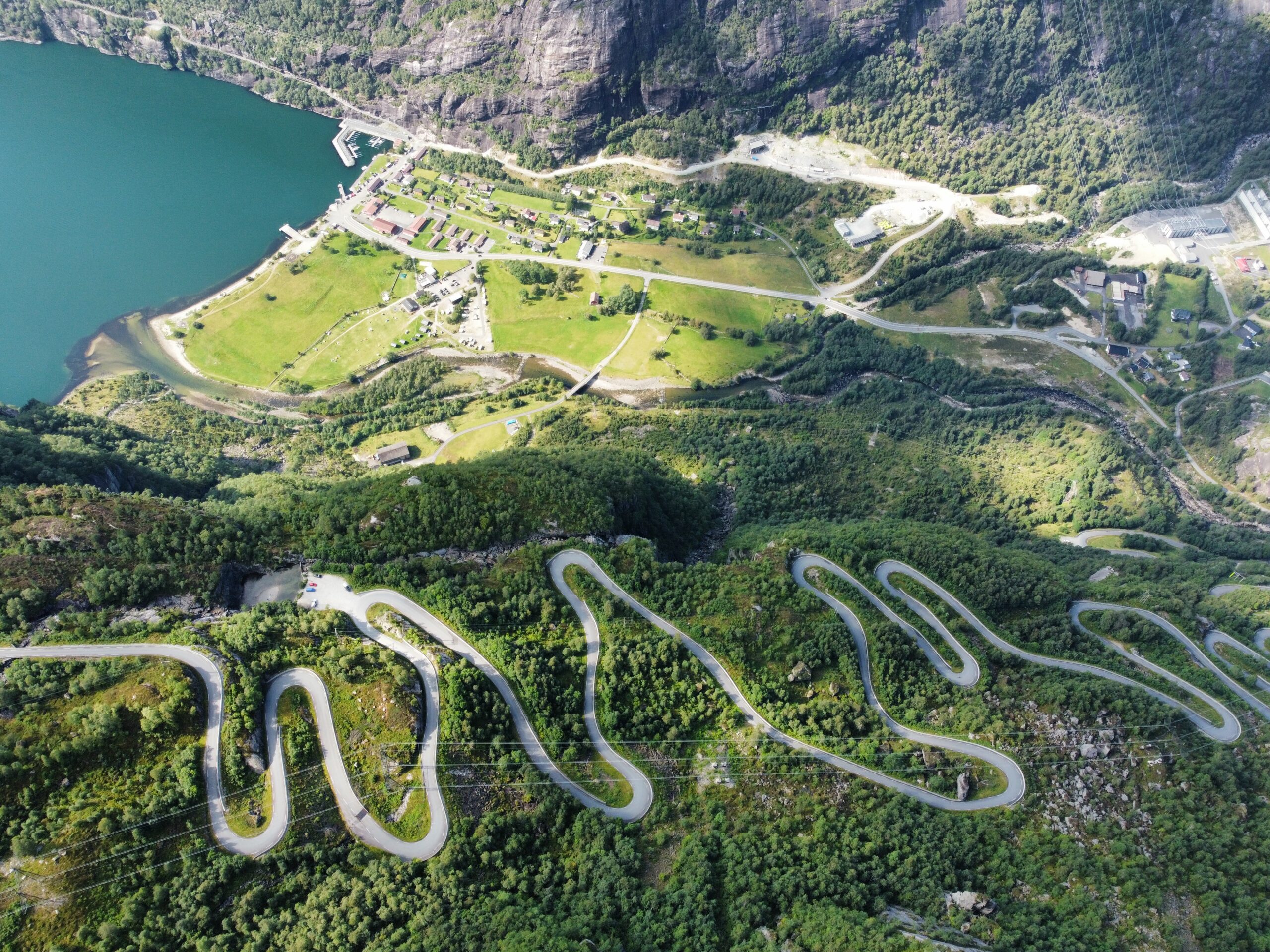
Early in the morning, we arrive in Lysebotn, a small village at the end of the fjord, reached by an iconic winding road. From there, we set out on one of Norway’s most famous hikes – to Kjeragbolten, the legendary boulder wedged between rocks high above Lysefjord, which has become an icon of Norwegian fjords and a dream for many travelers. The views of the fjord are as dramatic as we imagined. After returning, we take a ferry from Lysebotn towards Lauvvik. Along the way, we pass Flørli with its famous 4,444 steps, and in the evening, we move to the Tau area near Stavanger.
Day 7
From Tau, we continue north and use the electric ferry between Hjelmeland and Nesvik – a quiet and modern transfer that feels almost futuristic. We stop at Blåsjø, Norway’s largest artificial lake, located in a rugged high-mountain landscape, which, with its size and remoteness, feels more like a Nordic inland sea than a typical dam. In the afternoon, we visit the Stegastein viewpoint above Aurland and then pass through the Lærdal Tunnel (24.5 km), the longest road tunnel in the world – an experience that lasts longer than we would expect.
Day 8
We move across the Sognefjellet pass on road 55 and enter the Jotunheimen area – Norway’s highest mountains. We set up our base near the Leirvassbu cabin in the Leira valley. The mountains appear rugged and majestic, and although they would offer many more challenging hikes, we opt for a more reasonable pace and a relatively easier goal – Mount Kyrkja.
Day 9
We stay inland and combine relaxation with resupply. In addition, we take a trip to Lake Aursjøen in Dovrefjell–Sunndalsfjella National Park. The lake lies at an altitude of 856 m a.s.l., and its location among the mountains gives it a dramatic character.
Day 10
We move to Åndalsnes, the gateway to the popular Romsdalseggen ridge, which is among the most photogenic and sought-after panoramic routes in all of Norway. We use the Romsdalen Gondola and continue along the ridge towards Mjølvafjellet (1216 m a.s.l.). The views of the Romsdalen valley, the Rauma river, and the surrounding glaciers are among the most beautiful on the entire route.
Day 11
After a longer sleep, we move to Ålesund, a city known for its Art Nouveau architecture and the view from Aksla hill. Subsequently, we set out on road 659 across a series of islands, where modern infrastructure of bridges and tunnels sensitively connects with the traditional fishing world of the Norwegian coast. We discover peaceful beaches, small harbors, and an authentic coastal atmosphere away from the main tourist routes.
Day 12
On Harøya island, we climb Harøyburet (156 m a.s.l.) and enjoy views of the open sea. We return to the mainland by ferry and head to the Atlantic Ocean Road with the iconic Storseisundbrua bridge. In the evening, we end up in the city of Kristiansund.
Day 13
A longer transfer awaits us, passing through Trondheim northwards to the Harran area. We use the day for travel and rest, as further distant destinations await us.
Day 14
In the morning, we head to the ferry for Leka island. The island captivates us with its geological uniqueness – oceanic crust rocks rising to the surface create a completely different landscape character. After a few hours of exploration, we continue north to the city of Mo i Rana.
Day 15
We move to Bodø with two significant stops. First, we visit Marble Castle (Marmorslottet) by the Glomåga river, where water has created extraordinary marble formations. Subsequently, we cross the Arctic Circle at the Arctic Circle Centre. In the evening, we board a ferry from Bodø to Værøy island.
Day 16
On Værøy island, we explore the northern part of the island, dramatic cliffs, and deserted beaches, and climb Mount Håen (438 m a.s.l.). The island feels wild and peaceful at the same time. In the evening, the ferry takes us to Lofoten, to Moskenes.
Day 17
After arriving in Moskenesøy at night, we look for a camping spot near Reine. Later, we climb Ryten, one of Lofoten’s most popular viewpoints (543 m a.s.l.), from where an iconic view of Kvalvika beach opens up to us. In the evening, we enjoy a well-deserved rest in Stamsund.
Day 18
We continue along the E10 road towards Svolvær. We stop in the town of Henningsvær, known for arguably the most iconic football pitch in the world. The next stop is at Vågan Church (Lofoten Cathedral). Subsequently, we take a ferry to Skrova island, where we discover beaches and the Skrova fyr lighthouse. We conclude the day by moving to Narvik via the Hålogaland Bridge.
Day 19
We begin our return journey. Along the E10 road, we leave Norway towards Sweden. We stop at Masugnsbyns naturreservat and cross the Arctic Circle again near Juoksengi. We spend the evening by the Torne River at Svansteins beach.
Day 20
We enter Finland and head to Rovaniemi. We visit Santa Claus Village on the Arctic Circle and later move to the Vaasa area.
Day 21
We discover the Kvarken Archipelago (UNESCO), a unique natural phenomenon where the land imperceptibly rises from the sea each year, creating new islands and shallows. We cross the Raippaluoto Bridge to Björkö island and complete a comfortable trek around Lake Bodvattnet. The area is known for its post-glacial land uplift, as well as its peaceful atmosphere.
Day 22
We move to Helsinki, stroll around Market Square and Helsinki Cathedral. In the late afternoon, we board a ferry to Tallinn.
Day 23 and 24
The morning is dedicated to Tallinn and its historic center with Alexander Nevsky Cathedral on Toompea Hill. Subsequently, we continue transit through Latvia, Lithuania, and Poland back to Slovakia. After a total of 23 days, 8 countries, and 8,340 kilometers, our Nordic road trip concludes.
Overall Route Parameters
The road trip lasts 24 days, passes through 8 countries, and combines fjords, islands, iconic roads, tunnels, and selected mountain hikes. The route can be adjusted according to time, energy, or preferences – add more days in Lofoten, reduce transfers, or include more challenging ascents in Jotunheimen.