
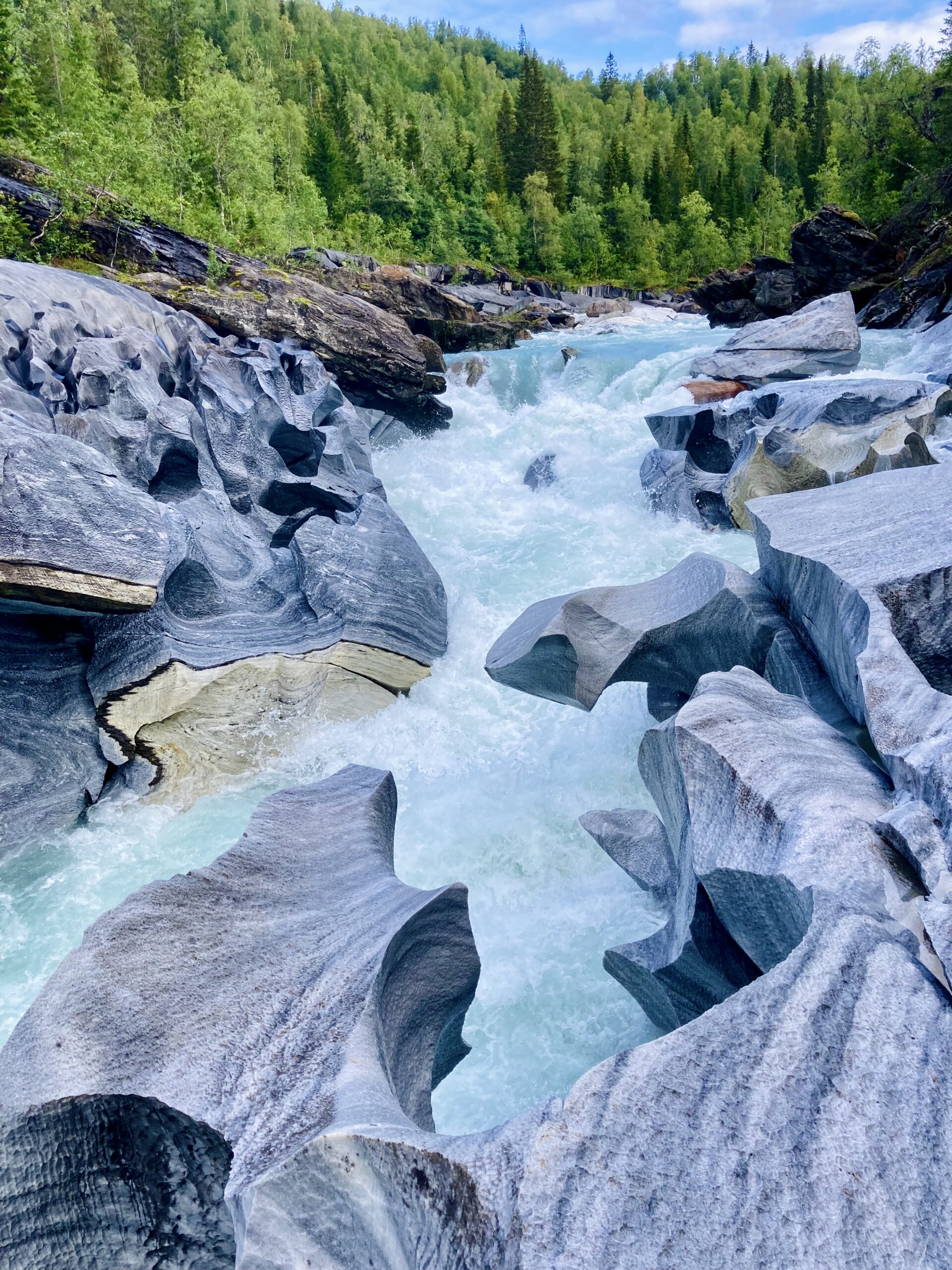
Northern Norway offers countless natural wonders, but some of them remain off the main tourist routes. One such place is the Marmorslottet rapids – a marble gorge carved by the river into white rock, which looks almost unreal. Our visit was a short detour during our journey across the north of the country, but it left a strong impression.
Morning at the Arctic Circle
We wake up in the town of Mo i Rana, just a short distance from the Arctic Circle. Today we have a transfer all the way to the port town of Bodø, from where we have a booked ferry to the island of Værøy. The schedule is tight, so we choose the sensible route along the main E6 road, which runs through the northern interior. Alternatives would mean several ferries and unnecessary complications.
Nevertheless, we don’t skip a small detour – a trip to the Marmorslottet rapids.
The route to Marmorslottet and parking
After a few kilometres from the E6 we turn in the village of Røsvoll onto road number 7366. From there we continue left onto road 7370, which runs along the Langvatnet lake. The road is narrow but paved, and in the early morning hours almost traffic-free.
We continue to a place where the road turns sharply left and crosses the Glomåga river by a bridge. Just before the bridge we turn off the main road and follow the river along an unpaved track, which gradually climbs up to a small parking area.
We thought we’d be alone this early in the morning, but we were wrong. Just as we get out of the car, a couple of German tourists are already returning from the rapids. I take the opportunity to quickly ask about the route and conditions.
Parking here is paid exclusively via a QR code placed on the information board. You need a mobile phone with active data, a payment card and, above all, patience – the signal at this location was really weak. After a few attempts the payment succeeds and we can set off.
Trail to the rapids
The trail starts on the right side of the parking area. It first passes around a few buildings above the parking lot and then continues directly along the valley floor. The route gently climbs and leads through pleasant woodland terrain. Along the way we cross several small streams and two to three shorter steeper sections, but overall it is an easy walk.
In less than twenty minutes we arrive at a junction where there is a clearly marked turn-off labelled Marmorslottet. We turn left. The trail first runs along flat ground and across several wetlands, which are covered by wooden footbridges. Then we reach above the Glomåga riverbed, where the route starts to descend more noticeably.
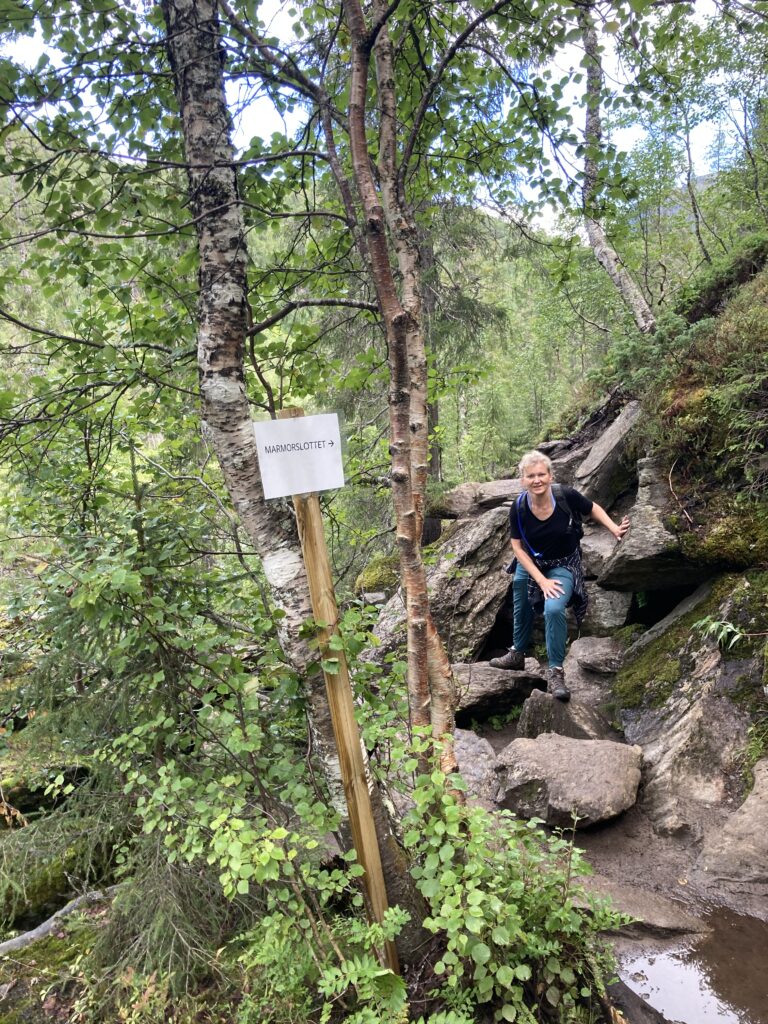
The surface changes to muddy and rocky, in places with exposed tree roots. The closer we get to the river, the more slippery and technical the terrain becomes. It’s nothing extreme, but it requires focus and caution with every step.
At the end of the route we come to a section where the trail bypasses larger boulders – probably remnants of stronger floods. This place can also be managed without major problems. From the parking area until here we had Ibo loose in his hiking sling, but in these passages we put him on a leash. The river is already very close and the smooth, water-polished stones are extremely slippery. A fall of a person or dog into the river here could have fatal consequences.
Colors unlike any other
The rock formations around the rapids are fascinating. Over thousands of years the water has sculpted the white marble into smooth, undulating shapes that look almost like sculptures. The beauty of this place, however, goes hand in hand with its danger – the surface is extremely slippery and a small lapse of attention is enough to cause a problem. Also noteworthy are the colors playing here. The water has an almost unbelievable turquoise color and the light reflected on it tints the already unusually colored stones into shades that are striking to the eye.
Here you fully appreciate the power of nature and, above all, what the combination of time and a constant flow of water can achieve. Marmorslottet is not an attraction with viewing platforms and railings, but a raw piece of northern Norway that has kept its wildness.
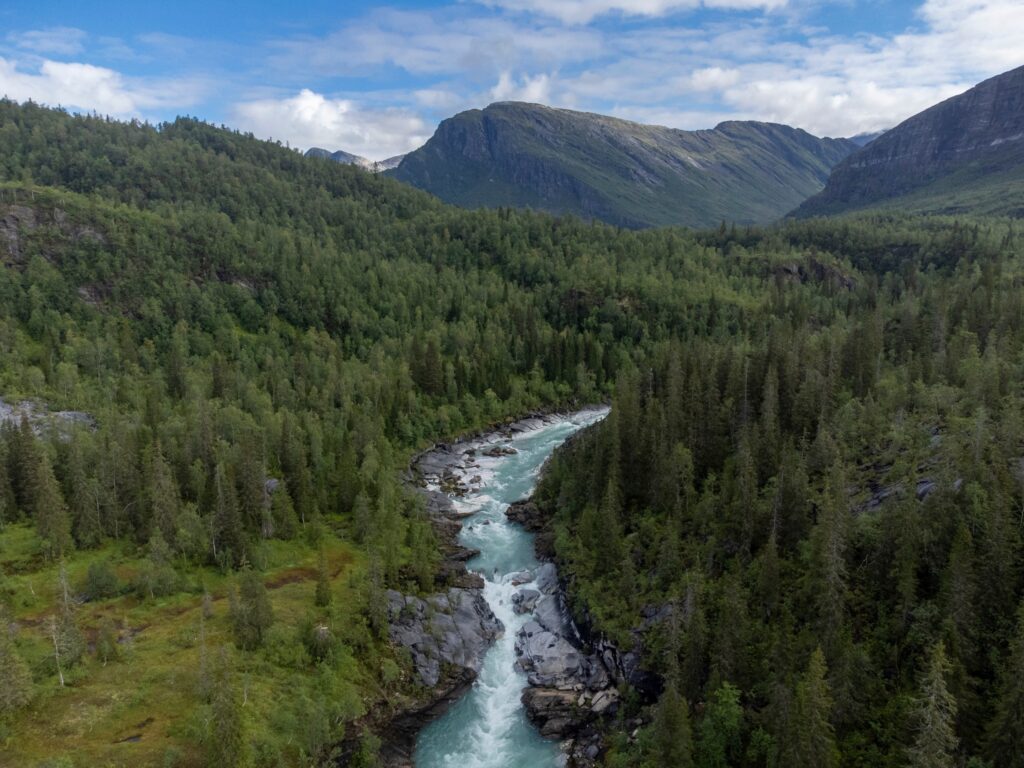
We spend a few dozen minutes here. I don’t miss a short drone flight and get a view of this place from a bird’s perspective. The screen opens a view of the continuation of the valley and the surrounding mountains. Unfortunately we don’t have more time, so we slowly return along the same route back to the car.
Ibo gives this trip a symbolic full stop by bathing in one of the smaller streams that cross the trail just before the parking area. He then doesn’t forget to roll on the ground, thereby finally sealing his fate – he crosses the Arctic Circle dirty as a pig.
Conclusion
Marmorslottet is a short but very powerful stop during a road trip through northern Norway. Easy access, the raw beauty of the marble rapids and minimal tourist traffic make it a place worth visiting even on a tight schedule. However, you should expect slippery terrain and act with respect – towards nature and the power of the river.
Facts about the hike:
- walking time to the rapids: approximately 20 minutes one way
- route length: short and easy, also suitable as a quick detour from the main road
- terrain: forest trail, wetlands, muddy and rocky sections
- parking: paid