

If you travel around Latin American countries (but not only there), sooner or later you’ll come across the term blue dollar and the difference between the “official” and “unofficial” exchange rate of the US dollar against the local currency. For a tourist this can be confusing at first, but if you understand it, it can save you a considerable amount of money.
This article briefly explains the theoretical background of the topic – that is, why such exchange rate differences arise at all – and at the same time offers a practical view through our personal experiences from three different countries where we exchanged euros or dollars for local currency using the “blue rate”.
At the end of the article you’ll also find a bullet summary of the most important points and one concrete tip that will be really useful when using the blue exchange rate.
Why a country has multiple exchange rates
In some countries the state regulates the exchange rate of the domestic currency against the US dollar. It does so mainly to protect foreign currency reserves, maintain currency stability, control inflation or limit capital outflows abroad.
The result is an official rate set by the central bank. However, this rate is often significantly distant from the real value of the currency on the market. If people and companies do not have the possibility to legally buy dollars at the official rate – or only in very limited amounts – naturally, as with any form of economic regulation, a parallel, unofficial market arises.
And it is in this environment that the term blue dollar appears.
What is the blue dollar (blue dollar)
The blue dollar denotes the unofficial, market exchange rate of the US dollar. It is best known from Argentina, where the term dólar blue is used, but similar mechanisms operate in other countries.
The blue dollar arises outside the official banking system; its rate reflects the true supply and demand and is usually much more favorable to the tourist than the official rate. In practice this often means that for the same amount of dollars you get tens of percent more local currency – in extreme cases more than double compared to an official exchange.
Advantages and disadvantages for the tourist
From a traveller’s point of view, the biggest advantage of the blue dollar is clearly the significantly better exchange rate. Accommodation, food, transport and services therefore practically become noticeably cheaper than official prices or the bank rate would suggest. Thanks to this, it is possible to travel more comfortably or longer without having to significantly lower standards.
However, such a system also has its dark sides. For a tourist it can be initially difficult to understand why there are multiple rates and which one is most advantageous in a given situation. Rates can change quickly and with unofficial exchange there is always a risk of fraud or unfair practices. In some countries attempting to use the blue rate moves you into a legal gray zone, which may be tolerated but is not officially supported.
Therefore follow a simple rule: take advantage of a good rate, but use common sense.
Our personal experiences
Paraguay
Paraguay is not a typical country where you would commonly encounter the blue rate, but for us it was the first country in Latin America where we tried exchanging money directly on the street with local money changers.
This happened in the center of the capital Asunción, specifically at the intersection of Palma and Chile streets. Paradoxically there is also a bank here – specifically the Banco de la Nación Argentina – but at the same time the place is literally swarming with local money changers. You don’t even need to do anything; very quickly they spot you as a tourist and approach you with an exchange offer.
The fact that it all happens in the presence of police officers, who stand at almost every junction, needs no special comment.
First we exchanged dollars for Paraguayan guaraní. The exchange went smoothly and compared to the official rate we saved a few percent. Since our further travel plans included Argentina, we then tried to exchange the remaining euros for Argentine pesos. We knew it was an unusual combination, but we wanted to try.
The money changer – in fact an older gentleman – willingly took a calculator and after a moment showed us the offered rate. However, it was almost identical to the official one, so we backed out of the transaction. The whole situation happened in a friendly atmosphere; the only real obstacle was the language barrier. We ended the deal, thanked him and moved on.
Our first experience with street money exchange was therefore rather a pleasant experience.
Argentina
Argentina at the time of our visit was a textbook example of how the blue dollar works. The country was wracked by extreme inflation, prices of goods and services rose literally week by week and the difference between the official and unofficial rate was huge. This difference affected practically everything – from accommodation prices to everyday grocery shopping.
We knew about the country’s situation before the trip and tried to prepare for it. Nevertheless, complications appeared in practice that forced us to deal with money exchange much more thoroughly than we had originally planned. Inevitably with that came valuable, though not always pleasant experiences.
Since the blue dollar is an unofficial rate, all official payments – whether by card or exchanging at a bank – follow the official rate, which is markedly disadvantageous for the traveller. In most cases it therefore doesn’t make sense to pay by card or to exchange dollars or euros at banks.
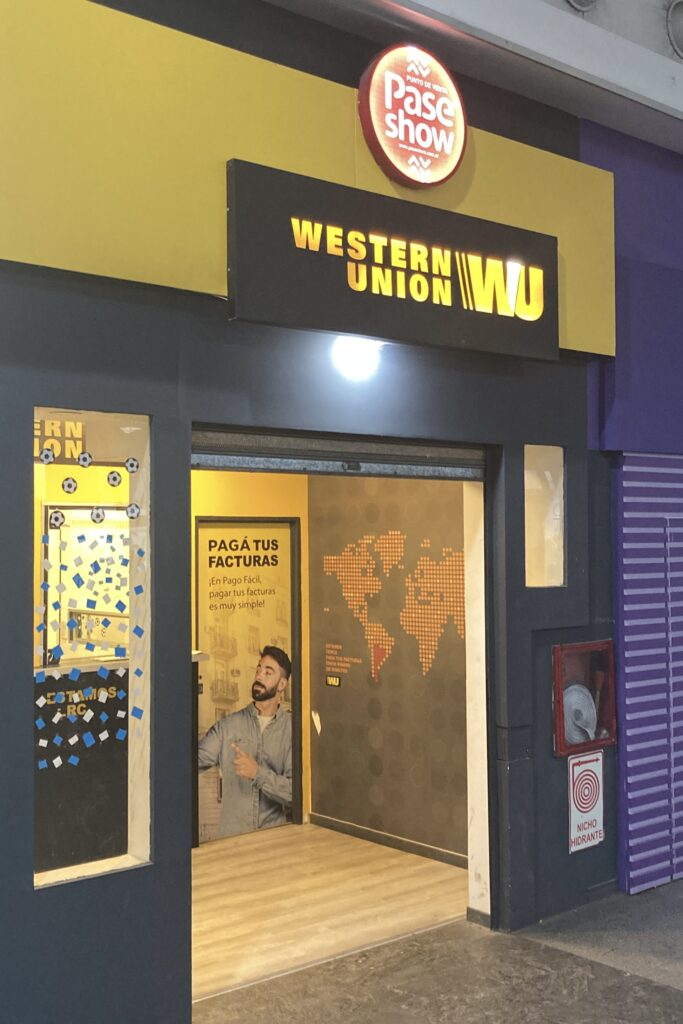
A big exception is the service Western Union. Although it is an official financial institution, in practice its exchange rate very closely approaches the blue one. We actively used this option and even before arriving in Argentina we sent several payments to ourselves.
Already when initiating the transfer the app clearly informed us of the rate at which the transaction would be executed. Euros left our account and upon arrival in Argentina we collected cash in Argentine pesos. However, this solution has its pitfalls. Western Union branches are mainly available in larger cities and in an economically heavily distorted country like Argentina at that time they were often overwhelmed. Long queues and lack of cash were not uncommon.
The first serious problem occurred in the city of Córdoba, when one of our Western Union payments could not be withdrawn due to an error in their system – to this day unknown to us. Even though I properly identified myself with my passport and the details matched the recipient’s data, the clerk at the window informed me that the system would not allow the payout. She contacted technical support herself, but without success. The payment therefore remained “stuck” until the end of our holiday. Although the money was later returned to us, its temporary absence caused further complications.
We had to carry out further exchanges directly on the street with money changers (cambistas, cambio). Since we relied on Western Union, we did not have enough cash in dollars on us, only a minimum of USD and the rest in euros. That was another complication, since the dollar is clearly the preferred currency in Argentina.
At the first street exchange we were finally assisted by an employee of the Hertz car rental in the city of Salta. When his superior heard that we were going to change money ourselves, he offered us a “guide.” The employee went with us and the whole exchange took place at Plaza 9 de Julio, at a table in a local café. We exchanged euros at a really favourable rate and from that moment we had the justified feeling that in Argentina we were buying things for half price.
The second and also last exchange we carried out again in Córdoba, this time at Plaza San Martín. We tried it without the “bodyguard.” The first money changer led us into a small shopping arcade to a glassed window where perhaps her colleague was. However he refused to put pesos into the window before we handed him euros. That immediately raised doubts in me. I withdrew the money back to my pocket, we thanked her and calmly left.
A few minutes later another money changer approached us, who transparently and directly on the spot exchanged our euros for Argentine pesos. Without pressure, without strange manoeuvres. Maybe our caution was excessive, but in such situations a simple rule applies: if the other side’s behaviour raises doubts, it’s better to back out of the deal.
Regarding Argentina – and possibly other countries with a similar system – it should be added that the presence of money changers (*cambistas, cambio) is directly proportional to the size of the city. While in cities like Córdoba or Salta you’ll encounter them easily on every busier street, in the countryside finding someone willing to change money can be a matter of long searching.
Bolivia

Bolivia is another example of a country where state interventions in the free market have gone fairly far. The situation here is not as extreme as in Argentina, but the differences between the official and unofficial rate are noticeable here too.
Unlike Argentina, in Bolivia exchanging at the more favourable blue rate is common and widely tolerated. In practice this means you don’t have to look for street money changers – just enter a regular exchange office and agree the rate on the spot. If you don’t like the offered rate, simply head to the next exchange office.
We easily exchanged dollars this way, for example in the city of Santa Cruz de la Sierra, in the streets near Plaza Metropolitana 24 de Septiembre.
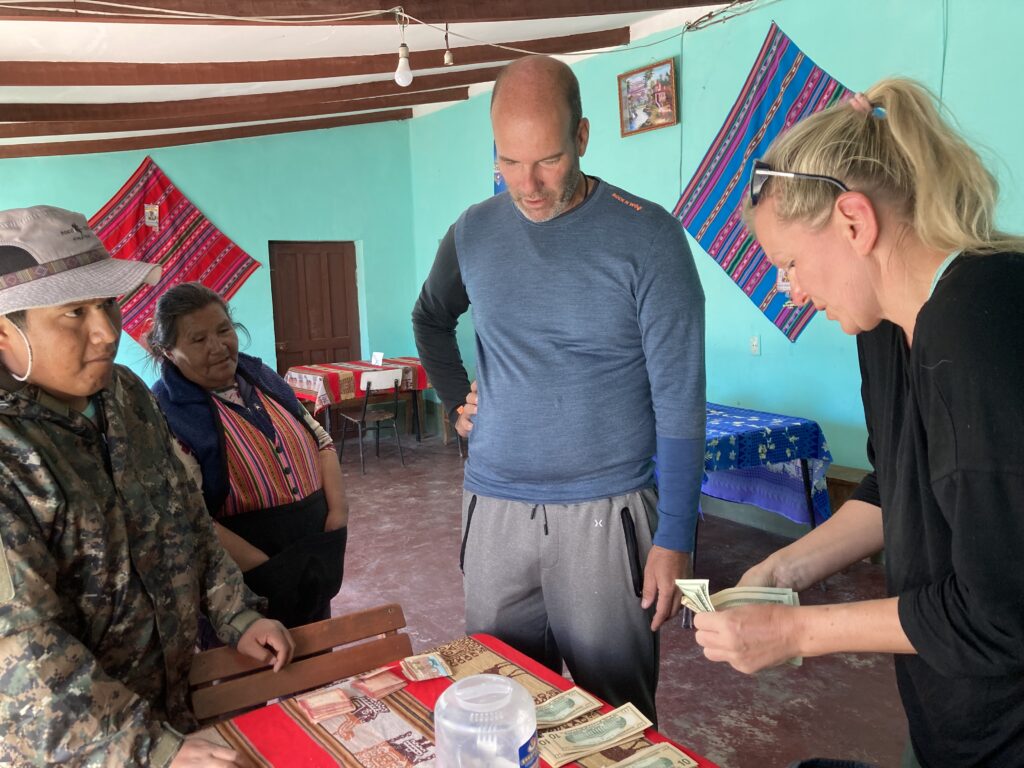
An interesting experience also came from a much smaller town in the Altiplano region – specifically from San Pedro de Quemes. There we did not initially expect success. The exchange required more walking from house to house and questioning locals, but in the end we were successful. In a local restaurant we arranged a meeting directly with two interested parties who bought our dollars for a very good rate against the boliviano (BOB).
To complete the experiences, in Bolivia we also tried exchanging via Western Union, specifically in the city of Tarija. It was a quick action. In the evening I sent money from my account via the Western Union app and already in the morning I was withdrawing it at the local branch. The only complication was that the clerk at the window requested a copy of the passport from me. I finally obtained it at a local copy centre, of which there were, by the way, plenty in the area.
Where you can encounter the blue dollar
A multi-tier currency environment, where alongside the official rate an unofficial market also operates, exists or has existed for example in these countries:
- Argentina – long the best-known example (official rate vs. dólar blue),
- Bolivia – state-regulated rate and a growing parallel market,
- Venezuela – historically an extreme example with multiple rates,
- Cuba – a combination of official and unofficial rates,
- Iran, Egypt, Nigeria – examples outside Latin America.
The situation can change from month to month, so it’s always worth checking the current status before travel. Generally, the more an economy is state-controlled and the worse its economic condition, the more likely the existence of a blue (unofficial) rate.
Conclusion
The blue dollar and the difference between the official and unofficial rate are not exotic concepts but a practical reality in countries with a regulated currency system. For the tourist it can be both an advantage and a trap.
If you understand how the system works, you can travel significantly cheaper. If you ignore it, you may lose out unnecessarily. The basics are being informed, common sense and willingness to adapt to local conditions. And that is often what travelling is about.

Practical tips in brief
- Before traveling to a country always check the current situation regarding the exchange rate of the dollar or euro against the local currency and find out whether there is a difference between the official and unofficial rate.
- When traveling to countries where the blue rate operates, carry enough cash. Ideally have US dollars, while always respecting official limits on bringing cash into the country.
- Avoid card payments or internet payments. Everything that can be, pay in local currency in cash that you obtained at the more favourable rate.
- When exchanging money on the street pay attention to your safety. Avoid suspicious people, coercive situations and scenarios that raise doubts in you.
- When exchanging money present yourself only with the amount you want to exchange. Do not create the impression that you are travelling with a large amount of cash.
- If possible, prefer more official and safer exchange options such as Western Union or brick-and-mortar exchange offices.
- Carry out exchanges rather in larger cities. In the countryside exchange services may not be available at all or only very limited.
- Bonus tip: For the large amount of money in local currency take a suitable, conspicuous bag. Thanks to the favourable rate and high banknote denominations you can for a relatively small sum in dollars get a very large volume of cash, which may not fit into your pockets or wallet.